Antimension.
In the first centuries of Christianity, the Divine Liturgy was
celebrated on the tombs of the Martyrs and this was celebrated
by the Bishop. Later, as the Church expanded and the size of
a typical Diocese with it, the Bishops of the early Church began
to ordain Priests as their representatives to the growing number
of Christian communities. Only with the Bishop's permission could
a community and its Priest serve the Liturgy and the same holds
true today. One of the vehicles by which these important ancient
practices are effected today is a simple piece of cloth, folded
within another, and resting always on the Holy Table of every
Orthodox church the Antimension.
The Antimension is a rectangular piece of cloth, gold in color,
measuring about 18 by 24 inches, and while on the Holy Table it
is folded within another cloth, red in color, called the Iliton,
which represents the swaddling clothes and the burial shroud of
Jesus Christ. Depicted on the top of the Antimension is an Icon
of the Burial of Christ, along with Icons of the four Evangelists,
as well as Saints Basil the Great and John Chrysostom, for whom
the usual Divine Liturgies are named. Sewn into every Antimension
is an incorruptible relic of a Saint, making real the early liturgical
connection with the Martyrs who died rather than renounce Christ,
and whose blood, after the Blood of Christ, formed the very foundation
of the Church.
Printed on every Antimension are the words: By the grace of the
All-Holy, Life-giving Spirit, this Antimension, the Holy Table,
is consecrated for the Offering on it of the Body and Blood of
our Lord in the Divine Liturgy. Each one is signed by the ruling
Bishop of the Diocese and placed on the Holy Table, constituting
his permission for the community to exist as an Orthodox parish
and to celebrate the Liturgy. This is so, since true Christianity
has always held that without the Bishop there is no Church and
through the Bishop comes our unity of Faith and Communion which
is Orthodoxy.
The word Antimension is a combination of Greek and Latin which
means in place of the table. While Holy Tables were always to have
been consecrated and relics placed inside of them, it was not always
possible for the Bishop to visit each community to do so. For that
reason, Bishops consecrated cloths or boards and sent them to each
community to be used in place of the consecrated Holy Table. This
also allowed for portable Holy Tables for travelers. The use of
the Antimension is mandatory, even on Holy Tables which have been
consecrated, and a Priest is not permitted to celebrate the Divine
Liturgy without it. Military Chaplains and Missionaries also use
it instead of the table when serving in remote areas.
Also placed on the Holy Table are two indispensable items: the
Cross and the Book of the Gospels. The Cross is placed there both
as a sign of Christ's victory over the Devil and of our deliverance.
Since the Lamb of God was slain on the Cross for our salvation,
it is especially appropriate that it be placed upon the Holy Table
where the Bloodless Sacrifice is offered on behalf of all and for
all. As it is the Word of God, the Book of the Holy Gospels is
placed on the Holy Table, signifying that God is mystically present.
It is usually richly-adorned and as it is the Book of Life, its
Governing may not be of the skins of dead animals (i.e., leather),
but is usually made of precious metals adorned with jewels. At
the center of the cover is usually represented Christ, with the
four Evangelists Matthew, Mark, Luke and John at the four corners.
As the Holy Table represents the sepulcher of the Lord, upon it,
at the rear, is placed the Ark (or Tabernacle), so-called because
of its general shape, within which are placed the Holy Gifts (Reserved
Sacrament) used for the Communion of the sick. Candlesticks are
also placed on the Holy Table, signifying the Light of Christ which
illumines the world.
In addition to the above, a natural (not artificial) Sponge is
usually placed beside the Antimension with which to brush off the
particles from the Paten into the Chalice. Also found is a vessel
containing the Holy Chrism used for Chrismation, and also a Sick-Call
Kit (the Ciborium) within which are to be found a small chest for
the Holy Gifts, a small Chalice and Spoon, a small vessel for wine
and a sponge to clean the Chalice with. In addition, a small chest,
called the Artophorion is placed on the Holy Table during Great
Lent, within which is placed the consecrated Lamb (s) used for
the Presanctified Liturgy (if the same is not placed in the Tabernacle).
Often a canopy is suspended over the Holy Table, representing the
heavens over the earth, from which is suspended a dove with outstretched
wings (the Fix), representing the Holy Spirit. (In many places,
the pre-sanctified Lamb was placed in the Fix during Great Lent.)
Behind the Holy Table a seven-branched Candlestick is usually
placed (seven being the sacred number), and sometimes a large Processional
Cross. Behind this, at the extreme East end of the Altar is a raised
place, called the High Place (or Bema), upon which is placed the
Cathedra (Bishop's Throne), with seats for the Priests on either
side. During the Liturgy, the Priests (representing the Holy Apostles)
sit at either side of the Bishop (representing the King of Glory).
[In modern times, the Cathedra is usually found only in Cathedrals
and large Monasteries.]
On either side of the Bishop's Throne are placed ceremonial Fans,
with which, in ancient times, the Holy Gifts were fanned to keep
away insects. Now they are carried in solemn processions, signifying
the six-winged Seraphim who minister at the Divine services, and
who are represented iconographically upon them. Above the High
Place is an Icon of the Savior and on both sides Icons of the Holy
Apostles or (more often) Holy Bishops. Before the Icon of the Savior
is suspended a lampada, called the High Light.
The Bells
A striking component of Orthodox worship is the ringing of bells.
Every daily cycle of public divine services starts with the ringing
of bells and no one who has witnessed the procession around the
church at Holy Pascha can forget the almost continuous ringing
of all the church bells. In Pre-Revolutionary Moscow, for example,
travelers invariably commented on the stirring clamor of the
more than 1600 bells of the city ringing simultaneously at the
Pascha of Our Lord. Usually a separate structure, the Bell Tower,
was constructed to contain the bells, but more often in modern
times a belfry is erected over the entrance to the church building,
within which the bells are placed.
The purpose of ringing the bells is to call the faithful to services,
to inform those absent from divine services of the various important
liturgical moments of the services, as well as calling the worshippers
to concentrated attention at these same moments. It is also used
to signal the arrival of the Archpastor at the church or monastery.
There are four basic types of bell-ringing in the Russian Church:
The Announcement (Blagovest announcing); the Peal (Trezvon three
bells); Chain-ringing (Perezvon across (or linked) bells); and
the Toll (Perebor broken (or interrupted).
The Announcement (Blagovest').
This is a slow rhythmic, unhurried striking of one bell, which
is usually rung for the announcing of the beginning of services:
Before the All-Night Vigil (also accompanied by the Trezvon);
before each group of services of the daily cycle (9th Hour Vespers
Compline; Nocturns Matins 1st Hour; 3rd Hour 6th Hour Liturgy
or Typical Psalms); and before Great Compline). The Announcement
is also employed at other important moments of the services.
For example, there are Twelve strikes for the twelve parts of
the Creed and also before It is truly meet... of the Divine Liturgy;
before the Molieben (if there be) following the Liturgy.
During Great Lent on weekdays, the Announcement Bell is rung at
the 3rd, 6th, and 9th Hours, as well as at Great Compline three
strikes for the 3rd Hour, six for the 6th Hour, nine for the 9th
Hour, and twelve for Great Compline. During Passion Week, the Announcement
Bell is rung at the beginning of each Passion Gospel (Holy Friday
Matins), according to the number of the Gospel one strike for the
first, two for the second, etc. (At the conclusion of the reading
of the Passion Gospels, the Trezvon is rung.) At the Royal Hours
of Holy Friday, the Bell is rung three strikes for the 3rd Hour,
six for the 6th and nine for the 9th.
Before the Divine Liturgy, the Announcement Bell is rung until
the Hours begin (usually accompanied by twelve recitations of Psalm
51 for twelve strikes of the Bell or the recitation of Psalm 119),
usually about one-half hour before the Liturgy.
The Peal (Trezvon).
This is the ringing of bells in three modes, three times repeating
a musical measure with a definite harmony of many selected bells.
The Peal is used at the beginning of major services: Combined
with the Announcement, the Peal is rung at the beginning of the
All-Night Vigil, at Matins, before the Six Psalms, the Gospel,
and at the end of the Vigil. At the Liturgy the Peal is rung
after the 6th Hour and before the actual start of the Liturgy
and after the conclusion of the Liturgy. If there be a Molieben
on the church or monastery Feast Day, the Peal is rung before
and after it. It is also rung at the end of the reading of the
Twelve Passion Gospels of Holy Friday Matins, as well as after
the Gospel reading during the Liturgy of the first day of Holy
Pascha.
Chain-Ringing (Perezvon).
This is a successive ringing of all the bells from the largest
(lowest pitch) to the smallest (highest pitch), with the striking
of each bell a number of times before the next bell is struck,
and repeating this method several times. It is used before the
Blessing of Waters, before the carrying-out of the Holy Cross
on the Feast of the Exaltation of the Holy Cross (Sept. 14) and
the Third Sunday of Great Lent, as well as at the Hours before
the Consecration of a Bishop. It is also rung, together with
a short ringing of the Peal at the immersing of the Holy Cross
during the Great Blessing of Waters and after the carrying-out
of the Holy Cross to the center of the church.
This mode of ringing is also used during the Vespers of Holy Friday
when the Plaschanitsa is taken from the Altar to the center of
the church, and also at the Great Doxology of the Matins of Holy
Saturday when the Plaschanitsa is carried out around the church.
(When the procession re-enters the church, the Peal follows.) Chain-Ringing
is also used at the burial of Priests and Bishops.
The Toll (Perebor).
This is the slow tolling of each bell, beginning with the largest
to the smallest and ending with a striking of all the bells at
once. It is used at the carrying-out of the deceased from the
church for burial and is known as the funeral toll. There is
no Peal after the Toll.
At the Hierarchical Liturgy, the Announcement is rung at the appointed
time; then the Peal is rung at the arrival of the Bishop. The Announcement
then continues to ring up to the time of the vesting of the Bishop.
The Peal is rung again at the 6th Hour.
The Candles and Their Symbolism
Lit candles and Icon lamps (lampadas) have a special symbolic meaning
in the Christian Church, and no Christian service can be held
without them. In the Old Testament, when the first temple of
God was built on earth the Tabernacle services were held in it
with lamps as the Lord Himself had ordained (Ex. 40:5, 25). Following
the example of the Old Testament Church, the lighting of candles
and of lampadas was without fail included in the New Testament
Church's services.
The Acts of the Apostles mentions the lighting of lamps during
the services in the time of the Apostles. Thus, in Troas, where
Christ's followers used to gather on the first day of the week
(Sunday) to break bread, that is, to celebrate the Eucharist, there
were many lights in the upper chamber (Acts 20:8). This reference
to the large number of lamps signifies that they were not used
simply for lighting, but for their spiritual significance.
The early Christian ritual of carrying a lamp into the evening
service led to the present-day order of Vespers with its entry
and the singing of the ancient hymn, O Jesus Christ, the Joyful
Light..., which expresses the Christian teaching of spiritual light
that illumines man of Christ the Source of the grace-bestowing
light. The order of the morning service of Matins is also linked
to the idea of the Uncreated Light of Christ, manifested in His
Incarnation and Resurrection.
The Fathers of the Church also witnessed to the spiritual significance
of candles. In the 2nd Century, Tertullian wrote: We never hold
a service without candles, yet we use them not just to dispel night's
gloom we also hold our services in daylight but in order to represent
by this Christ, the Uncreated Light, without Worn we would in broad
daylight wander as if lost in darkness [ Works, 3rd ed., Kiev,
1915, p.76]. The Blessed Jerome wrote in the 4th Century that In
all the Eastern Churches, candles are lit even in the daytime when
one is to read the Gospels, in truth not to dispel the darkness,
but as a sign of joy...in order under that factual light to feel
that Light of which we read in the Psalms (119:105): Thy word is
a lamp to my feet, and a light to my path [Works, part IV, 2nd
ed., Kiev, 1900, pp.301-302].
St. Sophronius, Patriarch of Jerusalem, wrote in the 7th Century:
Lampadas and candles represent the Eternal Light, and also the
light which shines from the righteous [Writings of the Holy Fathers...,
St. Petersburg, 1855, Vol. I, p.270]. The Holy Fathers of the 7th
Ecumenical Council decreed that in the Orthodox Church, the holy
Icons and relics, the Cross of Christ, and the Holy gospel were
to be honored by censing and the lighting of candles; and the Blessed
Simeon of Thessalonica (15th Century) wrote that candles are also
lit before the Icons of the Saints, for the sake of their good
deeds that shine in this world [Works, Moscow, 1916, p. 108].
Orthodox faithful light candles before the Icons as a sign of
their faith and hope in God's help that is always sent to all who
turn to Him and His Saints with faith and prayers. The candle is
also a symbol of our burning and grateful love for God. During
the reading of the Twelve Passion Gospel at Holy Friday Matins,
the faithful hold candles, re-living our Lord's sufferings and
burning with love for Him. It is an ancient custom of Russian Orthodox
Christians to take home a lit candle from this Service and to make
the Sign of the Cross with it on their doors in remembrance of
Our Lord's sufferings and as protection against evil.
At Vespers on Holy Friday, when the Plashchanitsa (Epitaphion)
is borne out of the Altar and also during the Lamentation Matins
of Holy Saturday, the faithful stand holding lit candles as a sign
of love for Christ Crucified and Dead, showing their faith in His
radiant Resurrection. On Pascha itself, from the moment of the
procession around the church, in memory of the Myrrh-bearers who
proceeded with burning lamps to the sepulcher of the Lord, the
faithful hold lit candles in their hands until the end of the Paschal
Service, expressing their great joy and spiritual triumph
Since ancient times, at hierarchical services special candle-holders
have been used. The faithful reverently bow their heads when blessed
by the Bishop with the dikeri, representing the two natures of
Christ His Divinity and His humanity, and the trikeri, representing
the Holy Trinity. Candles are also lit during the celebration of
the Holy Eucharist.
Holy Baptism is celebrated with the Priest fully vested and all
the candles lit. Three candles are lit before the baptismal font
as a sign that the Baptism is accomplished in the Name of the Holy
Trinity; and the person to be baptized (if an adult) and the sponsors
hold lit candles in their hands during the procession around the
font as an expression of joy at the entry of a new member into
the Church of Christ.
At the betrothal ceremony, the Priest hands the bride and bridegroom
lit candles before they enter the church to receive the Sacrament
of Matrimony, throughout which they hold the lit candles as a symbol
of their profound love for each other and of their desire to live
with the blessing of the Church. At the Sacrament of Holy Unction,
seven candles are lit around the vessel of Holy Oil as a sign of
the grace-bestowing action of the Gifts of the Holy Spirit. And
when the body of a deceased person is brought in the church, four
candles are placed about the coffin to form a cross to show that
the deceased was a Christian. During the Funeral service, as well
as Memorial services, the faithful stand with lit candles as a
sign that the deceased's soul has left this world and entered the
Kingdom of Heaven the Unwaning Light of God.
During the Vespers portion of the Liturgy of the Presanctified
Gifts, the Priest blesses the congregation with a lit candle and
censer, proclaiming, The Light of Christ illumines all! On the
Eve of the Nativity of Christ and the Theophany, a lit candle is
placed before the festal Icon in the middle of the church to remind
us of the birth and appearance on earth of Christ Our Savior, the
Giver of Light. At all Divine Liturgies, lit candles are carried
in procession at various parts of the service.
Thus candles and lampadas are lit at all Church services, all
with a wide variety of spiritual and symbolic meanings; for it
is God Who said, Let light shine out of darkness, [and] Who has
shone in our hearts to give the light of the knowledge of the glory
of God in the face of Christ (1 Cor. 4:6). So too, lit candles
in the church are also an expression of the worshippers' adoration
and love for God, their sacrifices to Him, and at the same time
of their joy and of the spiritual triumph of the Church. The candles,
by their burning, remind one of the Unwaning Light which in the
Kingdom of Heaven makes glad the souls of the righteous who have
pleased God.
The Church Building
External Arrangement.
Orthodox churches generally take one of several shapes that have
a particular mystical significance. The most common shape is an
oblong or rectangular shape, imitating the form of a ship. As a
ship, under the guidance of a master helmsman conveys men through
the stormy seas to a calm harbor, so the Church, guided by Christ,
carries men unharmed across the stormy seas of sin and strife to
the peaceful haven of the Kingdom of Heaven. Churches are also
frequently built in the form of a Cross to proclaim that we are
saved through faith in the Crucified Christ, for Whom Christians
are prepared to suffer all things. Less frequently churches are
built in the shape of a circle, signifying that the Church of Christ
shall exist for all eternity (the circle being one of the symbols
of eternity) or in the shape of an octagon, signifying a star,
for the Church, like a star, guides a man through the darkness
of sin which encompasses him. Because of the difficulties of internal
arrangement, however, the latter two shapes are not often used.
Almost always Orthodox churches are oriented East West, with the
main entrance of the building at the West end. This symbolizes
the entrance of the worshipper from the darkness of sin (the West)
into the light of Truth (the East). This rule is violated only
if the building had been previously constructed for another purpose,
or if services are conducted in a private home, for example, when
the entrance and main portion have been arranged according to convenience.
On the roof of Orthodox churches are usually found one or more
cupolas (towers with rounded or pointed roofs), called crests or
summits. One cupola signifies Christ, the sole head of the Christian
community; three cupolas symbolize the Most-Holy Trinity; five
cupolas represent Christ and the four Evangelists; seven cupolas
symbolize the Seven Ecumenical Councils which formulated the basic
dogmas of the Orthodox Church, as well as the general use in the
Church of the sacred number seven; nine cupolas represent the traditional
nine ranks of Angels; and thirteen cupolas signify Christ and the
Twelve Apostles.
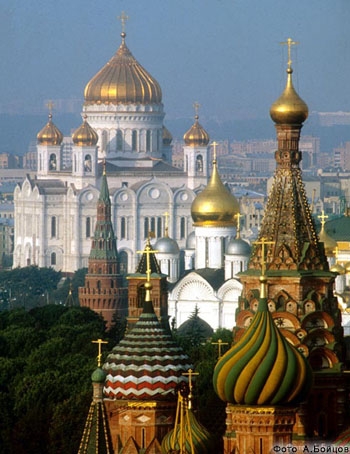
A peculiar feature of Russian Orthodox churches is the presence
of onion-shaped domes on top of the cupolas. In the early history
of the Russian Church, especially in Kiev, the first capital, the
domes of the churches followed the typical Byzantine rounded style,
but later, especially after the Mongol Period, Russian churches
tended toward the onion domes, which, in many places, became quite
stylized. Historians are not in agreement as to the origin of this
particular style, but some point to the possible influence of Persia
on this peculiar feature of Russian church architecture, while
others argue that since this style was more popular in the far
North of Russia, it had a practical application, in that the shape
was particularly suited to shed the large amounts of snow common
in the region.
Every cupola, or where there is none, the roof, is crowned by
a Cross, the instrument of our salvation. The Cross may take one
of many different shapes, generally according to the national tradition
of a particular local Church. In the Russian Church, the most common
form is the so-called three-bar Cross, consisting of the usual
crossbeam, a shorter crossbeam above that and another, slanted,
crossbeam below. Symbolically, the three bars represent, from the
top, the signboard on which was written, in Hebrew, Latin and Greek,
Jesus of Nazareth, the King of the Jews (John 19:19); the main
crossbeam, to which the hands of Jesus were nailed; the lower portion,
to which His precious feet were nailed.
The three-bar representation existed in Christian art from very
early times in Byzantium, although usually without the bottom bar
slanted, which is particularly Russian. The origin of this slanted
footboard is not known, but in the symbolism of the Russian Church,
the most common explanation is that it is the pointing upward to
Paradise for the Good Thief on Jesus' right and downward to Hell
for the Thief on His left (Luke 23). Sometimes the bottoms of the
Crosses found on Russian churches will be adorned with a crescent.
In 1486, Tsar Ivan IV (the Terrible) conquered the city of Kazan
which had been under the rule of Moslem Tatars, and in remembrance
of this, he decreed that from henceforth the Islamic crescent be
placed at the bottom of the Crosses to signify the victory of the
Cross (Christianity) over the Crescent (Islam).
Internal Arrangement.
The interior of an Orthodox church is divided into several parts.
One enters the church through the Porch where, in ancient times,
the Weepers (Penitents forbidden to enter the church proper)
stood. From the Porch one entered the Vestibule (Narthex; Lity
Greek; Pritvor Russian), in ancient times a large, spacious place,
wherein the Catechumens received instruction while preparing
for Baptism, and also where Penitents excluded from Holy Communion
stood. Here was found the Baptismal Font and it is here that
the Church Typikon specifies that penitential services (such
as Compline, Nocturns and the Hours) be served. In modern times,
except for certain monasteries, the Vestibule has fallen into
disuse with the decline of the Catechumenate, and has virtually
disappeared in church architecture.
The main body of the church is the Nave, separated from the Sanctuary
(Altar) by an Icon screen with doors, called the Iconostasis (Icon
stand). The walls of the Nave are usually decorated with Icons
and frescoes or paintings, before many of which are hanging lit
lamps (lampadas). On each side, near the front, are usually found
portable Icons called Banners which are fastened to staffs. These
are carried in triumphant processions in like manner to the ancient
military banners of victory, which they imitate. Especially noticeable
in traditional Orthodox churches is the absence of any seating
(except perhaps for benches placed along the walls and at the rear).
The Holy Fathers deemed it disrespectful for anyone to sit during
the Divine services (except at certain explicit moments of instruction
or Psalm reading) and the open spaces were seen to be especially
conducive to the many bows and prostrations typical of Orthodox
worship.
At the extreme Eastern end of the church is found the Altar (or
Sanctuary), with two small rooms the Sacristy and the Vestry at
either side, separated from the Nave by the Iconostasis. The Iconostasis
is placed near the edge of the platform upon which stands the Altar
and the part of the platform which projects out into the Nave is
called the Soleas (an elevated place) where the Communicants stand
to receive Holy Communion and where the Celebrants come out for
public prayers, sermons, etc. At either side of the Soleas are
places for two Choirs, called the Kleros (meaning lots, since in
ancient times Readers and Singers were chosen by lots). At the
front of the Soleas, before the Holy Doors, is an extension of
the Soleas, called the Ambo (ascent) which is the specific spot
where the faithful receive Communion and where sermons are given.
In many Greek churches, there is a separate place to the side of
the Soleas for the delivery of sermons the Pulpit.
Sometimes placed in the center of the Nave is a raised platform
called the Cathedra. Here the Bishop stands when he is vested and
it is from here that parts of the services are performed by him.
In some churches a special throne is set at the side of the Nave
for the Bishop's use.
A Russian Orthodox Church of the Most Usual Type. (Interior Plan).
The Altar.
0. The Iconostasis
1. The Holy Table
2. The Table of Preparation
3. The High Place
4. The Vestry
5. The Holy Doors
6. The South Door
7. The North Door
8. The Ambo
9. The Kleros (Choirs)
10. The Soleas
11. The Nave
12. The Vestibule
13. The Bell-Tower
14. The Porches
The Clergy
In the Orthodox Church there are three Major Orders Bishop, Priest
and Deacon and two Minor Orders Subdeacon and Reader. All of
these have specific functions in the Church and all have distinctive
vestments relative to these functions. [For a further study of
these Holy Orders, please see the section of this book entitled
The Sacraments.]
Reader.
The universal garment worn by all classes of ordained persons is
the Stikharion (or Dalmatic), a long garment with sleeves, reaching
to the ground. Except for a short garment barely covering the
shoulders when he is set apart by the Bishop (Reader's Phelonion
symbolizing his dedication to the service of God), the Reader's
basic ecclesiastical garment is the Stikharion. This garment
(for Readers, Sub-Deacons and Deacons with wide sleeves; Priests
and Bishops with narrow sleeves) is called the robe of salvation
and the garment of joy, symbolizing a pure and peaceful conscience,
a spotless life, and the spiritual joy in the Lord which flows
in him who wears it.
Sub-Deacon.
In addition to the Stikharion, a Sub-Deacon wears, crossed upon
the breast and back, a long, wide band of material, called an
Orarion (or stole), typifying the wings of angels who serve at
the Throne of God, just as do the Sub-Deacons, Deacons, Priests
and Bishops. Sometimes the words, Holy, Holy, Holy are embroidered
upon the Orarion.
Deacon.
Whereas the Sub-Deacon always wears his Orarion crossed, the Deacon,
for the most part, wears his on his left shoulder, only crossing
them at the time of the Communion of the clergy and the faithful.
The Orarion is the Deacon's principal vestment, without which
he cannot serve at any service whatever. In ancient times Deacons
used to wipe the lips of communicants after they had partaken
of the Holy Gifts.
In addition to the Orarion, the Deacon also wears the Cuffs (as
do the Priests and Bishops) for convenience during services and
also to remind him that he must not put his trust in his own strength
alone, but in the right hand of the Almighty God.
Priest.
In addition to the Stikharion (called a Cassock (or Podriznik),
in this case) with narrow sleeves, the Epitrachelion (what is
worn around the neck an Orarion worn around the neck so that
both ends hang down the front, being buttoned or sewn together
for convenience), and the Cuffs (which for the Priest also symbolizes
the bonds with which Christ's hands were bound), the Priest also
wears a Belt (Zone) around his Cassock and Epitrachelion, for
convenience in serving at the Altar. It symbolizes that the Celebrant
must place his hope, not in his own strength, but in the help
of God.
If so awarded, the Priest may also wear the Nabedrennik and the
Palitsa (thighshields), which are worn at the hip and are either
rectangular (Nabedrennik or Epigonation) or lozenge-shaped (Palitsa).
The Nabedrennik is worn on the right hip, but if the Palitsa is
awarded, it is worn on the right hip, and the Nabedrennik on the
left. These symbolize the sword of the Spirit, which is the Word
of God.
Over the Cassock and Epitrachelion, the Priest wears a long garment,
sleeveless, with a hole for the head, called a Phelonion (Chasuble).
[In the Russian tradition, the Phelonion is shorter in the front
than in the back, with the back part extending up behind the neck.]
This signifies that the Priests are invested with truth, and are
ministers of the truth.
As tokens of honor, a Priest also may be awarded a pointed hat
(the Skufia) or a tall flat-brimmed hat (the Kamilavka), such as
Monks wear, except that they are of purple color. [If the Priest
be a Monk, he wears the Kamilavka with the veil the Klobuk.] In
addition, at ordination to the Priesthood, the Priest is given
a Pectoral Cross, symbolizing that he must confess the Cross of
Christ before all men as a Preacher of the faith. As further distinctions
of honor, a Priest may also be awarded a Gold Cross or a Jeweled
one. A Priest may also be awarded the right to wear a Mitre (a
headpiece decorated with precious stones and Icons, similar to
that worn by the Bishop).
Bishop.
The Bishop wears all the vestments of the Priest, except the Phelonion
and the Nabedrennik. Originally the Phelonion was part of the
Bishop's vestments, but in Byzantine Imperial times, this was
replaced by a garment, similar to the Deacon's Stikharion, called
a Saccos (sackcloth garment), symbolizing that the Bishop must
rise to holiness of life, wearing this garment of humility. As
Christ's robe was without seam, so too, the Bishop (as an Icon
of Christ) wears the Saccos, either sewn or buttoned at the sides.
Draped over the Saccos, the Bishop wears a wide Orarion, called
the Omophorion (shoulder-covering), which, in ancient times, was
made of sheepskin. This hangs down in front and back, and symbolizes
the wandering sheep which Christ took upon His shoulders as the
Good Shepherd, which the Bishop also must be. At other moments
of the Divine services, the Bishop may wear a shorter Omophorion
(with both ends hanging down the front), usually called the Small
Omophorion.
Upon his head, the Bishop wears a richly embroidered headgear,
called a Mitre (headband), dating from Byzantine times and now
symbolizing, as does a crown, the power bestowed upon a minister
of the Church. [The Mitre is sometimes awarded to Archimandrites,
Abbots, and certain Archpriests.]
Upon his breast, in addition to the Pectoral Cross, the Bishop
also wears a small, circular Icon of the Savior or of the Mother
of God, called the Panagia (All-Holy), reminding him that he must
always bear in his heart Our Lord and His Holy Mother, and thus
his own heart must be pure, and his spirit upright.
As a symbol of his pastoral service, the Bishop bears a Staff
(Crozier), as a reminder of the Shepherd's Crook and that he is
a shepherd of Christ's flock. The Episcopal Staff has a double
crook at the top, and above that a Cross. [Sometimes this double
crook is in the shape of serpent's heads, symbolizing the brazen
serpent lifted up by Moses in the Wilderness, which symbolizes
Christ lifted up on the Cross, and whose Icon the Bishop is.] The
Staff is also given to some Archimandrites and Abbots as a token
of their spiritual authority over the monastery which they rule.
In addition, at certain times the Bishop wears a monastic garment,
the Mantiya, which covers his whole body except his head. Its flowing
lines symbolize the wings of angels, for which reason it is often
called the angelic vestment. It has no sleeves (nor do any monastic
Mantiyas), symbolizing for all Monks (of whom the Bishop is one)
that the fleshly members are dead to the world. Unlike the typical
monastic Mantiya, however, which is black, that of the Bishop is
some other color, usually red (blue in the case of Russian Metropolitans)
and upon it are sewn the Tables of the Law (square patches at the
neck and feet), typifying the Old and New Covenants from which
the ministers of God receive their doctrines. In addition, strips
of cloth (called fountains) are sewn horizontally around the Mantiya,
representing the streams of teachings which flow from the Bishop's
mouth.
During Divine services, the Bishop stands on a small round or
oval rug, upon which is represented an eagle hovering over a city.
The view of the city symbolizes his rule over a city and the eagle
(for which reason this rug is called an Orlets (eaglet)) reminds
the Bishop that by his teaching and life he must rise above his
flock and be to them an example of one aspiring to the things of
heaven.
At various times during the Divine services, the Bishop blesses
the faithful with two candlesticks one with two candles (dikiri)
and the other with three (trikiri). The one symbolizes the two
natures of Christ, while the other symbolizes the three Persons
of the Holy Trinity.
The Iconostasis
The most prominent feature of an Orthodox church is the Iconostasis,
consisting of one or more rows of Icons and broken by a set of
doors in the center (the Holy Doors) and a door at each side
(the Deacon's Doors). In ancient times, the Iconostasis was probably
a screen placed at the extreme Eastern end of the church (a tradition
still preserved by Russian Old-Believers), but quite early it
was moved out from the wall as a sort of barrier between the
Nave and the Altar, with the opening and closing of curtains
making the Altar both visible and inaccessible.
The Holy Fathers envisioned the church building as consisting
of three mystical parts. According to Patriarch Germanus of Constantinople,
a Confessor of Orthodoxy during the iconoclastic controversies
(7th-8th Centuries), the church is the earthly heaven where God,
Who is above heaven, dwells and abides, and it is more glorious
than the [Old Testament] tabernacle of witness. It is foreshadowed
in the Patriarchs, is based on the Apostles..., it is foretold
by the Prophets, adorned by the Hierarchs, sanctified by the Martyrs,
and its high Altar stands firmly founded on their holy remains....
Thus, according to St. Simeon the New Theologian, the [Vestibule]
corresponds to earth, the [Nave] to heaven, and the holy [Altar]
to what is above heaven [Book on the House of God, Ch. 12].
Following these interpretations, the Iconostasis also has a symbolic
meaning. It is seen as the boundary between two worlds: the Divine
and the human, the permanent and the transitory. The Holy Icons
denote that the Savior, His Mother and the Saints, whom they represent,
abide both in Heaven and among men. Thus the Iconostasis both divides
the Divine world from the human world, but also unites these same
two worlds into one whole a place where all separation is overcome
and where reconciliation between God and man is achieved. Standing
on the boundary between the Divine and the human, the Iconostasis
reveals, by means of its Icons, the ways to this reconciliation.
A typical Iconostasis consists of one or more tiers (rows) of
Icons. At the center of the first, or lowest, tier, are the Holy
Doors, on which are placed Icons of the four Evangelists who announced
to the world the Good News the Gospel of the Savior. At the center
of the Holy Doors is an Icon of the Annunciation to the Most-Holy
Theotokos, since this event was the prelude or beginning of our
salvation. Over the Holy Doors is placed an Icon of the Last Supper
since, in the Altar beyond, the Mystery of the Holy Eucharist is
celebrated in remembrance of the Savior Who instituted the Sacrament
at the Last Supper.
At either side of the Holy Doors are always placed an Icon of
the Savior (to the right) and of the Most-Holy Theotokos (to the
left). In addition, next to the Icon of the Savior is placed that
of the church, i.e., an Icon of the Saint or Event in whose honor
the church has been named and dedicated. Other Icons of particular
local significance are also placed in this first row, for which
reason the lower tier is often called the Local Icons. On either
side of the Holy Doors, beyond the Icons of the Lord and His Mother,
are two doors Deacon's Doors upon which are depicted either sainted
Deacons or Angels who minister always at the heavenly Altar, just
as do the earthly Deacons during the Divine services.
Ascending above the Local Icons are several more rows (or tiers)
of Icons. The tier immediately above are those representing the
principal Feasts of the Lord and the Theotokos. The next tier above
that contains Icons of those Saints closest to the Savior, usually
the Holy Apostles. Just above the Icon of the Last Supper is placed
an Icon of the Savior in royal garments, flanked by His Mother
and St. John the Baptist, called the Deisis (prayer), since the
Theotokos and the Forerunner are turned to Him in supplication.
As these Icons (Apostles, Theotokos, and Forerunner) are arranged
in order on either side of the Savior the tier is usually called
the Tchin (or rank). Often this tier was to be found just above
the Local Icons and below the Feast Day Icons.
The next row usually contains the Old Testament Saints Prophets,
Kings, etc. in the midst of which is the Birthgiver of God with
the Divine Infant Who is from everlasting and Who was their hope,
their consolation, and the subject of their prophecies. If there
are more tiers, Icons of the Martyrs and Holy Bishops would be
placed above the Old Testament Saints. At the very top of the Iconostasis
is placed the Holy Cross, upon which the Lord was crucified, effecting
thereby our salvation.
As pointed out, the central place of the Iconostasis is occupied
by the Holy Doors, because the Mystery of the Holy Eucharist celebrated
within the Altar, is brought forth through them to the faithful.
They are also called the Royal Gates (or Doors), since the King
of Glory passes through them in the Holy Eucharist. Behind the
doors is placed a curtain which is opened or closed, depending
on the solemnity or penitential aspect of a particular moment of
the Divine services.
The Sacristy and Vestry
The Sacristy.
At the North end of the Altar (in ancient times a separate room,
called the Sacristy or Chapel of the Oblation (sometimes Chapel
of Preparation in Russian, Zhertvinnik) is placed the Table of
Oblation (offering or Prothesis) where the offerings are prepared
during the Proskomedia or Liturgy of Preparation. Like the Holy
Table, the Table of Oblation is covered with rich coverings and
the wall around it is decorated with Icons. Upon it are placed
the sacred vessels used in the preparation of Sacrament of the
Holy Eucharist.
Paten (Diskos).
This is a round vessel with a foot, upon which are placed the Lamb
and the particles taken out from the breads (prosphora) in memory
of the Theotokos, the Forerunner, the Saints, the Living and
the Dead.
Star-Cover (Asterisk).
This consists of two bands of metal joined by a screw which, when
put together, form the shape of a Cross. This is placed over
the Paten after the Lamb and particles have been placed thereon,
to support the veil above the Paten and also to keep the particles
in order.
Spear.
This is a lance-shaped knife, representing the spear with which
the Savior's Body was pierced, used to take particles out of
the breads.
Chalice.
This is a cup with a foot into which the wine, mixed with water
is poured during the preparation of the Sacrament. To the Chalice
also belongs a small Ladle (Zeon) with which the mixed wine and
water are poured into the Cup, and also used for the warm water
(hence the name Zeon hot water) poured into the Chalice at the
Communion of the Clergy.
Spoon.
This is used to administer the Sacrament at the Communion of the
Faithful.
Sponge.
There are two Sponges (cut from natural sponges) one used at the
Holy Table and one used at the Table of Oblation. That used at
the Holy Table to wipe the particles from the Paten into the
Chalice, is usually kept in a fold of the Antimension and thus
is called the Antimension Sponge. The other is kept on the Table
of Oblation to wipe the Chalice after it has been washed at the
end of the Liturgy and thus is called the Cleansing Sponge.
Veils.
Three Veils are used: two smaller ones to cover the Paten and Chalice,
protecting the Lamb and particles from dust and insects, and
a larger Veil, with which the Paten and Chalice and their respective
Veils are together covered. This is usually called the Aer since
it covers the Holy Vessels even as air covers the earth.
Censer.
This is a cup-shaped vessel with a cover held by three chains uniting
into one handle, within which are placed a piece of burning charcoal
and incense. This is swung at many places during the Divine services,
representing the prayers of the faithful ascending to Heaven.
At the Liturgy of Preparation, the Censer, with the incense,
represents the gifts offered by the Magi to the Infant Christ
gold, frankincense and myrrh.
The Vestry.
At the right (South) side of the Altar is a space reserved for
the sacred vessels, books and vestments, called the Vestry (or
Diakonnikon, since the Deacons are usually in charge of these
items). In ancient times this was a separate room and here the
faithful would bring all sorts of edible gifts (cheese, eggs,
boiled rice or wheat, etc.) for the clergy.
--------------------------------------------------------------------------------
Excerpt
taken from "These Truths We Hold - The Holy Orthodox
Church: Her Life and Teachings". Compiled and Edited by A
Monk of St. Tikhon's Monastery. Copyright 1986 by the St. Tikhon's
Seminary Press, South Canaan, Pennsylvania 18459.