The Divine Liturgy
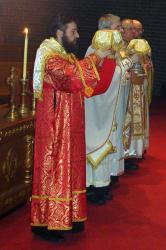
The Divine Liturgy
The Divine Liturgy has its origins in the Sacrament of the Holy Eucharist, instituted by the Lord Himself: Now on the first day of Unleavened Bread the disciples came to Jesus, saying, Where will You have us prepare for You to eat the passover? He said, Go into the city to a certain one, and 'say to him, 'The Teacher says, My time is at hand; I will keep the Passover at your house with My disciples.' And the disciples did as Jesus had directed hem, and they prepared the Passover. When it was evening, He sat at table with the twelve disciples.... Now as they were eating, Jesus took bread, and blessed, and broke it, and gave it to the disciples and said, Take, eat; this is My body. And He took a cup, and when He had given thanks He gave it to them, saying, Drink of it, all of you; for this is My blood of the new covenant, which is poured out for many for the forgiveness of sins... And when they had sung a hymn, they went out to the Mount of Olives (Matt. 26:17-20; 26-28, 30). This Eucharistic Supper and the Lord's commandments concerning it were held sacred by the Apostles; for when they met together, they spent the time in prayer, in the singing of sacred hymns, and the breaking of bread in memory of Christ. That is, they celebrated the Holy Eucharist. This custom became the cornerstone of the new Christian community, and is witnessed to by St. Paul in his first letter to the Corinthians: / received from the Lord what I also delivered to you, that the Lord Jesus on the night when He was betrayed took bread, and when He had given
thanks, He broke it, and said, This is My body which is broken for you. Do this in remembrance of Me. In the same way also the cup, after supper, saying, This cup is the new covenant in My blood. Do this, as often as you drink it, in remembrance of Me (1 Cor. 11:23-25).In the course of time the Eucharistic gathering became more developed. Originally the public portion of the Liturgy (the Synaxis, or gathering), consisting of instruction, Scripture readings, etc., primarily for the Catechumens who were about to receive Baptism, and the Eucharist (a private gathering of the faithful only) were celebrated separately; but about the 4th Century they were linked together, and eventually expanded. In time, the Service of Preparation (or Proskomedia) was joined to it.
Customarily three Liturgies are celebrated by the Orthodox the Liturgy of St. John Chrysostom, the Liturgy of St. Basil the Great, and the Liturgy of the Presanctified Gifts. The first two are entitled ...of Saint John..., ...of St. Basil..., since each contains prayers undoubtedly composed by St. John and St. Basil, respectively. The Presanctified Liturgy (at which no consecration takes place, since the Holy Gifts are presanctified on the previous Sunday) probably contains prayers composed by Pope St. Gregory Dialoges, to whom this Liturgy is
attributed. In addition, in a few places, such as at Jerusalem, the Liturgy of St. James the Brother of the Lord is celebrated only on the patronal feast day of St. James (Oct. 23).The Divine Liturgy can be celebrated only by a Bishop or a Priest, and neither can celebrate more than one Liturgy in one day. This is because they must partake of the Holy Gifts, having, of necessity, prepared themselves beforehand by fasting, prayer, etc. [If the Holy Gifts would be consumed before another Liturgy, the fast would therefore be broken!] The Liturgy can be celebrated only at an Altar (Holy Table) upon which is placed an Antimension consecrated by a Bishop this constitutes his permission to serve the Liturgy although the Liturgy
may be served at another place, as long as the Antimension is present. Not more than one Liturgy may be celebrated at one Altar (Holy Table), upon one Antimension, in one day.Upon entering the church before the Divine Liturgy is to be served, the Priest (and Deacon) stand before the Holy Doors and say the Entrance Prayers. Then, after asking for and receiving in turn forgiveness of the faithful, they enter the Altar; and having made three prostrations before the Holy Table, they kiss the Holy Gospel (Priest) and the Table itself (Priest and Deacon). After this they vest with appropriate prayers and blessings the Deacon in Stikharion, Cuffs and Orarion (Stole), and the Priest in Cassock, Epitrachelion, Belt, Cuffs, Nabedrennik and Palitsa (if so awarded), as well as the Phelonion. Then both wash their hands and prepare to celebrate the Liturgy of Preparation (the Proskomedia).
Liturgy of Preparation.
The first part of the Divine Liturgy (not really part of the Liturgy proper) is the Proskomedia (Greek the bringing of gifts). In ancient times the faithful brought gifts of bread and wine and from these the Priest selected that to be
used at the Holy Eucharist. At the present time, the Priest usually prepares five loaves (one loaf in the Greek tradition), in remembrance of the five loaves that fed 5,000 people in the Gospel, called Prosphora (oblations) made of wheat flour, mixed with plain water, and leavened. On the top of each loaf is a Cross with the Greek inscription IC, XC, NI, KA, in the four corners, meaning (in Greek) Jesus Christ conquers. The wine must be made from the juice of red grapes with nothing added.From the first loaf a cube, the size of the entire seal on top, is cut out. This cube, called the Lamb, signifies Jesus Christ, the Paschal Lamb. This is placed on the center of the Paten. A Cross is incised on the top of the Lamb and with the spear the side is pierced in remembrance of the piercing of the Savior's side. At the words ...blood and water came out, wine and water are poured together into the Chalice.
From the second loaf a particle is taken out, signifying the Mother of God, and placed at the Lamb's right (the left, looking down at the paten). From the third loaf, nine particles are taken out, signifying nine classes of Saints: 1) St. John the Baptist, 2) Prophets, 3) Apostles, 4) Sainted Hierarchs, 5) Martyrs, 6) Holy Monks and Nuns, 7) Holy Unmercenaries and Physicians, 8) the Ancestors of God, Joachim and Anna, the Saint whose church it is, the Saint of the day (one particle for all), and 9) the Saint whose Liturgy it is. These are placed in three rows of three particles each, at the Lamb's left (the right, looking down).
From the fourth loaf particles are taken out for the living and placed in a row below the Lamb, and from the fifth loaf particles are taken out for the departed and placed in a row below that of the living. Thus all of the particles are arranged on the Paten around the Lamb, depicting the Church Militant and Triumphant, united in the Liturgy as in common divine service.
The Star (or Asterisk) is then placed over the particles to keep them in place, at the same time signifying the Star of Bethlehem which came over the place where the Christ Child lay. Then the Paten and Chalice are covered by veils, respectively, and both covered by a larger veil the Aer signifying that Christ was clothed in glory, that His glory covered the whole world and that He covers us also with His grace. The prepared elements are then censed by the Priest, who prays that the Lord may bless the gifts and accept them in memory of those offering them and on behalf of those for whom they were offered and also that he, the Priest, be worthy to celebrate the Holy Mystery.
Liturgy of the Catechumens.
The second part of the Divine Liturgy (the Liturgy proper) is called the Liturgy of the Catechumens (or the Liturgy of the Word). In ancient times, not only the faithful, but also the Catechumens (those preparing for Holy Baptism) and Penitents (those excluded from Holy Communion for a time) were present at this portion of the Divine Liturgy, which consists of prayers, hymns in honor of the Holy Trinity, and readings from the Word of God. This, of course, was taken over from the old Synagogue worship with which the earliest Christians were familiar. It begins with the opening of the Holy Doors, signifying the heavens opened at the Baptism of the Lord, and the exclamation of the Priest, Blessed is the Kingdom..., which is a glorification of the Kingdom of the Most-Holy Trinity, which Jesus has come to establish on earth.The Deacon (or Priest if no Deacon; this holds true for most of the Deacon's parts) begins the Great Litany (often called the Litany of Peace because of the words, In peace let us pray to the Lord!) which consists of twelve petitions dealing with man's most pressing needs peace, seasonable weather, God's help for travelers, the sick, etc. After the Priest's exclamation at the end of the Great Litany, For unto Thee are due all glory, honor and worship..., ideally two Choirs sing the Antiphons (Greek sounding in answer responsive singing of two Choirs standing opposite each other), which are divided by the Little Litanies into three parts, in honor of the Holy Trinity.
One of three types of Antiphons are sung, depending on the importance of the day. The type most frequently sung are the Typical Antiphons (Ps. 104, 146 and the Beatitudes, Matt. 5:3-12), so-called because they form part of the typical service. These are sung on Sundays and major Feast Days. On Great Feast Days, special Antiphons are sung, consisting of prophetic verses selected from the Psalms, appropriate to the particular Feast being celebrated, to which are joined hymns relating to the Feast. For this reason, these Antiphons are commonly called the Festal Antiphons. On ordinary weekdays, if it not be a major feast, the Daily Antiphons are sung, consisting of Psalm 92, 93 and 95. To the Second Antiphon of the Typical group is joined a hymn glorifying the Incarnation of the Son of God Only-begotten Son and Immortal Word of God....
During the singing of the Third Antiphon, the Holy Doors are opened, signifying the going-out of the Savior to preach to the world. The Priest, preceded by the Deacon holding the Holy Gospels, and a Candle-Bearer, make a solemn entrance (the Little Entrance), going out through the North Deacon's Door and entering the Altar again through the opened Holy Doors. The Book of the Gospels here represents Christ Our Lord, and the candle going before signifies that Christ, represented by the teachings of the Gospels, is the Light of the World.
In ancient times, during the persecutions, the Gospel Book was borne out from a secret place (where the sacred vessels also were kept). This also marked the first entry of the Celebrant into the Sanctuary (the main body of the Church) and signaled the beginning of the Liturgy. The clergy vested in a separate room, called the Sacristy, where the Gospel and Cross were kept and then proceeded to the Sanctuary. The Catechumens were then commanded to depart and the Celebrants, headed by the Bishop, entered into the Sanctuary itself.
According to ancient rules of the Jerusalem Church of the Resurrection and the Church of St. Sophia in Constantinople, the Liturgy of the Catechumens was held in a separate place from the Liturgy of the Faithful. After the entrance into the Sanctuary, breads, etc., were selected from among those offered by the faithful and the Proskomedia performed. Later the Proskomedia was transferred to the beginning of the Liturgy, although in a room separate from the Altar; the Little Entrance was made from this room, to the Sanctuary and then into the Altar. This ancient practice is preserved somewhat in the Hierarchical Divine Liturgy, although the Proskomedia is now usually performed at the side of the Altar itself, the Procession proceeding through the North Deacon's Door.
After the Little Entrance, which is an expression of entering into the Sanctuary and joining there the Saints, the Church glorifies those Saints or the sacred event of the Feast Day by singing triumphant hymns in their honor Troparia and Kontakia. The Troparia and Kontakia are special short hymns sung in one of the Eight Tones composed in honor of the Feast or Saint (s) commemorated and express the essence of the Feast or the life and spiritual feats of the Saint (s).
The Troparia and Kontakia are similar to each other in length, literary form, etc., but each stresses a different aspect of the essence of the commemoration. While the Troparion provides us with a picture of the external side of the commemorated event, the Kontakion draws attention to the inner aspect, and vice versa. The Kontakia, however, usually reflect more fully the essence of the sacred event. This can be seen, for example, in the following Troparion and Kontakion of the Feast of Holy Pentecost:
Blessed art Thou, O Christ our God, Who hast revealed the fishermen as most wise by sending down upon them the Holy Spirit; through them Thou didst draw the world into Thy net. O Lover of Man, Glory to Thee! [Troparion]
When the Most High came down and confused the tongues, He divided the nations; but when He distributed the tongues of fire, He called all to unity. Therefore, with one voice, we glorify the All-Holy Spirit! [Kontakion]
After the Troparia and Kontakia, the Choir sings the Trisagion Hymn: Holy God! Holy Mighty! Holy Immortal, have mercy on us! According to Church Tradition, the origin of the Trisagion is as follows. At the beginning of the 5th Century there was a great earthquake in Constantinople. In connection with this, services were held in all the city churches, followed by a procession around the city. Among the worshippers was a young boy who heard the
miraculous singing of the Angels: Holy God! Holy Mighty! Holy Immortal! He recounted what he had heard to all those around him, whereupon the Christians began to sing the hymn, adding the words, Have mercy on us! and the earthquake stopped. From this time, the prayer was adopted by the Holy Church.Through the singing of this prayer, the Church arouses believers to a spiritual contemplation of the Lord of glory Whom the heavenly powers extol, to repent of their sins and turn to Him for mercy and grace bestowing aid. During the singing of the hymn, Christians recall the vision of the Prophet Isaiah, who saw the Throne of God surrounded by the holy angels, singing: Holy, holy, holy is the Lord of hosts; the whole earth is full of His glory! Shaken by this vision, the Prophet cried: Woe is me! For I am lost; for I am a man of unclean lips, and I dwell in the midst of people of unclean lips (Is. 6:3, 5)!
At Hierarchical services, the Trisagion is sung seven times, since, in Sacred Tradition, seven is seen to be a symbol of perfection: And on the seventh day God finished His work which He had done (Gen. 2:2). On certain Feast Days (Elevation of the Cross and the 3rd Sunday of Great Lent), the Trisagion is replaced by, Before Thy Cross, we bow down in worship, O Master.... On other Feast Days (Nativity of Christ, Theophany, Lazarus Saturday, Holy Saturday, Bright Week, Pentecost), the Trisagion is replaced by, As many as have been baptized into Christ....
Next comes the Epistle and Gospel lessons, which are preceded by special Prokeimena (Greek proceeding), which serve as an introduction to lessons from the Epistle and Gospel (the Prokeimenon before the Gospel being the Alleluia). These are usually taken from the Psalms, serving to prepare our minds to comprehend what is read, indicating in brief the significance and importance of the Scripture Lessons. In ancient times, Old Testament lessons were also read here (preserved at Festal Vespers).
During the reading of the Epistle lesson, the Deacon censes the Altar, Iconostasis, the Celebrant(s), Reader, Singers and Faithful. This is prescribed as a sign of reverence before the reading of the Gospel lesson and indicates that through the preaching of the Gospel, the grace of the Holy Spirit, which has spread to all corners of the world, fills men's hearts with the taste of life eternal (2 Cor. 2:14).
At the conclusion of the Epistle lesson, the Prokeimenon Before the Gospel is chanted (now called the Alleluia) with the threefold refrain Alleluia! Then the Gospel is brought out and the Gospel lesson is read by the Deacon. Before the Gospel is placed a lit candle as a sign of veneration for the Word of God 'and as a symbol of the Light of God which emanates from the Gospel, illumining the listeners to the attainment of saving mysteries. The Gospel is read from the Ambo (Greek anabaino I ascend), signifying an elevated spot a boat, or a hill from which the Lord preached to the people.
After the Gospel reading follows the Sermon (sometimes moved to the end of the Liturgy) and then the Litany of Fervent Supplication, since it is meet, that after hearing the Word of God, we should pray to Him with redoubled fervor for the things necessary for soul and body. On certain days this Litany is followed by the Litany for the Dead. Then follows the Litany of the Catechumens, referring to that ancient class of people the Catechumens who were being instructed in the Christian faith and prepared for Baptism. Immediately after this Litany, the Catechumens were dismissed, Depart, Catechumens! Catechumens, depart!.... The institution of the Catechumenate has now fallen into disuse, but the Litany still remains, to remind us of the vows made at Baptism and to arouse in the faithful a humble consciousness of sin. With the Dismissal of the Catechumens, who were not considered to be sufficiently prepared by the early Church to behold the Holy Mysteries without understanding them, this second part of the Divine Liturgy the Liturgy of the Catechumens ends.
Liturgy of the Faithful.
The third part of the Divine Liturgy is called the Liturgy of the Faithful, since only the Faithful in ancient times were permitted to be present for the Sacrament of the Eucharist. The Liturgy of the Faithful can be divided into four parts: 1) the final preparation of the Holy Gifts and the faithful for the Sacrament of the Eucharist; 2) the Sacrament of the Eucharist (primarily the Eucharistic Canon Anaphora); 3)the preparation for Communion and the partaking of Communion; and 4) the Thanksgiving for Communion and the conclusion of the Liturgy.
After two Little Litanies for the faithful, the Holy Doors are opened and the Cherubic Hymn is sung, so-called because we are preparing to minister at the Throne of God even as the Cherubim minister at the Heavenly Throne. During the singing of this hymn, during which the Deacon censes the Altar, Iconostasis, Clergy and Faithful, the Great Entrance is made, typifying the Lord going to His voluntary Passion and Death. The Angels are with us at Christ's going-out; for Christ, as King, is upborne invisibly by them.
In this Entrance, the Holy Gifts are borne from the Table of Oblation to the Altar, by passing out through the North Deacon's Door and then in through the Holy Doors. In the early days of the Church, during this Entrance all those who had brought or sent offerings for the use of the Church were mentioned by name. This is retained, but in expanded form, by the Russian Church. The Greeks retain only the last phrase, You and all Orthodox Christians, may the Lord God remember.... The Chalice and Paten are then placed on the Holy Table and covered with the large veil (Aer).
The removal of the Chalice and Paten from the Deacon's head symbolizes the removal of the Body of Christ from the Cross. We the faithful are present at the placing of the Body in the tomb (the Holy Table) and wrapped in linens (the Aer), which also symbolizes the stone rolled across the door of the tomb for which reason the Holy Doors are closed and the curtain drawn in the Russian tradition. At the same time, the conclusion of the Cherubic Hymn is sung, with the addition of Alleluia, followed by a Litany of Supplication, in which we ask for spiritual mercies.
After the Litany, the Clergy exchange the Kiss of Peace at the summons of the exclamation, Let us love one another.... In ancient times the faithful would also observe this Kiss of Peace, now only preserved by the Clergy. In response to the summons, the Choir sings the short confession of the Holy Trinity: Father, Son and Holy Spirit, the Trinity, One-in-Essence, and Undivided! The Deacon then intones, The Doors, the Doors..., which, in ancient times, were guarded so that no unworthy persons or pagans might enter the Sanctuary during the celebration of the Holy Eucharist. This custom is not adhered to now, but still serves to remind us to guard the doors of our soul against all evil thoughts as we prepare to confess our faith in the words of the Creed, and to give heed to the Holy Mysteries.
The Creed, which was formulated during difficult times in the Church's history, during the heretical divisions and the struggle for purity in her dogmas, is now sung. The first part of the Creed (which is discussed in more detail in a separate place in this book) is our confession of God the Father, and an extensive confession of the Son. This confession of faith is an introduction to the acceptance of our salvation and our participation in eternity.
The Eucharistic Canon (Anaphora).
Having sung the Creed together with the Congregation, the Deacon then turns to the people and intones: Let us stand aright.... These words are a summons to inner spiritual concentration, to be attentive and reverent towards the Sacrament about to be celebrated. We must bear in mind that the Holy Gifts must be offered to God in spiritual peace, as this Sacrifice is made to God not only for us, but from us; we are assisting at it as participants in the Divine Liturgy. With these words, begins the most sacred part of the Divine Liturgy the Eucharistic Canon (or Anaphora, Greek offer). The Choir responds, A mercy of peace..., signifying that the Eucharistic Sacrifice on God's part is His great mercy towards us and is the result of our reconciliation with God through Our Savior; while on our part it is our praise of God's Majesty, revealed in the Divine Economy of our salvation (Heb. 13:15; Ps. 50:14).In keeping with ancient custom, the Priest turns to the people with St. Paul's words, The grace of our Lord Jesus Christ, the love of God the Father, and the communion of the Holy Spirit be with all of you (2 Cor. 13:14). By this blessing the Celebrant wishes the worshippers that the highest spiritual gifts grace, love and communion be sent down from the Throne of the Holy Trinity. On behalf of the Congregation, the Choir responds to the Priest's blessing with the mutual wish for spiritual well-being, And with your spirit! that is, they wish his soul the same gifts and blessings from God the Almighty.
In order to focus the feelings of the soul upon the celebration of the Sacrament of the Holy Eucharist, the Priest summons all in the church to elevate their hearts from earth heavenwards, to the eternal and heavenly, to Our Lord God: Let us lift up our hearts! The human heart is that spiritual organ through which man perceives the spiritual world on high and enters into communion with God. As the Lord Himself says, Blessed are the pure in heart, for they shall see God (Matt. 5:8). The Congregation responds through the Choir: We lift them up unto the
Lord, which affirms that their hearts and minds are striving after the heavenly, God's Throne, and God Himself.Following the example of Christ our Savior, Who thanked God the Father at the Last Supper (Luke 22:17-19), the Priest then summons the Faithful to give thanks to God: Let us give thanks to the Lord. The Choir responds: It is meet and right..., during the singing of which the Priest reads the First Eucharistic Prayer, It is meet and right to
sing of Thee..., in which is contained a thanksgiving for the Sacrifice which was offered for us by the Son, and further, for making us ascend to Heaven, concluding with the exclamation, Singing the triumphant hymn.... The Choir responds with the Song of the Seraphim, Holy, Holy, Holy, Lord of Sabaoth..., taken partly from the Prophet Isaiah and partly from the Apocalypse (Revelation) of St. John.As the Choir sings, the Priest reads the Second Eucharistic Prayer, in which, mentally among the hosts of Angels present at the celebration of the Eucharist, he praises the Lord for the Economy of Salvation of mankind: With these blessed powers..., ending with the exclamation, Take, eat... and Drink of it, all of you..., the words of the Savior at the Last Supper, when the Holy Eucharist was instituted. The Choir sings Amen after each; and during the second Amen, the Priest reads the Prayer of Commemoration: Remembering this saving commandment.... Then as the Deacon raises the Paten and Chalice with crossed arms, the Priest exclaims, Thine own, of Thine own, we offer unto Thee, on behalf of all and for all! We note here that what is being offered is not that which belongs to us, but that which belongs to the Savior.
As the Choir sings, We praise Thee..., the Priest prays, Again we offer unto Thee this reasonable and bloodless worship, and ask Thee, and pray Thee, and supplicate Thee: Send down Thy Holy Spirit upon us and upon these Gifts here offered. Thus the Priest and worshippers fervently pray the Heavenly Father to send down the Holy Spirit both upon the worshippers and the Holy Gifts upon the worshippers to cleanse them of all evil and make them worthy to partake of Christ's Sacrifice; upon the Holy Gifts to consecrate them and make them into the precious Body and Blood of Our Lord.
This invocation of the Holy Spirit is called the Epiclesis (meaning invocation). In it the Church confesses her faith in the sanctifying power of the Holy Spirit, considering this to be the loftiest moment in the Prayer. In the Russian Church, the Troparion of the Third Hour, O Lord, Who didst send down Thy Most Holy Spirit upon Thine apostles at the third hour..., is recited thrice, and although it appears only about the 15th-16th Centuries, it well conveys the tender and penitent feelings with which the celebrants of the Eucharist accomplished the consecration of the Holy Gifts.
The next prayer is that of intercession, Again we offer unto Thee this reasonable worship..., in which the Priest commemorates the members of the Church, in whose behalf the Holy Eucharist has been offered, ending with a
commemoration of the Most-Holy Theotokos, Especially for our Most-Holy, Most-Pure, Most-Blessed and Glorious Lady Theotokos and Ever-Virgin Mary. The Choir sings, It is truly meet... (or some other hymn if it be a Great Feast).While this is being sung, the Priest continues with the commemoration of St. John the Baptist, the Departed, the Episcopate and the ruling authorities, ending with the exclamation, Among the first, remember, O Lord.... This is a prayer for the Church in her earthly activity for the life of men. And grant that with one mouth and one heart... is a Trinitarian doxology which concludes the Eucharistic Prayer. The worshippers respond with Amen, symbolizing their participation in the offering of the Sacrifice and in the commemoration of the members of the Church.
Immediately after this part of the Liturgy begins the Preparation of the Faithful for Communion. The Deacon chants the Litany of Supplication which, appropriately, is followed by the Lord's Prayer, perfectly expressing the
Eucharistic sense of the petition, Give us this day our daily bread. After the exclamation, For Thine is the Kingdom..., the Priest blesses the people: Peace be unto all! The curtain is drawn, and as the Lamb is elevated by the Priest, he exclaims: The Holy Things, for the holy! a call to the Saints (the Faithful) to communion after which the Choir responds, One is Holy... and then the Communion Hymn, which relates to the memories of the day and the Lessons from the Gospel and Epistle.Holy Communion.
Communion is preceded by the fraction of the Lamb. The Priest and concelebrating Clergy, if any, communicate from the portion XC and the portions NI and KA are for the Communion of the laity. The portion 1C is placed in the Chalice last. Hot water is poured into the Chalice after the 1C portion, symbolizing the water that poured forth from the Lord's side, showing that although He was dead, His body was not devoid of divine virtue that is, the warmth and vitality of the Holy Spirit.After the Communion of the Clergy, the curtain is opened and the Priest comes out with the Chalice, at the exclamation, In the fear of God and with faith, draw near! Before the Communion of the Faithful, the Communion Prayer a brief Symbol of Faith in Christ is recited.
Prayer:
I Believe, O Lord and I confess that Thou art truly the Christ, the Son of the living God, Who earnest into the world to save sinners, of whom I am first, I Believe also that this is truly Thine own most pure Body, and that this is truly Thine own precious Blood, Therefore, I pray Thee: have mercy upon me and forgive my transgressions, both. voluntary and involuntary, of word and of deed, of knowledge and of ignorance. And make me worthy to partake wit/tout condemnation of Thy most pure Mysteries; for the remission of my sins, and unto fife everlasting. Amen.
Of Thy Mystical Supper, O Son of God, accept me today as a communicant for I will, not speak of Thy Mystery to Thine enemies; neither like Judas wilt I give Thee a kiss; But like the thief wilt I confess Thee: Remember me, O Lord, in Thy Kingdom.
May the communion of Thy holy Mysteries Be neither to my judgment, nor to my condemnation, O Lord, But to the heating of soul and Body.
All the Faithful, adults and infants, alike, are communicated, partaking of the mingled Holy Body and Blood by means of a special spoon. Infants receive Holy Communion by virtue of their having received Holy Chrismation immediately after Baptism, which makes them full members of the Church of Christ. The approaching faithful receive the Holy Gifts with arms crossed on the breast; after receiving, very gently, they kiss the edge of the Chalice, as if it were the side of Christ Himself. As the Priest communes each of the faithful, he says, The servant (handmaid) of God (name) partakes of the precious and holy Body and Blood of our Lord and God and Savior Jesus Christ, for the remission of sins and unto life everlasting. During the Communion the Choir sings, Receive the Body of Christ... (or another hymn at certain other times).
After the Communion, the Priest carries the Chalice into the Altar and places it on the Holy Table, after which he turns and blesses the people, O Lord, save Thy people..., at which the Choir sings the hymn setting forth what mercies the people have received: We have seen the True Light.... Then, taking up the Chalice, the Priest faces the people, saying quietly, Blessed is our God.../'and then aloud, Always, now and ever..., which symbolizes the Lord's Ascension into Heaven. As the Priest carries the Chalice to the Table of Oblation, the Choir sings the Hymn of Thanksgiving, Let our mouths be filled with Thy praise, O Lord.... Thus, in the Liturgy the earthly life of Jesus Christ passes before us.
The Liturgy concludes with a short Litany of Thanksgiving and the Prayer Before the Ambo, O Lord, Who blessest those who bless Thee.... The Choir responds with, Blessed be the Name of the Lord... (thrice) and (rarely done now), the first eleven verses of Psalm 34: / will bless the Lord at all times.... The final blessings are bestowed, and the Faithful come up to kiss the Handcross held by the Priest. Those who had not communed, then receive a piece of the bread which remained after the Lamb was cut out at the Proskomedia, for which reason it is called Antidoron (in place of the Gifts). The communicants remain after the Dismissal to listen to more prayers of thanksgiving for Communion. The Holy Gifts, if not consumed by a Deacon, are consumed by the Priest. The particles which had been taken out at the Proskomedia, other than the Lamb i.e., for the Theotokos, Saints, living and dead having by now been placed in the Chalice, are likewise consumed.
The Liturgy of St. Basil the Great.
The Liturgy of St. Basil differs from the usual Liturgy of St. John Chrysostom in the following particulars. The Prayers at the time of the Eucharistic Canon are substantially longer and the hymns sung at this point are sung to special melodies to accommodate the length of the Prayers. The Words of Institution, Take, eat... and Drink of it... are somewhat different and instead of It is truly meet..., the hymn, All of Creation rejoices...is sung. At the Proskomedia and at the final Dismissal of the Liturgy, St. Basil is commemorated rather than St. John Chrysostom.
The Liturgy of the Presanctified Gifts.
The Holy Fathers considered that it was unbefitting the contrition of Great Lent to serve the full Liturgy of St. John Chrysostom or St. Basil the Great, so that these Liturgies are allowed only on Saturdays and Sundays of the Fast, as well as on the Feast of the Annunciation and Holy Thursday. In its place, on Wednesdays and Fridays of Great Lent, as well as on Thursday of the Fifth Week and the first three days of Passion Week, the Liturgy of the Presanctified Gifts is celebrated. [If the patronal feast of a church or monastery falls on a weekday of Great Lent, or if one of a small handful of major feasts fall thereon, the Presanctified Liturgy is celebrated on that day.] This Liturgy is called Presanctified, since the Holy Gifts were presanctified (or consecrated) on the previous Sunday. This Liturgy consists of Vespers, followed by a portion of the full Liturgy, omitting the consecration of the Holy Gifts.
The structure of the Vesperal part of the Presanctified Liturgy is identical to the first half of ordinary Vespers regular beginning, Psalm 104, Great Litany, Kathisma (usually the 18th), Lord, I have called..., with ten appointed Stikhera, accompanied by a censing of the whole church, Entrance with either the censer or Gospel Book (if there will be a Gospel reading because of a Feast), O Jesus Christ, the Joyful Light..., and then the Prokeimenon. During the reading of the Kathisma, the Presanctified Gifts are solemnly transferred from the Holy Table to the Table of Oblation.
After the Prokeimenon, an appointed Old Testament Lesson is read, followed by another Prokeimenon. Then, as everyone makes a prostration, the Priest turns and faces the Faithful with a candle and censer, intoning, The Light of Christ illumines all! This signifies that the Prophets, from whose writings we have heard and shall hear were illumined by the same light (the Light of Christ) that still enlightens all men. A second Old Testament lesson is now read. At the conclusion of the second Old Testament Lesson, the moving hymn of supplication, Let my prayer arise... is sung, with the Faithful and Clergy on bended knees:
Let My Prayer Arise:
Let my prayer arise in Thy sight as incense, and let the lifting up of my hands be an evening sacrifice.
Lord, I have called to Thee, hear me! Attend to the voice of my prayer when I call to Thee!
Set a guard over my mouth, O Lord, a. secure around my lips!
Incline not my heart to words of evil, to invent excuses for my sins.
Let my prayer arise in Thy sight as incense, and let the lifting up of my hands Be an evening sacrifice.
This is followed by the Lenten Prayer of St. Ephraim the Syrian and three prostrations. If Gospel and Epistle lessons are prescribed (usually if it be a feast), they are said here. Then, whether Gospel and Epistle lessons or not, the Litany of Fervent Supplication is chanted, as well as a Litany for the Catechumens and finally their dismissal. [In the ancient Church, among the Catechumens there were some who were soon to be baptized (illumined) usually on Holy Saturday and after the mid-point of the Great Lent, a special Litany was inserted for them at this point at the Presanctified Liturgy: All catechumens, depart. Depart, catechumens. As many as are preparing for illumination, draw near. Pray, you who are preparing for illumination, etc.]
With the Dismissal of the Catechumens, the Liturgy proper begins. After two Litanies for the Faithful, as at the full Liturgy, the Choir sings the special Cherubic Hymn: Now the powers of heaven do serve invisibly with us. Lo, the King of glory enters. Lo, the mystical sacrifice is upborne, fulfilled. A Great Entrance is made from the Table of Oblation to the Altar by the Priest bearing the Presanctified Gifts, in profound silence. At this time the faithful make a prostration before Christ, Who passed before them in the Sacrament. At the conclusion of the Cherubic Hymn and the Alleluia, the Lenten Prayer of St. Ephraim is again recited with three prostrations.
The Holy Doors are now closed and the Preparation for Communion begins with the Litany of Supplication (which begins, Let us complete our evening prayer to the Lord, since this is an evening service) and the Lord's Prayer. During this the curtain is drawn only half-way, signifying that this is not the full Liturgy. After the Lord's Prayer and the usual exclamations, the Holy Gifts are not elevated, since this was done previously at the Sunday Liturgy, but the Priest only touches them, saying, The Presanctified Holy Things are for the holy! The Choir responds, One is holy..., as usual, and then the Communion Hymn, O taste and see that the Lord is good! Alleluia!
The Communion of the Clergy and Faithful take place, as usual, except that instead of Blessed is He that comes in the name of the Lord..., the Choir sings, I will bless the Lord at all times.... A special Prayer Before the Ambo, O Almighty Master, Who in wisdom hast fashioned all creation..., is said after the usual Litany of Thanksgiving and then the Dismissal is said, as usual, except that St. Gregory Dialoges, Pope of Rome, is commemorated instead of St. John Chrysostom or St. Basil the Great.