Hieromartyr Patrick, bishop of Prusa, and his companions: Presbyters Acacius, Menander, and Polyenus (362)
Commemorated on May 19/June 1
Saint Patrikios lived during the I Century and was bishop of the city of Prussa in Bythnia (Asia Minor). He openly and boldly preached the teachings of Christ the Saviour and denounced the error of the pagans. For this he was taken together with the three presbyters – Akakios, Menander and Polienos, and led for interrogation to the governor of the city, Julius. At the time Julius was on journey for treatment at an hot-springs, and he gave orders to bring along after him also the Christian bishop with the presbyters, bound in iron chains. Having washed in the hot-springs, Julius offered sacrifice to his gods and, summoning Saint Patrikios and the other prisoners, he demanded them to offer sacrifice to the pagan gods, threatening punishments in case of refusal.
Saint Patrikios replied to this: "I am a Christian and I worship the One True God, Jesus Christ, Who hath created the heavens and the earth and these warm springs for the benefit of all mankind". On the command of Julius they threw the saint into the hot spring, and with firm faith the martyr prayed for help: "Lord, Jesus Christ, help me, Thy servant", – and he remained unharmed.
In a rage of impotence Julius gave orders to cut off the head of Saint Patrikios and his three presbyters.
The end for the martyrs occurred in about the year 100 after the Birth of Christ.
Martyr Thalelaeus at Aegae in Cilicia and companions, Martyrs
Alexander and Asterius (284)
Commemorated on May 20/June 2
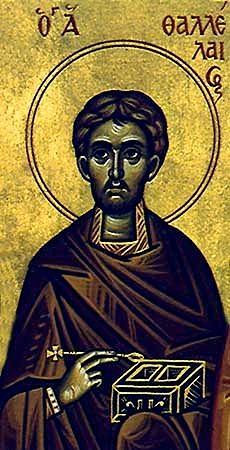
The
Martyrs Thalaleas, Alexander and Asterias: During the reign of
Numerian (283-284), the governor of the
city of Aegea dispatched
soldiers to seek out Christians. They brought to him Thalaleas,
an 18 year old blond-haired youth. To the governor's interrogation
Saint Thalaleas answered: "I am a Christian, a native of Lebanon.
My father, by the name of Beruchius, was a military commander,
and my mother was named Romilia. My brother has the dignity of
sub-deacon. I however am a student of medicine under the physician
Makarios. During a former time of persecution against Christians
in Lebanon I was brought before the governor Tiberias, and just
barely escaped execution. But now I stand before this court, do
with me what thou dost wish. I desire to die for Christ the Saviour
and my God, hoping from Him help to endure all torments".
The enraged governor ordered the two torturers Alexander and Asterias to pierce
the legs of the martyr with rope and suspend him head downwards. But the executioners,
by the design of God, bored into a block of wood, which they hung up in place
of the martyr. When the governor saw that they had deceived him, he then ordered
that Alexander and Asterias be fiercely whipped, and they too confessed themselves
Christians and glorified God. The governor gave orders to immediately cut off
their heads. Twice he himself attempted to carry out the execution, and to
pierce the leg-bones of the saint, but the grace of God prevented him, and
he in his impotence then commanded that Saint Thalaleas be drowned.
The returning servants reported to the governor that they had carried out
the execution, but suddenly, just as they finished their report, Saint Thalaleas
appeared in white raiment. For a long while everyone was numbed with terror,
but finally the governor said: "Behold, this sorcerer hath bewitched even
the sea". Then one of his advisers, the magician Urvician, advised the
governor to have the martyr thrown for devouring by wild beasts, but neither
the vicious bear, not the hungry lion and lioness, would touch the saint, all
meekly but laying down at his feet. Seeing this happen, the people began loudly
to shout: "Great is the God of the Christians, O God of Thalaleas, have
mercy on us!". The crowd seized hold of Urvician and threw him to the
beasts, which did not hesitate to tear apart the magician. Finally, the governor
gave orders to kill the holy martyr with a sword. They led away the martyr
of Christ to the place of execution, called Aegea, where he prayed to God
and bent his neck beneathe the sword. This occurred in the year 284. The
relics
of the holy martyr Thalaleas are situated in the church of Saint Agathonikos
of Constantinople and have made many miracles. The holy Martyr Thalaleas,
as a physician without payment treating the sick, is called by the Church
an UnMercenary,
and is called on in prayers over the sick in the Sacrament of Anointing-with-Oil
and during the Blessing of Waters.
Venerable Stephen, abbot of Piperi in Serbia (1697)
Commemorated on May 20/June 2
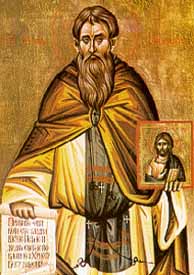
This saint was born into the Niksich clan in the village of Zupa
of poor but devout parents, Radoje and Jacima. According to tradition,
he first lived a life of asceticism in the monastery of Moraca
where he was abbot. The Turks drove him out of Moraca and he settled
in Rovacki, Turmanj in the place which today is called Celishte.
Later, he settled in Piperi in a cell where he remained in labor
and god-pleasing asceticism until his death. He died peacefully
in the Lord on May 20, 1697 A.D. His relics repose there even today
and with many miracles they glorify Christ the God and Stephan,
God's chosen one.
Holy Equals-to-the-Apostles Emperor Constantine (337) and Helen,
his mother (327)
Commemorated on May 21/June 3
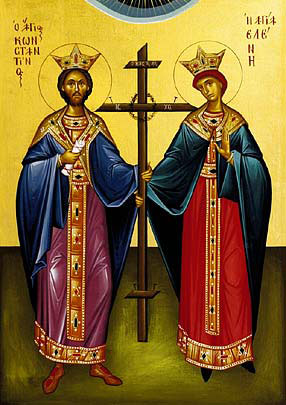
The Holy Emperor Constantine (306-337),
has received from the Church the title "Equal-to-the-Apostles", and in world
history he received the name "the Great". He was the
son of Caesar Constantius Chlorus (305-306), governing the lands
of Gaul and Britania. The immense Roman empire was at this time
divided into a Western and an Eastern empire, at the head of which
were two independent emperors and also co-rulers titled "Caesars", – such
in the Western half of the Roman empire was the aforementioned
father of Saint Constantine. Saint Contantine's mother was the
empress Helen, who was a Christian. The future ruler of all the
whole Roman empire – Constantine – was raised to have
respect for the Christian religion. His father did not persecute
Christians in the lands governed by him, this at a time, when through
all the rest of the Roman empire Christians were subjected to fierce
persecutions by the emperors Diocletian (284-305) together with
his co-ruler Maximian Galerius (305-311) in the East, and the emperor
Maximian Hercules (284-305) in the West. After the death of Constantius
Chlorus, his son Constantine in 306 was proclaimed by the army
as emperor of Gaul and Britania. The first act of the new emperor
was to promulgate in the lands subject to him the freedom of confession
of the Christian faith. The pagan-fanatic Maximian Galerius in
the East and the fierce tyrant Maxentius in the West hated the
emperor Constantine and they plotted to overthrow and kill him,
but Constantine bested them in a series of battles, and he defeated
his opponents with the help of God. He prayed to God to give him
a sign, which should inspire his army to fight valiantly, and the
Lord manifest to him in the heavens a radiant Sign of the Cross
with the inscription "With this Sign thou wilt conquer".
Having become sole ruler of the Western half of the Roman empire,
Constantine in the year 313 issued the Edict of Milan concerning
religious toleration, and in the year 323, when he came to rule
as the sole ruler over the whole Roman empire, he extended the
conditions of the Milan Edict also over the Eastern half of the
Roman empire. After three hundred years of persecution, Christians
finally received the possibility to openly confess their faith
in Christ.
Renouncing paganism, the emperor did not let his capital remain
in ancient Rome, the former centre of the pagan realm. He transferred
his capital to the
East, to the city of Byzantium, which also was renamed Constantinople ["Constantinopolis" means "the
city of Constantine"]. Constantine was deeply convinced, that only the
Christian religion could unify the immense Roman empire with its diverse peoples.
He supported the Church in every way, he brought back from banishment the Christian
confessors, he built churches, and he showed concern for the clergy. The emperor
deeply revered the victory-bearing Sign of the Cross of the Lord, and he wanted
also to find the actual Life-Creating Cross, upon which was crucified our Lord
Jesus Christ. For this purpose he dispatched to Jerusalem his own mother – the
holy Empress Helen, granting manifold plenitude of power and material means.
Together with the Jerusalem Patriarch Makarios, Saint Helen set about the
search, and through the Will of God the Life-Creating Cross was discovered
in a miraculous
manner in the year 326. (The account about the finding of the Cross of the
Lord is located under the Feast of the Exaltation of the Cross, 14 September).
Situated in Palestine, the holy empress did much of benefit for the Church.
She gave orders, that all places connected with the earthly life of the Lord
and His All-Pure Mother, should be freed of all traces of paganism, and she
commanded that churches should be built at these places of memory. Over the
Cave of the Sepulchre of the Lord the emperor Constantine himself gave orders
to construct a magnificent church to the glory of the Resurrection of Christ.
Saint Helen gave the Life-Creating Cross to the Patriarch for safe-keeping,
and part of the Cross she took with her for the emperor. Having distributed
generous alms at Jerusalem and seeing to the feeding of the needy, during
which times she herself attended them, the holy Empress Helen returned to
Constantinople,
where she soon after died in the year 327.
For her great services to the Church and her efforts in finding the Life-Creating
Cross, the empress Helen is titled "Equal-to-the-Apostles".
The peaceful state of the Christian Church was rent by the rise from within
the Church by dissensions and quarrels from heresies which had appeared.
Already at the beginning of the emperor Constantine's reign there had arisen
in the
West the heresies of the Donatists and the Novatians, demanding a second
baptism over those who lapsed during the times of the persecutions against
Christians.
These heresies, repudiated by two local Church councils, were finally condemned
at the Milan Council of 316. But particularly ruinous for the Church was
the rise in the East of the heresy of Arius, daring to repudiate the Divine
Essence
of the Son of God, and teaching that Jesus Christ was a mere creature. By
order of the emperor, in the year 325 there was convened the First OEcumenical
Council
in the city of Nicea. At this Council were gathered 318 bishops. Among its
participants were confessor-bishops from the period of the persecutions and
many other luminaries of the Church, among whom – was Sainted-hierarch
Nicholas of Myra in Lycia. (The account about the Council is located under
29 May). The emperor was present at the sessions of the Council. The heresy
of Arius was condemned and a Symbol-Creed of Faith compiled, in which was included
the term "of One-Essence with the Father", always confirming in
the consciousness of Orthodox Christians the truth of the Divinity of Jesus
Christ,
Who took on and assumed upon Himself human nature for the redemption of all
the human race.
The deep churchly awareness and feeling of Saint Constantine might possibly
surprise one, where the working-out of the definition "of One-Essence"heard
by him in the disputes of the Council, was at his insistence included within
the Symbol-Creed of Faith.
After the Council of Nicea, Saint Constantine continued with his active role
in the welfare of the Church. He accepted holy Baptism at the end of his life,
having prepared for it all his whole life. Saint Constantine died on the day
of Pentecost in the year 337 and was buried in the church of the Holy Apostles,
in a crypt earlier prepared by him.
St. Helen of Dechani, Serbia (1350)
Commemorated on May 21/June 3
(Prepodobna Jelena Decanska je hrišcanska svetiteljka. Jelena
je bila sestra Stefana Decanskog. Preminula je sredinom XIV veka
i sahranjena je u manastiru Decanima gde joj se mošti i
danas nalaze).
St. John-Vladimir, martyr and ruler of Serbia (1015)
Commemorated on May 22/June 4
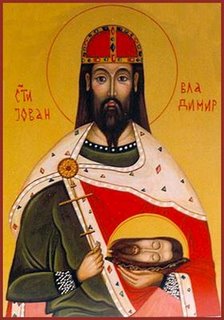
The Holy Martyr John-Vladimir, a Serbian prince, was born in the X Century.
From his childhood he was raised in piety, and at maturity he wisely governed
his holdings Illyria and Dalmatia, preserving in purity the holy faith. The
noble prince was married to Kosara, a daughter of the Bulgarian tsar Samuel.
Summoned under pretense of talks with the Bulgarian tsar John-Vladislav, he
was treacherously murdered by him on 22 May 1015, at the entrance to a church.
The pious spouse of the holy prince, Kosara, withdrew into a women's monastery
that she built, and where also she died, to the very end of her life not quitting
the church. The relics of the holy prince are situated near Elbosan.
Venerable Michael the Confessor, bishop of Synnada (818)
Commemorated on May 23/June 5
Sainted
Hierarch Michael the Confessor yearned from his youthful years
for the monastic life and was directed
by His Holiness
Patriarch Tarasios (784-806) to a monastery, located at the coast
region
of the Black Sea. There also entered the monastery together with
him – Saint Theophylaktos (Comm. 8 March), the future bishop
of Nikomedia. At the monastery both monks proceeded through the
efforts of salvation and soon were glorified by graced gifts
from the Lord. Once during a time of harvest, when the people
were weakened
by thirst, by the prayer of the monks an empty metal vessel was
filled with water.
His Holiness Patriarch Tarasios ordained Saint Michael as bishop of the city
of Synada. Through his holy life and wisdom, Saint Michael gained the deep
love of believers and the particular notice of the emperors Nicephoros I (802-811)
and Michael I Rangaves (811-813). In the year 787 Saint Michael was present
at the Seventh OEcumenical Council at Nicea.
When the Iconoclast heretic Leo the Armenian (813-820) entered upon the throne,
he began to expel Orthodox hierarchs from their cathedrae-seats, appointing
in their place his like-minded heretics.
Saint Michael during this time firmly defended Orthodoxy, bravely opposing
the heretics and denouncing their error. Leo the Armenian brought Saint Michael
to trial, but not fearing torture he answered resolutely: "I venerate
the holy icons of my Saviour Jesus Christ and the All-Pure Virgin, His Mother,
and all the saints, and it is to them I bow down. Thine decrees about the removal
of icons from churches I shall not fulfill". Leo the Armenian then banished
Saint Michael to imprisonment in the city of Eudokiada, where the confessor
died in about the year 821. The head of Saint Michael is preserved in the Laura
of Saint Athanasias on Mount Athos, and part of the relics – are at
the Iversk monastery.
Venerable Symeon Stylites (the Younger) of the Wonderful Mountain
(596)
Commemorated on May 24/June 6
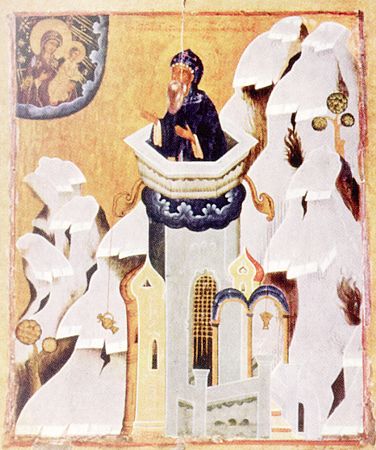
The Monk Simeon the Pillar-Dweller was born in the year 521 in
Syrian Antioch from the pious parents John and Martha. Saint Martha
(Comm. 4 July)from her youthful years prepared herself for an unmarried
life and yearned for monasticism, but her parents insisted on her
entering into marriage with the youth John. After ardent prayer
in a church in the name of Saint John the Fore-Runner, the future
nun was directed in a vision to submit to the will of her parents
and enter into marriage. In married life, Saint Martha strove to
please God and her husband in everything. She often prayed about
granting her a baby and promised to devote him to the service of
God. In his appearance to the saint, Saint John the Fore-Runner
revealed to the pious Martha that of her would be born a son, who
indeed would serve God. When the infant was born, he was named
Simeon and baptised at two years of age.
When Simeon was six years old, an earthquake occurred in the city of Antioch,
during the time of which his father perished. Simeon during the time of the
earthquake was in church. Leaving it, he became lost and spent seven days sheltered
by a pious woman. Having again appeared to Blessed Martha, John the Baptist
indicated where to find the lost boy. The mother of the saint, having found
her lost son, settled after the earthquake on the outskirts of Antioch. Already
during his childhood the Lord Jesus Christ appeared several times to Saint
Simeon, foretelling him his future exploits and the recompense for them.
The six year old lad Simeon went off into the wilderness, where for a certain
time he was situated in complete isolation. During this time a light-bearing
Angel guarded and fed him and finally, he arrived at a solitary monastery,
the head of which was the hegumen Abba John, pursuing asceticism upon a pillar,
and with love he accepted the lad.
After a certain while Saint Simeon turned with a request to the Elder John
to permit him also asceticise upon a pillar. A new pillar was erected by the
brethren of the monastery with the blessing of the hegumen, not far from his
pillar. Having completed the obedience of the seven year old boy into monasticism,
Abba John himself raised him up upon this pillar. The young ascetic, strengthened
by the Lord, quickly grew spiritually, in his efforts surpassing even his experienced
preceptor. For his stringent efforts, Saint Simeon received from God the gift
of healing. The fame about the deeds of the young monk began to spread about
beyond the bounds of the monastery, and monks and laypeople began to come to
him from various places, wanting to hear his counsel and receive healings from
infirmities. The humble ascetic continued to pursue asceticism with instructions
from his spiritual mentor Abba John.
At 11 years of age the lad decided to pursue asceticism upon still higher a
pillar, to the top of which was 40 feet. The bishops of Antioch and Seleukos
came to the place of the monk's exploits, and ordained the holy ascetic to
the dignity of deacon, and then they permitted him to go up upon the new pillar,
on which the Monk Simeon asceticised over the course of 8 years.
The Monk Simeon prayed ardently for the sending down upon him of the Holy Spirit,
and the holy prayer of the ascetic was heard. The Holy Spirit came down upon
him in the form of a blazing light, filling the ascetic with Divine Wisdom.
Alongside with spoken precepts, Saint Simeon dispatched written precepts about
repentance, monasticism, about the Incarnation of Christ and about the future
Judgement.
After the death of his elder, Saint Simeon structured his life thus: from the
rising of the sun until mid-afternoon he read books and copied Holy Scripture,
after which he again rose to prayer and prayed all night. When the new day
began, having rested somewhat, he began his usual rule of prayer with the rising
of the sun.
The Monk Simeon concluded his efforts on the second column and by the decree
of God settled upon the Wondrous Mount, having become in his monastery an experienced
elder for guidance to monks. The ascent onto the Wondrous Mount was marked
by a vision of the Lord, standing atop a column. Saint Simeon continued his
exploits at this place where he saw the Lord, at first upon a stone, and then
upon a pillar again raised up. Future events were revealed to the Monk Simeon,
and thus he foretold the death of the archbishop of Antioch, Ephrem, and the
illness of the bishop, Domnos, which overtook him in punishment for his lack
of pity. And finally, the Monk Simeon predicted an earthquake for the city
of Antioch and urged all the inhabitants to repent themselves of their sins.
On the Wondrous Mount Saint Simeon established a monastery, the church of which
sick people healed by him built, in gratitude for the mercy shown them. For
the needs of the monastery the monk petitioned by prayer a spring of water,
and once during the time of a shortage of grain, by his prayer to the Lord
wheat was multiplied in the granaries of the monastery. In the year 560 by
the command of the Lord the holy ascetic at age 39 received the priestly dignity
from the bishop of Seleukos, Dionysios. At age 75 the Monk Simeon was forewarned
by the Lord about his impending end. He summoned the brethren of the monastery,
instructed them in a farewell blessing talk and peacefully expired to God in
the year 596, having toiled in the feat of pillar-dwelling for 68 years.
Just as during life, so also after death the monk worked miracles, healing
the blind and lame and leprous, saving many from wild beasts, casting out devils
and resuscitating the dead.
Pentecost – Trinity Sunday
Commemorated on May 25/June 7
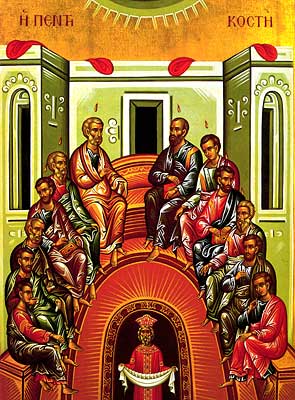
The Feast of Holy Pentecost is celebrated each year on the fiftieth
day after the Great and Holy Feast of Pascha (Easter) and ten days
after the Feast of the Ascension of Christ. The Feast is always
celebrated on a Sunday.
The Feast commemorates the descent of the Holy Spirit upon the
Apostles on the day of Pentecost, a feast of the Jewish tradition.
It also celebrates the establishment of the Church through the
preaching of the Apostles and the baptism of the thousands who
on that day believed in the Gospel message of salvation through
Jesus Christ. The Feast is also seen as the culmination of the
revelation of the Holy Trinity.
The story of Pentecost is found in the book of The Acts of the
Apostles. In Chapter two we are told that the Apostles of our Lord
were gathered together in one place. Suddenly, a sound came from
heaven like a rushing wind, filling the entire house where they
were sitting. Then, tongues of fire appeared, and one sat upon
each one of Apostles. They were all filled with the Holy Spirit
and began to speak in other languages as directed by the Spirit
(Acts 2:1-4).
This miraculous event occurred on the Jewish Feast of Pentecost,
celebrated by the Jews on the fiftieth day after the Passover as
the culmination of the Feast of Weeks (Exodus 34:22; Deuteronomy
16:10). The Feast of Weeks began on the third day after the Passover
with the presentation of the first harvest sheaves to God, and
it concluded on Pentecost with the offering of two loaves of unleavened
bread, representing the first products of the harvest (Leviticus
23:17-20; Deuteronomy 16:9-10).
Since the Jewish Feast of Pentecost was a great pilgrimage feast,
many people from throughout the Roman Empire were gathered in Jerusalem
on this day. When the people in Jerusalem heard the sound, they
came together and heard their own languages being spoken by the
Apostles (Acts 2:5-6). The people were amazed, knowing that some
of those speaking were Galileans, and not men who would normally
speak many different languages. They wondered what this meant,
and some even thought the Apostles were drunk (Acts 2:7-13).
Peter, hearing these remarks, stood up and addressed the crowd.
He preached to the people regarding the Old Testament prophecies
about the coming of the Holy Spirit. He spoke about Jesus Christ
and His death and glorious Resurrection. Great conviction fell
upon the people, and they asked the Apostles, "What shall
we do?" Peter said to them, "Repent, and let every one
of you be baptized in the name of Jesus Christ for the remission
of sins; and you shall receive the gift of the Holy Spirit" (Acts
2:38-39).
The Bible records that on that day about three thousand were baptized.
Following, the book of Acts states that the newly baptized continued
daily to hear the teaching of the Apostles, as the early Christians
met together for fellowship, the breaking of bread, and for prayer.
Many wonderful signs and miracles were done through the Apostles,
and the Lord added to the Church daily those who were being saved
(Acts 2:42-47).
Apostles Carpus of the Seventy and Alphaeus (1st c.)
Commemorated on May 26/June 8
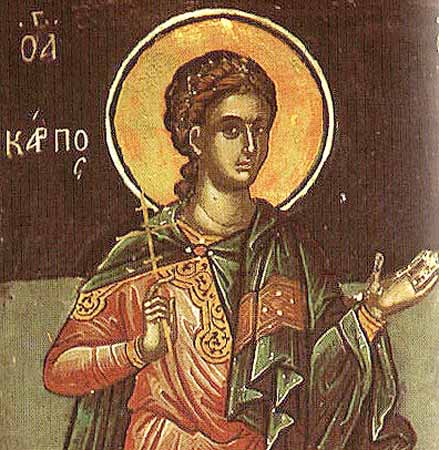
The
Holy Disciple Carpus (from the 70) – was
a disciple and companion of the holy Apostle Paul. In the 2nd
Epistle to
Timothy, the apostle mentions the name Carpus, at the house of
whom in Troias
he left a phelon and books (2 Tim. 4: 13). Knowing Carpus as
a man of virtue and possessing a mind of lofty purity, the Apostle
Paul made him bishop of Thracian Bereia. The disciple Carpus
went
preaching the Gospel to the island of Crete. Here he encountered
Saint Dionysios the Areopagite (Comm. 3 October). In his reminiscences
Dionysios recounts about a miraculous vision to the disciple
Carpus.
The holy disciple Carpus died peacefully at Bereia (according to other histories
he received a martyr's end during the persecution under the emperor Nero).
Hieromartyr Therapon, bishop of Sardis (259)
Commemorated on May 27/June 9
The PriestMartyr Therapontos, Bishop of Sardis suffered for Christ
during the III Century (the city of Sardis, or Sarda, was situated
in the Asia Minor district of Lydia). In fulfilling his priestly
service, Saint Therapontos enlightened with the light of the Christian
faith and baptised many of the pagan-Hellenes (Greeks). For this,
he was brought to trial before the governor Julian and fearlessly
declared himself a Christian bishop. They threw him into prison,
where for a long time he languished with hunger and thirst, and
then they gave him over to cruel tortures, but the torments did
not break the saint's valiant confessing of faith. In chains they
led off the saint to the city of Sinaion in Phrygia, and thence
to Ancyra. In these cities they again tortured him. They took him
to the River Astala, where they stretched him cross-form and bare
upon the ground, fastened to four posts driven into the ground,
and they beat him fiercely. After this torture, they took the passion-bearer
of Christ off to the outskirts of the Satalia diocese, part of
the Sardis metropolitanate, and here after long beatings Saint
Therapontos ended with his martyr's deed. The dry posts, to which
the saint had been tied, and having soaked up his blood, gave forth
green shoots and grew into large trees, the leaves of which were
found to have curative powers through which many people received
graced healing.
Venerable Nicetas, bishop of Chalcedon (9th c.)
Commemorated on May 28/June 10
The
Monk Nikita the Confessor, Bishop of Chalcedon, lived during the
2nd half of the VIII Century. For his God-pleasing
life he
was elevated to the dignity of bishop of Chalcedon. Saint Nikita
distinguished himself by his charity, he always helped the poor,
he took in wanderers into his dwelling, he concerned himself
about the orphaned and the widowed, and he interceded for the
wronged.
During the reign of the Iconoclast Leo the Armenian (813-820),
Saint Nikita bravely denounced the Iconoclast heresy and urged
his flock reverently to venerate the holy icons of Christ, the
Mother of God and the holy Saints. Saint Nikita endured much
suffering from the impious emperor and his like-minded cohorts;
he was subjected
to tortures and sent off to exile. The holy Confessor Nikita
died at the beginning of the IX Century. From his relics occurred
miracles
of healing. In the Canon of the service to him, written by the
Constantinople presbyter Joseph, it declares as glorified amongst
the Saints also the brother of Saint Nikita – Saint Ignatios.
Virgin-martyr Theodosia of Tyre (308)
Commemorated on May 29/June 11
The Holy Martyress Theodosia of Tyre suffered in the year 307. On 29 May is
celebrated the transfer of her relics to Constantinople, and later on to Venice.
Once, during a time of persecution against Christians, which then had already
lasted for five years, the seventeen year old Theodosia went up to condemned
Christian prisoners, situated in the Praetorium. It was the day of Holy Pascha,
and the martyrs spoke about the Kingdom of God. Saint Theodosia asked them
to remember her before the Lord, when they should come to stand before Him.
Soldiers saw that the maiden bowed to the prisoners, and they seized hold
of her and led her before the governor, Urban. The governor advised the maiden
to offer sacrifice to the idols but she refused, confessing her faith in
Christ.
Then they subjected the saint to cruel tortures, – her body they struck
at with iron claws such that they did lay bare the bones. The martyress was
silent and with an happy face endured the sufferings, and to a second suggestion
by the governor to offer sacrifice to the idols she answered: "Thou fool,
I have been granted to join the martyrs!" They threw the maiden with a
stone about her neck into the sea, but Angels drew her out from the depths.
Then they gave over the martyress for devouring by wild beasts. Seeing that
the beasts would not touch her, they cut off her head. By night Saint Theodosia
appeared to her parents, who had tried to talk their daughter into not going
to the sufferings. She was in bright garb with a crown upon her head and a
luminous gold cross in her hand, and she said: "Behold the great glory
that ye did want to deprive me of!".
Venerable Isaac, founder of the Dalmatian Monastery at Constantinople
(383)
Commemorated on May 30/June 12
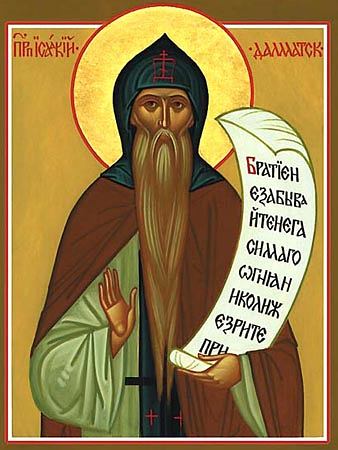
The Monk Isaac lived during the IV Century, accepted monastic
vows and pursued asceticism in the wilderness. During the years
of the reign of the emperor
Valentus (364-378) – a zealous adherent of the Arian heresy, they began
to persecute the Orthodox, closing and destroying churches. Having learned
of the persecution, the Monk Isaac quit the wilderness and arrived in Constantinople,
so as to console and encourage the Orthodox. At this time barbarian Goths,
dwelling along the River Danube/Dunaj, were making war against the empire.
They seized Thrace and advanced towards Constantinople. When the emperor Valentus
was leaving the capital with his soldiers, the Monk Isaac – turning himself
towards the emperor, loudly cried out: "Emperor, unlock the churches of
the Orthodox, and then the Lord wilt aid thee!". But the emperor, disdaining
the words of the monk, confidently continued on his way. Three times did the
monk repeat his request and prophecy. The angry emperor gave orders to hurl
the Monk Isaac into a deep ravine, grown over with prickly thorns. By day the
ravine was a swamp, and to emerge from it was impossible. But the monk with
the help of God remained alive, and he emerged, overtook the emperor and said: "Thou
wanted to destroy me, but the holy Angels did save me from peril. Hear me,
open up the churches to the Orthodox and thou shalt defeat the enemy. If however
thou dost not heed me, then thou shalt not return alive, but shalt perish in
fire". The emperor was astonished at the boldness of the monk and ordered
his attendants Saturninus and Victor to take the monk and hold him in prison
until his return.
The prophecy of the saint soon happened. The Goths defeated and began to chase
down the Greek army. The emperor together with his Arian generals took refuge
in a barn with straw, and the attackers set it afire. After receiving news
about the perishing of the emperor, they set free the Monk Isaac and began
to honour him as a prophet of God. Onto the throne was then chosen the holy
Emperor Theodosius the Great (379-395), who on the advice of Saturninus and
Victor summoned the elder to himself, meeting him with great respect, beseeching
prayers to the saints and fulfilling all his instructions: he banished the
Arians from Constantinople and restored the churches to the Orthodox. The Monk
Isaac wanted to return into the wilderness, but Saturninus and Victor besought
him not to leave the city, but rather to protect it with his prayers. In the
outskirts of Constantinople they built for the saint an hut, where monks gathered
to him. Thus arose a monastery, the hegumen and spiritual guide of which was
the Monk Isaac. He nourished also the laypeople, and helped many of the poor
and suffering. Having reached extreme old age, the Monk Isaac made co-hegumen
together with him the Monk Dalmatos (the account about him is located under
3 August), by whose name the monastery was called. The Monk Isaac died in the
year 383, and his memory is celebrated also on 22 March.
Apostle Hermes of the Seventy (1st c.)
Commemorated on May 31/June 13
The Holy Disciple Hermas was a bishop in Thracian Philippopolis.
The holy Apostle Paul greets him in the Epistle to the Romans (Rom.
16: 14). Preaching the Gospel, the Disciple Hermas endured much
grief from the pagans, but he died peacefully.
Martyr Hermias at Comana (160)
Commemorated on May 31/June 13
The Holy Martyr Hermias suffered for Christ in the city of Komana
during the time of persecution under the emperor Antoninus Pius
(138-161). The governor Sebastian, having arrived in Cappadocia
to carry out a commission to chase down Christians, urged the saint
to offer sacrifice to the pagan gods, promising for this both honours
and the mercy of the emperor. But the soldier grey with age bravely
confessed his faith in Christ. After long exhortation the governor
gave orders to torture the saint. They beat him on the face such
that the skin peeled from his face, and they threw him into a red-hot
oven. When the oven was opened after 3 days, the Martyr Hermias
emerged from it unharmed. The governor Sebastian ordered a sorcerer
to poison Saint Hermias with a potion. The poisonous drink did
the saint no harm. So likewise a second goblet with even stronger
poison failed to kill the saint. The sorcerer believed and offered
repentance to Christ the Saviour and was immediately beheaded,
baptised by his own blood and receiving a martyr's crown. But Saint
Hermias was subjected to even more terrible torturings: they tore
at his sinews, threw him in boiling oil, dug out his eyes, but
he humbly gave thanks to the Lord Jesus Christ. Then they suspended
the Martyr Hermias head downwards. For three days he hung in such
a position. People, sent by the governor to verify his death, found
him alive. Struck by the miracle, they were blinded with fright
and began to call out to the saint that he should help them. The
holy martyr ordered the blind to approach to him, laid hands on
and healed them in the Name of Jesus Christ. In anger the governor
ordered to flay the skin on the body of the saint, but as before
he remained alive. Then the crazed Sebastian by his own hand beheaded
him. Christians secretly buried the body of the Martyr Hermias,
from whose relics numerous relics were bestowed.
Martyr Justin the Philosopher, and those with him at Rome: Martyrs
Justin, Chariton and his wife Charita, Euelpistus, Hierax, Peon,
Valerian and Justus (166)
Commemorated on June 1/June 14
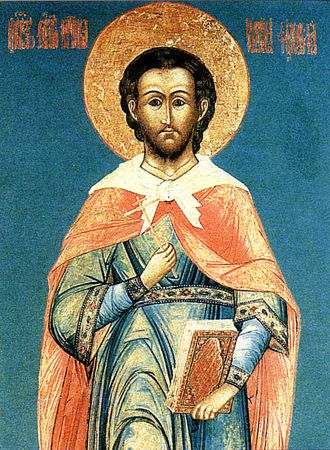
The Holy Martyr Justin the Philosopher was
born at Sykhem – an
ancient city of Samaria. Justin's parents, being Greeks, were pagan.
From the time of his childhood the saint displayed profundity of
mind, love for knowledge and a fervent devotion to the cognition
of Truth. When he came of age he studied the various schools of
Greek philosophy: the Stoics, the Peripatetics (Aristotelians),
the Pythagoreans, the Platonists – and he concluded, that
none of these pagan teachings revealed the way to the knowledge
of the True God.
Once, when he was strolling in a solitary place beyond the city
and pondering about where to seek out the way to the knowledge
of Truth, he met an old man,
who in the ensuing conversation revealed to Justin the essential essence
of the Christian teaching and advised him to seek out the solutions
to all the
questions of life in the books of Holy Scripture. "But before anything
else, – said the holy elder, – pray diligently to God, so that
He might open to thee the doors of Light. No one is able to comprehend Truth,
unless it be given him in understanding by God Himself, Who revealeth it to
each that seeketh Him in prayer and in love".
In his 30th year of life Justin accepted holy Baptism (between the years
133 and 137). From this time Saint Justin devoted his talents and vast philosophical
knowledge to preaching the Gospel among the pagans. He began to journey about
throughout the Roman empire, everywhere sowing the seeds of the faith of
salvation. "Whosoever
is able to proclaim Truth and does not proclaim, that one will be condemned
by God", – he wrote.
Justin opened up a school, where he preached Christian philosophy. Saint Justin
subsequently defended the veracity and the salvificity of the Christian teaching,
persuasively confuting pagan sophistry (thus, for example, in a debate with
the Cynic philosopher Crescentius) and heretical distortions of Christianity
(in particular, he spoke out against the teachings of the Gnostic, Marcian).
In about the year 155, when the emperor Antoninus Pius (138-161) started
a persecution against Christians, Saint Justin personally gave him an "Apologia" (Apology)
in defense of Christians innocently condemned to execution – Ptolemy
and Lucias, the name of a third remaining unknown. In the "Apologia" he
demonstrated the falseness of the slander against Christians accused "unjustly
for the mere name as loathsome and transgressive Christians". The "Apologia" made
such a favourable effect upon the emperor, that he ceased with the persecution.
Saint Justin journeyed with the decision of the emperor to Asia Minor, – where
they were persecuting Christians with particular severity, and he himself
distributed the joyous message about the imperial edict throughout the surrounding
cities
and countryside.
At Ephesus occurred the debate of Saint Justin with the Rabbi Trypho. The
Orthodox philosopher on the basis of the Old Testament prophetic writings
demonstrated
the truth of the Christian teaching of faith. Saint Justin gave an account
of this debate in his work "Dialogue with Trypho the Jew".
A second "Apologia" of Saint Justin was addressed to the Roman
Senate. It was written in the year 161, soon after Marcus Aurelius (161-180)
ascended
the throne.
Having returned to Italy, Saint Justin, like the Apostles, preached everywhere
the Gospel and by his Divinely-inspired words he converted many to the Christian
faith. When the saint arrived at Rome, the envious Crescentius – whom
Justin always defeated in debate – brought against him many false accusations
before the Roman court. Saint Justin was put under guard, subjected to torture
and accepted a martyr's death (+ 166).
In addition to the above-mentioned works, the following array of compositions
belong to the holy martyr Justin the Philosopher: "Observations about
the Soul", "Demonstration against the Hellenes", "Speech
against the Hellenes". Saint John Damascene preserved a significant part
of a non-surviving work of Saint Justin "About the Resurrection".
The church historian Eusebios asserts, that by Saint Justin were written books
entitled "The Singer", "Denunciation of all Existing Heresies" and "Against
Marcian".
The relics of Saint Justin the Philosopher rest in Rome.
In the Russian Church the memory of the martyr is particularly glorified in
temples of his name.
St. Nicephorus the Confessor, patriarch of Constantinople (829)
Commemorated on June 2/June 15
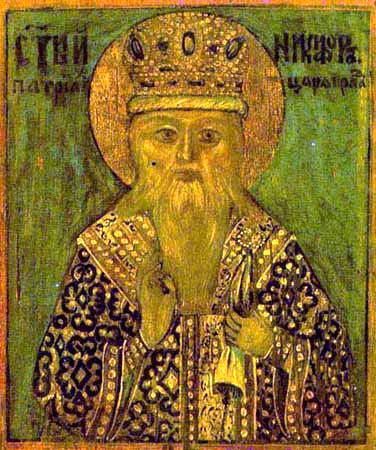
Sainted Nicephoros the Confessor was born in Constantinople in
the second half of the VIII Century. Deep faith and preparation
for the deed of confessor were instilled in him by his parents,
Theodore and Eudocia. They gave their son a genuine Christian upbringing,
reinforced by the example of their own life. His father suffered
as a confessor of Orthodoxy under the Iconoclast emperor Constantine
Copronymos (740-775). His mother, having shared in all the tribulation
with her husband, followed him into exile, and after his death
she returned to Constantinople and finished her life in a convent.
Saint Nicephoros received a fine secular education, but most of
all he studied the Holy Scriptures and he read spiritual books.
During the reign of Leo IV (775-780), Saint Nicephoros received
the position of imperial counselor. Situated at the imperial
court, he continued to lead
a strict and virtuous life, he firmly preserved the purity of his Orthodox
faith and zealously defended the veneration of holy icons. After the death
of Leo IV, during the reign of Constantine VI (780-797) and his mother Saint
Irene, – at Nicea in the year 787 was convened the VII OEcumenical
Council, which condemned the Iconoclast heresy. Being deeply knowledgeable
in the Holy
Scriptures, Saint Nicephoros in the emperor's name entered into the Council
in the defense of Orthodoxy, by which he rendered great assistance to the
holy fathers of the Council.
After the Council, Saint Nicephoros remained for several years at court, but
the whole life of vanity all more and more became burdensome to the saint.
He retired his position and settled in solitude near the Bosphorus, spending
his life in scholarly work, and in quietude, fasting and prayer. Saint Nicephoros
built a church, founded a monastery, and led a strict monastic life even before
taking monastic vows.
During the reign of emperor Nicephorus I (802-811), and after the death of
the holy Patriarch Tarasios (784-806), Saint Nicephoros was chosen to his place:
he received monastic vows and the priestly dignity and was elevated to the
patriarchal throne on 12 April 806, on the day of holy Pascha.
Under the emperor Leo V the Armenian (813-820), – a passionate adherent
of the Iconoclast heresy, there again began for the Church a period of unrest
and persecutions. The emperor was not immediately able to begin open persecution
against Orthodoxy, since Iconoclasm was condemned at the VII OEcumenical Council.
The holy Patriarch continued to serve in the Great church, bolding urging the
people to preserve the Orthodox faith, and he led the consequent and unremitting
struggle with heresy. The emperor began to recall from exile the bishops and
clergy, excommunicated from the Church by the VII OEcumenical Council. Having
convened with them an heretical council, the emperor demanded that the Patriarch
appear for a dispute about the faith. The Patriarch refused to argue about
the faith with heretics, since the teachings of the Iconoclasts were already
condemned in the anathema of the VII OEcumenical Council. He endeavoured all
the more to bring the emperor and those around him to their senses, he fearlessly
explained to the people the teaching about the veneration of holy icons, he
wrote admonitions to the empress and to the city-governor Eutykhianos, the
closest one to the imperial dignity, attaching at the end the prophetic words
about a quick perishing of heretics from "the punishing hands of the Lord".
Then the heretical council passed an excommunication of holy Patriarch Nicephoros
and his predecessors – the blessedly-reposing Patriarchs Tarasios and
Germanos. Saint Nicephoros was sent at first to a monastery at Chrysopolis,
and later – to the island Prokonnis in the Sea of Marmara. After 13
years of deprivation and sorrow the holy Patriarch Nicephoros died in exile
on 2
June 828.
On 13 March 847 the undecayed relics of the holy Patriarch Nicephoros, having
lain in the ground for 19 years, were solemnly transferred to Constantinople
into the cathedral church of Saint Sophia.
Saint Nicephoros was outstanding as a church activist of his times, "a
credit to his era and his chair (cathedra)" and, having much served the
Church, he left behind an extensive spiritual legacy – numerous works
of historical, dogmatic and canonical content.
Hieromartyr Erasmus of Ochrid, who reposed in peace, and 20,000
Martyrs with him (303)
Commemorated on June 2/June 15
"This saint was born in Antioch and lived in the reigns of
Diocletian and Maximian. He lived in strict asceticism on Mount
Lebanon, and was endowed by God with great wonderworking gifts.
As a bishop, he set out to preach the Gospel. Arriving at the city
of Ochrid, he restored the son of a man called Anastasius to life
by his prayers, and baptised him. At this time, Erazmus baptised
many other pagans and tore down the idolatrous altar in Ochrid.
For this he was denounced to the Emperor Maximian, who was at that
time staying in Illyria. The Emperor brought him before the copper
image of Zeus, and ordered him to bring sacrifices and worship
the idol. St Erazmus, by his power, caused a terrible dragon to
come out of the statue, which terrified all the people. The saint
then worked another wonder, and the dragon died. Then the saint
preached Christ and baptised 20,000 souls. The furious Emperor
commanded that all 20,000 be beheaded, and put Erazmus to harsh
torture, before throwing him into prison. But an angel of God appeared
to him, as once to the Apostle Peter, and led him out of the prison.
After that, this servant of God went to Campania, where he preached
the Gospel to the people, then returned again to the town of Hermelia,
where he withdrew to a cave and lived in asceticism for the rest
of his days. At the time of his death, he prostrated three times
towards the East and, with upraised hands, prayed to God to forgive
and give eternal life to all those who would, with faith, call
upon his name. At the end of his prayer, a voice was heard from
heaven: 'Let it be as thou hast asked, My little healer Erazmus!'
The saint looked up once more to heaven with great joy and saw
a wreath of glory descending upon him, and a choir of angels, prophets,
apostles and martyrs waiting to receive his holy soul. He finally
cried: 'Lord, receive my spirit!', and breathed his last, in about
the year 303. The cave and chapel of St Erazmus stand to this day
not far from Ochrid, and from there is proclaimed to this day the
great power of the man of God, Erazmus the hieromartyr." (Prologue)
Martyr Lucillian and those with him at
Byzantium: four youths — Claudius,
Hypatius, Paul, and Dionysius; and Virgin Paula (270)
Commemorated on June 3/June 16
The Holy Martyrs Lucillian, the Lads Claudius, Ipatius, Dionysius,
and Paula the Virgin: Lucillian was a pagan priest during the time
of the Roman emperor Aurelian (270-275). In his old age he became
persuaded of the falseness of the pagan religion, and with all
his heart he turned to the faith in Christ the Saviour, and was
baptised.
Under the influence of his preaching many a pagan was converted
to Christianity. Then certain Jews, out of concern for his spreading
faith in the Christ crucified
by them, reported against Lucillian to the Nicomedia city-governor Sylvanus,
who thereupon urged the elder to return to idol-worship. For his refusal,
they smashed the jawbone of Saint Lucillian, beat him with canes
and suspended him
head downwards, and then they locked him away in prison. Here he met up with
four lads that were confessors of Christianity – Claudius, Ipatius,
Paul and Dionysius. Saint Lucillian urged them to stand firm in the faith,
and to
fear neither tortures nor death. After a certain while they brought them
to trial and then thrown into a red-hot furnace, but suddenly rain poured
down
extinguishing the flames, and the martyrs remained unharmed. The governor
sentenced them to death by execution, sending them off to Byzantium for carrying
out
the sentence. The holy lads were beheaded by the sword, and the holy Martyr
Lucillian was nailed to a cross with quite many nails.
Witness to the deed of the holy martyrs was the holy Virgin Paula, who had
dedicated herself to the service of those suffering for the faith in Christ.
She provided food to Christian prisoners, washed their wounds, brought medications
and also buried the bodies of martyrs. After the death of Saint Lucillian and
the four lads, she returned to Nicomedia and continued on with her holy service.
The holy virgin was arrested and cast into a furnace, but by the power of God
she remained unharmed. Then they sent her off to Byzantium, where the holy
martyress was beheaded by the sword.
St. Metrophanes, first patriarch of Constantinople (325)
Commemorated on June 4/June 17
Sainted
Mitrophanes, Patriarch of Constantinople, was a contemporary of
Saint Constantine the Great (306-337).
His father, Dometius,
was by birth a brother of the Roman emperor Probus (276-282).
Having reasoned out the falseness of the pagan religion, Dometius
came
to believe in Christ. During a time of terrible persecution of
Christians at Rome, Saint Dometius set off to Byzantium with
two of his sons, Probus and Mitrophanes, and began to be instructed
in the law of the Lord by Bishop Titus, a man holy of life. Seeing
the ardent desire of Dometius to labour for the Lord, Saint Titus
ordained him presbyter. And after the death of Titus there was
elevated upon the bishop's throne first Dometius (272-303), and
thereafter his sons, Probus (303-315) and in 316 – Saint
Mitrophanes.
Upon a time having come to Byzantium, the emperor Constantine
was delighted by the beauty and comfortable setting of the city.
And having seen the holiness
of life and sagacity of Saint Mitrophanes, the emperor took him back along
to Rome. Soon Constantine the Great transferred the capital from Rome to
Byzantium and he brought Saint Mitrophanes there. In the year
325 there was convened
the First OEcumenical Council for resolving the Arian heresy. Constantine
the Great had the holy fathers of the Council bestow upon Saint
Mitrophanes the
title of Patriarch. In such manner, the saint became the first Patriarch
of Constantinople. Saint Mitrophanes was himself very old, and
was not able to
be present at the Council, and he sent in place of himself the khore-bishop
(vicar bishop) Alexander. At the close of the Council the emperor together
with the holy fathers visited with the ailing Patriarch. At the request of
the emperor, the saint disclosed his choice of worthy successor to himself – Bishop
Alexander, foretelling, that after Alexander there would be elevated upon
the patriarchal throne Paul (at that time a reader), and to the Patriarch
of Alexandria
Alexander he foretold, that his successor would be the archdeacon Saint Athanasias.
Saint Mitrophanes peacefully expired to God in the year 326, at age 117. His
relics rest at Constantinople, in a church, erected in his memory.
Sts. Mary and Martha, sisters of St. Lazarus (1st c.)
Commemorated on June 4/June 17 and on the Sunday of Myrrh-Bearing
Women
The Righteous Sisters Martha and Mary were believers in Christ
even before the Resuscitation by Christ of their brother Saint
Lazarus. After the murder of the holy Archdeacon Stephen a persecution
against the Jerusalem Church broke out, and Righteous Lazarus was
cast out of Jerusalem. The holy sisters then assisted their brother
in the proclaiming of the Gospel in various lands.
Hieromartyr Ioannicus, metropolitan of Montenegro and Littoral
(1941)
Commemorated on June 4/June 17

Metropolitan Joanikije (baptismal name Jovan), the son of Spiro
and Marija (maiden name Damjanovic) was born in Stoliva in the
bay of Boka Kotorska, on February 16, 1880. He completed primary
school in Prcanj, Grammar school in Kotor, Orthodox Theological
Institute in Zadar, and the Philosophical Faculty in Belgrade.
He also passed an exam for the professorship of theological subjects.
Jovan was ordained deacon on November 8 and hieromonk on November
10, 1912, by Rt. Rev. Vladimir, Bishop of Boka Kotorska and Dubrovnik.
In the period 1912-1918 he was a chaplain in Kotor, and afterwards
a parish priest in Lastva. From 1919 to 1925 he performed the job
of assistant professor in the Grammar School on Cetinje, and afterwards
in Lower-grade Female School, Female Teachers School, and the Cetinje
Seminary. From 1925 to 1940, he was a professor in the First Male
Grammar School in Belgrade.
Being a widower, he was elected Auxiliary Bishop of Budimlje in
the end of 1939. He took monastic vows and the name Joanikije in
the Rakovica Monastery, Skopje, Metropolitan Josif then serving.
Joanikije was ordained bishop on February 11, 1940 in the Belgrade
Cathedral. That same year, on December 10, he was elected the Metropolitan
of Montenegro and the Littoral at an extraordinary session of the
Holy Assembly of Bishops.
Metropolitan Joanikije managed the Diocese of Montenegro and
the Littoral in a very difficult period. By his efforts, the
Cetinje
Seminary functioned and existed even in the hardest times of
war. On July 20, 1942, he said to his priests: "to avoid any kind
of political engagement and to take care of their duties and dignity".
Due to arresting and persecuting of his clergymen, he tried to
leave the country together with seventy priests. Unfortunately,
he did not succeed; all of them were captured near Zidani Most.
The priests were shot, and Metropolitan Joanikije was taken to
Arandjelovac, where the Communists viciously killed him. The
site of his remains is still unknown.
At the regular session of the Holy Assembly of Bishops in 1999,
Metropolitan of Montenegro and the Littoral was canonized and his
name was entered into the List of Names of the Serbian Church Saints.
Hieromartyr Dorotheos, bishop of Tyre (361)
Commemorated on June 5/June 18
The PriestMartyr Dorotheos was bishop of the Phoenician city
of Tyre, during the time of the persecution against Christians
under the emperor Diocletian (284-305). Heeding the words of the
Gospel (Mt. 10: 23), the saint withdrew from Tyre and hid away
from the persecutors. He returned to Tyre during the reign of Saint
Constantine the Great (306-337, Comm. 21 May), again occupying
the bishop's throne he guided his flock for more than 50 years,
and converted many of the pagans to Christianity. When the emperor
Julian the Apostate (361-363) began openly to persecute Christians,
Saint Dorotheos was already over 100 years old. He withdrew from
Tyre to the Myzean city of Udum (present day Bulgarian Varna).
Delegates of the emperor arrested him there. For his refusal to
offer sacrifice to idols they began cruelly to torture the holy
elder, and under torture he gave up his soul to the Lord (+ c.
year 362, at age 107).
To Saint Dorotheos is ascribed by some the compiling of a work, "The Synopsis",
a collection of sayings, and including lives of the holy prophets and apostles.
Venerable Peter, monk, of Korisha, Serbia (1275)
Commemorated on June 5/June 18
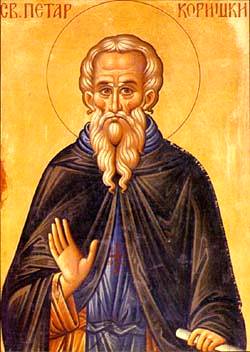
The Monk Peter, a Slav by descent, asceticised from his youthful years at the
Korishsk monastery near Prizren during the time of the holy emperor Saint Dushan
(1337-1351). The holy relics of the monk, situated at the Chernoretsk monastery,
were transferred to the church of the Archangel Michael in the city of Kalashin.
Venerable Bessarion the Wonderworker of Egypt (466)
Commemorated on June 6/June 19
The
Monk Bessarion, Wonderworker of Egypt, by descent an Egyptian,
was baptised while still in his youth
and he led a strict life,
striving to preserve the grace given him during Baptism. Seeking
to become more closely acquainted with the monastic life, he
undertook a journey to the holy places, – he was in Jerusalem,
he visited the Monk Gerasimos (Comm. 4 March) in the Jordanian
wilderness,
he viewed other monastic wilderness-monasteries, and assimilated
all the rules of monastic life. Upon his return, he accepted
monastic tonsure and became a disciple of the Monk Isidor Pelusiotes
(Comm.
4 February). Saint Bessarion took upon himself a vow of silence,
he partook of food only once a week, and sometimes he remained
without food or drink for 40 days. There was an instance when
the monk, immersed in prayer, stood motionless for 40 days and
40 nights
without food or sleep.
The Monk Bessarion received from God the gift of wonderworking:
when on a journey his disciple was strongly beset by thirst,
he sweetened bitter water; by his
prayer the Lord sent rain upon the earth, and he could as though on dry land
cross a river; with but a single word he cast out devils, but he did this
privately to avoid glory. His humility was so great, that when
one time a priest ordered
someone from the skete settlement to leave church for having fallen into
sin, together with him went also the monk with the words: "I too am a sinner".
The Monk Bessarion slept only standing or sitting. A large portion of the
life of the saint was spent under the open sky in prayerful solitude.
He peacefully
expired to the Lord, having reached old age.
Venerable Hilarion the New, abbot of the Dalmatian Monastery (845)
Commemorated on June 6/June 19
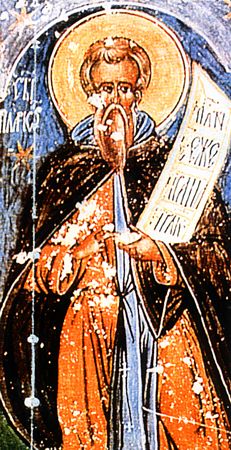
The Monk Ilarion (Hilary) the New was born
of pious parents, Peter and Theodosia, who raised him in the virtues
and instructed
him in Holy Scripture. At twelve years of age Saint Ilarion was
tonsured into monasticism at the Isykhia monastery near Byzantium,
and from there he transferred to the Dalmatia monastery, where
he took on the great schema and became a disciple of the Monk
Gregory Dekapolites (Comm. 20 November). The monk deeply venerated
his
God-bearing patronal-name saint – the Monk Ilarion the
Great (Comm. 21 October), and he strove to imitate his life,
whereby
he came to be called Ilarion the New. At the Dalmatia monastery
they ordained him presbyter. After the death of the hegumen the
brethren wanted to elect Saint Ilarion to this position, but
learning of this, he secretly withdrew away to Byzantium.
Then the monks of Dalmatia monastery sent off a petition to Sainted Patriarch
Nikephoros, asking that the Monk Ilarion be assigned as hegumen. The Patriarch
summoned the saint and persuaded him to give his assent. The Monk Ilarion submitted
out of holy obedience. Over the course of eight years he peacefully guided
the monastery. But in the year 813 the iconoclast Leo the Armenian (813-820)
occupied the imperial throne. The monk refused to blaspheme holy icons and
he boldly accused the emperor of heresy, for which he endured many torments.
They locked him up in prison for awhile, and vexed him with hunger and thirst.
The impious patriarch Theodotos, having replaced the exiled Patriarch Nikephoros,
caused the monk much suffering in demanding a rejection of Orthodoxy. The monks
of the Dalmatia monastery went to the emperor and besought him to release the
saint, promising to submit to the imperial will. But having returned to the
monastery, the Monk Ilarion and all the monks continued to venerate holy icons.
The enraged emperor again locked up the monk in prison. With all the powers
at his disposal to demand a renunciation, he gave the saint over to torture
and confined him in prison.
But the wrath of God overtook the wicked emperor: he was cut down by his
own soldiers in church at that very spot, where once before he had thrown
down
an holy icon. The new emperor Michael II the Stammerer (820-829) set free
the Monk Ilarion from his imprisonment, and the saint settled into a solitary
cell.
Upon the death of the Monk Theodore the Studite (Comm. 11 November) – who
likewise had suffered for holy icons, the Monk Ilarion was vouchsafed to
behold holy Angels lifting up to Heaven the holy soul of Saint Theodore.
Under the iconoclast emperor Theophilos (829-842), the Monk Ilarion was again
put under guard, and beaten terribly, and they confined him on the island of
Athysia.
After the death of Theophilos, the holy empress Saint Theodora (842-855) gave
orders to restore the confessors from exile. The Monk Ilarion returned to the
Dalmatia monastery, again accepting to be hegumen at it, and he peacefully
died in the year 845.
Martyr Theodotus of Ancyra (303)
Commemorated on June 7/June 20
The Holy Martyr Theodotos lived in Galatian Ancyra in the III
Century. He was distinguished by an especial kindliness and concern.
At the height of the persecution under Diocletian (284-305) he
provided Christians all the necessities and gave them shelter in
his home, where secretly they made Divine-services. Saint Theodotos
visited the Christian captives in prison, paid their bail, and
reverently gave burial to the bodies of martyrs thrown for devouring
by wild beasts. One time he dragged out of the water and gave burial
to the bodies of seven holy martyresses, drowned in the sea (Comm.
18 May). They reported about this to the governor. Having refused
to offer sacrifice to idols and having denounced the pagan folly,
Saint Theodotos confessed the true faith in Christ, for which they
subjected him to terrible tortures and beheaded him with the sword
(+ 303). They wanted to burn up the body of the holy martyr, but
a storm having arisen made it futile to attempt this, and they
gave him over to a Christian for burial.
Translation of the relics of Great-martyr Theodore Stratelates
(319)
Commemorated on June 8/June 21
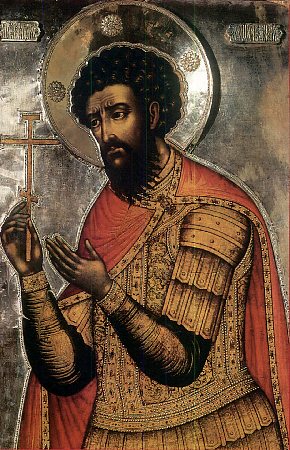
The Holy GreatMartyr Theodore Stratelates suffered for Christ
in Herakleia on 8 February 319. At the time of his sufferings the
holy Greatmartyr Theodore ordered his servant Uaros to bury his
body on the estate of his parents in Eukhaitos. The transfer of
the relics of the Greatmartyr Theodore was done on 8 June 319.
On this day also is remembered a miracle from an image of the Greatmartyr Theodore
in a church of his name, at a place called Karsata, near about Damascus. The
Saracens had turned this church into a residence. One of the Saracens shot
an arrow into the image of the greatmartyr. From the shoulder of the saint,
where the arrow had stuck into the wall, blood flowed forth in front of the
eyes of everyone. A short while later, the Saracens who had settled in the
church, killed each other. Accounts about this miracle are given by the holy
Patriarch Anastasias of Antioch (+ 599, Comm. 20 April) and the Monk John Damascene
(+ c. 780, Comm. 4 December).
St. Cyril, archbishop of Alexandria (444)
Commemorated on June 9/June 22

Sainted Cyril, ArchBishop of Alexandria, a distinguished champion of Orthodoxy
and a great teacher of the Church, came from an illustrious and pious Christian
family. He studied the secular sciences, among which number also was philosophy,
but most of all he strove to acquire knowledge of the Holy Scriptures and
the truths of the Christian faith. In his youth Saint Cyril entered the skete-monastery
of Saint Makarios in the Nitreia hills, where he stayed for six years. The
Patriarch of Alexandria Theophilos (385-412) ordained him to the dignity
of
deacon, numbered him among the clergy and, seeing his giftedness, entrusted
him to preach.
Upon the death of Patriarch Theophilos, Saint Cyril was unanimously chosen
to the patriarchal throne of the Alexandrian Church. He headed the struggle
against the spread in Alexandria of the Novatian heresy, which taught that
a Christian, having fallen away from the Church during time of persecution,
is not able to be received back by it again.
Saint Cyril, seeing the futility of admonishing the heretics, sought their
expulsion from Alexandria. The Jews appeared a greater danger for the Church,
repeatedly making riots, accompanied by the brutal killing of Christians. The
saint long contended with them. And to end with the remaining paganism, the
saint cast out devils from an ancient pagan temple and built on the place a
church. Into it were transferred the relics of the holy Unmercenaries Cyrus
and John. Still more difficult a struggle awaited the saint with the emergence
of the Nestorian heresy.
Nestorius, a presbyter of the Antioch Church, was chosen in 428 to the Constantinople
cathedra and therein got the chance to widely spread about his heretical
teaching, directed against the dogma about the uncommingled union of two
natures in the
Person of the Lord Jesus Christ. Nestorius called the Mother of God not the
Bogoroditsa (Theotokos or "Birth-giver of God"), but rather Khristoroditsa
(Christotokos or "Birth-giver of Christ"), implying that she gave
birth not to God, but only to the man Christ. The holy Patriarch Cyril repeatedly
wrote to Nestorius and pointed out his error, but Nestorius continued to persevere
in it. Then the saint sent out epistles against Nestorianism to the clergy
of the Constantinople Church and to the holy nobleborn emperor Theodosius the
Younger (408-450) – two treatises with a denunciation of the heresy.
Saint Cyril wrote also to other Churches – to Pope Celestine and to
the other Patriarchs, and even to monks of several monasteries, warning about
the
emergence of a dangerous heresy.
Nestorius started an open persecution against the Orthodox. In his presence
one of his partisans, bishop Dorotheos, pronounced from the church cathedra
an anathema for anyone who would call the MostHoly Virgin Mary the Bogoroditsa
(Theotokos).
Nestorius hated Saint Cyril and brought out against him every kind of slander
and fabrication, calling him an heretic. The saint with all his powers continued
to defend Orthodoxy. The situation became so aggravated, that it became necessary
to convene an OEcumenical Council, which opened in the year 431 in the city
of Ephesus. At the Council arrived 200 bishops from all the Christian Churches.
Nestorius, awaiting the arrival of the bishop of Antioch John and other Syrian
bishops, did not agree to the opening of the Council. But the fathers of
the Council began the sessions. The Alexandrian Patriarch Saint Cyril presided.
Having examined the teaching of Nestorius, the Council condemned him as an
heretic. Nestorius did not submit to the Council, and the arriving bishop
John
opened a "robber council", which decreed Saint Cyril an heretic.
The unrest increased. By order of the emperor, Patriarch Cyril of Alexandria
and Archbishop Memnon of Ephesus were locked in prison. And in this measure,
Nestorius also was deposed.
Soon Saints Cyril and Memnon were freed, and the sessions of the Council
continued. Nestorius, not submitting himself to the determinations of the
Council, was
deprived of priestly rank and by order of the emperor sent to the faraway
place Sasim in the Libean wilderness, where he died in grievous torments:
his tongue,
having blasphemed the Mother of God, was overtaken by punishment – in
it there developed worms. Even Bishop John of Antioch and the remaining Syrian
bishops signed the decretals of the Ephesus Council.
Saint Cyril guided the Alexandrian Church for 32 years: towards the end of
his abundant activity the flock was cleansed of heretics. Gently and cautiously
Saint Cyril approached towards anyone, who by their own simpleness and lack
of knowledge fell into false wisdom. To a certain elder, an ascetic of profound
life, – who incorrectly considered the Old Testament Righteous HighPriest
Melchisedek to be the Son of God, – Saint Cyril turned with a request
to pray to the Lord so that He should reveal, correctly how to consider that
righteous one. After three days the elder came to Saint Cyril and said, that
the Lord revealed to him, that Melchisedek was high-priest and a mere man.
Saint Cyril learned to overcome his prejudice against the memory of the great
Sainted-hierarch John Chrysostomos (Zlatoust') (+ 407, Comm. 13 November).
The Patriarch of Alexandria Theophilos, by birth an uncle of the saint, was
an antagonist of Sainted John, and presided in a council in judgement of
him. Saint Cyril from his youthful years found himself thus in a circle antagonistic
to John Chrysostom and involuntarily acquired prejudice against him. The
Monk
Isidoros Pelusiotes (+ c. 436-440, Comm. 4 February) repeatedly wrote to
Saint Cyril and urged him to include the name of the great father of the
Church into
the diptych-list of the saints, but Saint Cyril would not agree. But once
in a dream he saw a wondrous temple, in which was present the Mother of God
surrounded
by an host of Angels and saints, in which number stood also Saint John Chrysostom.
When Saint Cyril wanted to approach the MostHoly Lady and offer to Her veneration,
Saint John Chrysostom would not let him. The Mother of God asked Saint John
to forgive Saint Cyril, for having sinned against him through ignorance.
Seeing that Saint John hesitated, the Mother of God said: "Forgive him for Me,
since he hath laboured much for My honour, and hath glorified Me among the
people calling Me the Mother of God, the Theotokos Bogoroditsa". Saint
John answered: "By Thy intercession, Lady, I do forgive him", – and
then with love he hugged and embraced Saint Cyril.
Saint Cyril repented himself that he had maintained anger against the great
saint of God. Having convened all the Egyptian bishops, he made a solemn festal
celebration in honour of Sainted John Chrysostom.
Saint Cyril died in the year 444, leaving behind many works. In particular
ought to be mentioned: Commentaries – On the Gospel of Luke, On the Gospel
of John, On the Epistles of the Apostle Paul to the Corinthians and to the
Hebrews; also an Apologia in Defence of Christianity against the Emperor Julian
the Apostate (361-363). Of vast significance are: Five Books against Nestorius;
a work About the MostHoly Trinity; – under the title "Thesaurus",
written against Arius and Eunomios; also two dogmatic compositions About the
MostHoly Trinity, – distinguished by a precise exposition of the Orthodox
teaching about the Procession of the Holy Spirit. Saint Cyril wrote a composition – Against
Anthropomorphism, for several Egyptians, who through ignorance depicted God
in human form. Amidst a number of works by Saint Cyril are also the "Discussions",
among which is the moving and edifying "Discourse on the Exodus of the
Soul", inserted in the Slavonic "Following Psalter".
Hieromartyr Timothy, bishop of Prusa (362)
Commemorated on June 10/June 23
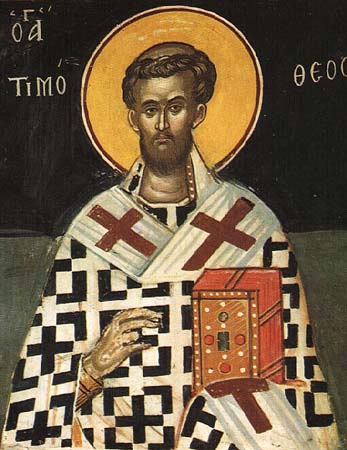
The PriestMartyr Timothy, Bishop of Prussa (Bithynia), received
from the Lord the gift of wonderworking because of his purity and
sanctity of life. At Prussa he converted many pagans to the faith
in Christ. The emperor Julian the Apostate (361-363), upon hearing
about Saint Timothy had him locked up in prison, but even there
also the saint continued to preach the Gospel. Julian forbade him
to anymore teach about the Name of Jesus Christ, but the saint
continued to spread about the Christian faith. Finally, the emperor
gave orders to behead the saint. The holy relics of the saint were
afterwards transferred to Constantinople.
Holy Apostles Bartholomew and Barnabas (1st c.)
Commemorated on June 11/June 24
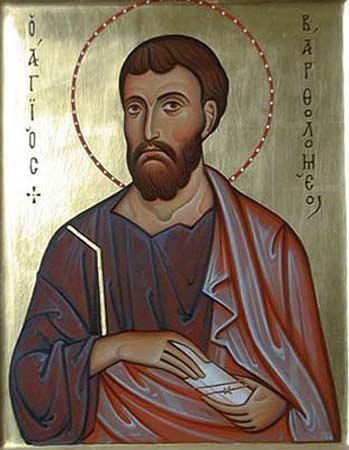
The Holy Apostle Bartholomew was born at Cana of Galilee and
was one of the Twelve Apostles of Christ. After the Descent of
the Holy Spirit on the Day of Pentecost, it fell by lot to the
holy Apostles Bartholomew and Philip (Comm. 14 November) to preach
the Gospel in Syria and Asia Minor. In their preaching they dispersed
through various cities, and then met up together again. Accompanying
the holy Apostle Philip was his sister, the holy virgin Saint Mariam.Traversing
the cities of Syria and Myzia, they underwent much hardship and
tribulations, they were stoned and they were locked up in prison.
In one of the villages they met up with the Apostle John the Theologian,
and together they set off to Phrygia. In the city of Hieropolis
by the power of their prayers they destroyed an enormous viper,
which the pagans worshipped as a god. The holy Apostles Bartholomew
and Philip with his sister proved their preaching with many a miraculous
sign.
At Hieropolis there lived a man by the name of Stakhios, who had been blind
for 40 years. When he received healing, he then believed in Christ and was
baptised. News of this spread throughout the city, and a multitude of the people
thronged to the house where the apostles were staying. The sick and those beset
by demons were released from their infirmities, and many were baptised. The
city governor gave orders to arrest the preachers and throw them in prison,
and to burn down the house of Stakhios. At the trial pagan priests came forth
with the complaint, that the strangers were turning people away from the worship
of the ancestral gods. Thinking that perhaps some sort of magic power was hidden
away in the clothes of the apostles, the governor gave orders to strip them.
But Saint Mariam began to seem like a fiery torch before their eyes, and none
dared touch her. They sentenced the saints to crucifixion. The Apostle Philip
was raised up on the cross upside down. But there then began an earthquake,
and a fissure in the earth swallowed up the governor of the city, together
with the pagan priests and many of the people. Others took fright and rushed
to take down the apostles from the crosses. Since the Apostle Bartholomew had
not been put up high, they managed to take him down quickly. The Apostle Philip
however had died. Making Stakhios the bishop of Hieropolis, the Apostle Bartholomew
and Blessed Mariam left the city and moved on.
Preaching the Word of God, Mariam arrived in Likaoneia, where she peacefully
died (Comm. 17 February). The Apostle Bartholomew set off to India, and there
he translated from Hebrew the Gospel of Matthew, and he converted many pagans
to Christ. He visited likewise Great Armenia (the country between the River
Kura and the upper stretches of the Tigrus and Euphrates Rivers), where he
worked many a miracle and healed the daughter of the emperor Polimios from
the demons afflicting her. The emperor in gratitude sent gifts to the apostle,
who however refused to accept them, saying that he sought only for the salvation
of the souls of mankind. Then Polimios together with the empress, their healed
daughter and many of those close to them accepted Baptism. And people from
the ten cities of Great Armenia followed their example. But through the intrigues
of the pagan priests, the Apostle Bartholomew was seized by the emperor brother
Astiag in the city of Al'ban (now the city of Baku), and crucified upside down.
But even from the cross he did not cease to proclaim the good news about Christ
the Saviour. Finally, on orders from Astiag, they flayed the skin from the
Apostle Bartholomew and cut off his head. Believers placed his remains in a
pewter coffin and buried him.
In about the year 508 the holy relics of the Apostle Bartholomew were transferred
to Mesopotamia, to the city of Dara. When the Persians seized the city in 574,
Christians took the relics of the Apostle Bartholomew with them when they fled
to the shores of the Black Sea. But since the enemy overtook them there, they
were compelled to leave the coffin at the sea. By the power of God the coffin
miraculously arrived on the island of Lipara. In the IX Century, after the
taking of the island by the Arabs, the holy relics were transferred to the
Neapolitan city of Beneventum in Italy, and in the X Century part of the relics
were transferred to Rome.
There is mention about the holy Apostle Bartholomew in the Vita of Joseph
the Melodist (+ 883, Comm. 4 April). Having received from a certain man part
of
the relics of the Apostle Bartholomew, the Monk Joseph conveyed them to his
own monastery near Constantinople, and he built a church in the name of the
Apostle Bartholomew, placing therein part of the relics. The Monk Joseph
ardently desired to compile a laudation in song in honour of the saint, and
he fervently
besought God to grant him the ability to do so. On the feastday in memory
of the Apostle Bartholomew, the Monk Joseph caught sight of him at the altar.
He beckoned to Joseph and took the holy Gospel from the altar-table and pressed
it to his bosom with the words: "Bless thou the Lord, and let thine song
delight the world". And from that time the Monk Joseph began to write
hymns and canons and with them adorn not only the feastday of the Apostle Bartholomew,
but also the feastdays of many other saints, – compiling altogether
about 300 canons. Saints John Chrysostom, Cyril of Alexandria, Epiphanios
of Cyprus
and certain other teachers of the Church regard the Apostle Bartholomew as
being one and the same person as Nathanael (Jn. 1: 45-51, 21: 2).
The
Holy Disciple Barnabas
Commemorated
on June 11/June 24
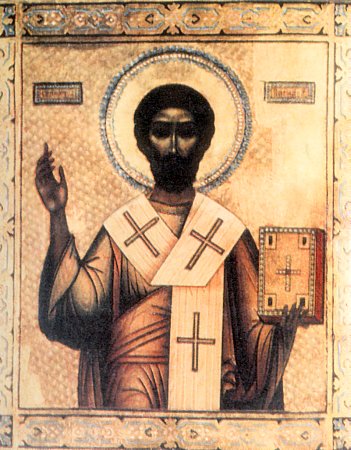
The Holy Disciple Barnabas was born on the island of Cyprus
into the family of rich Hebrews, and he was named Joseph.
He received
his education at Jerusalem, being raised with his friend and
co-student Saul (the future Apostle Paul) under the then reknown
teacher of the law, Gamaliel. Joseph was pious, he frequented
the Temple, he strictly observed the fasts and avoided youthful
distractions. And during this time period our Lord Jesus Christ
began His public ministry. Seeing the Lord and hearing His Divine
Words, Joseph believed on Him as the Messiah, he was ardent with
love for Him and followed Him. The Lord chose him to be among
His Seventy Disciples. And it was amongst the followers of the
Lord that Joseph received a second name – Barnabas, which
in Hebrew means "son of consolation". After the Ascension
of the Lord to Heaven, Barnabas sold land belonging to him near
Jerusalem and he brought the money to the feet of the Apostles,
leaving nothing for himself (Acts 4: 36-37).
When Saul after his conversion arrived in Jerusalem and sought to join with
the followers of Christ, everyone there was afraid of him as having been a
persecutor but a short while before. Barnabas however came with him to the
Apostles and reported, how the Lord had appeared to Saul on the road to Damascus
(Acts 9: 26-28).
As entrusted him by the Apostles, Saint Barnabas went to Antioch to encourage
the believers: "Having come and having seen the grace of God, he rejoiced
and he urged all to cleave to the Lord with sincerity of heart" (Acts
11: 23). Then the Disciple Barnabas went to Tarsis, and thereafter he brought
the Apostle Paul to Antioch, where for about a year they taught the people
in the Church. It was here that the disciples first began to be called Christians
(Acts 11: 26). With the onset of famine, and taking along generous alms, Paul
and Barnabas returned to Jerusalem. When king Herod killed the Apostle James
Zebedaeus, and to please the Jews had the Apostle Peter put under guard in
prison, Saints Barnabas and Paul and Peter were led out of the prison by an
Angel of the Lord, and they hid out at the house of Barnabas' aunt Maria. Later,
when the persecution had quieted down, they returned to Antioch, taking with
them Maria's son John, surnamed Mark. Under the inspiration of the Holy Spirit,
the prophets and teachers there imposed hands upon Barnabas and Paul, and sent
them off on matters to which the Lord had summoned them (Acts 13: 2-3). Arriving
in Seleucia, they sailed off to Cyprus and in the city of Salamis they preached
the Word of God in the Jewish synagogues. On Paphos they came across a sorcerer
and false-prophet named Barjesus, who was close with the proconsul Sergios.
Wanting to hear the Word of God, the proconsul invited the saints to come to
him. The sorcerer attempted to sway the proconsul from the faith, but the Apostle
Paul denounced the sorcerer, who through his words suddenly fell blind. The
proconsul believed in Christ (Acts 13: 6-12). From Paphos Barnabas and Paul
set sail for Pergamum Pamphylia, and then they preached to the Jews and the
Gentiles at Pisidian Antioch and throughout all that region. The Jews made
a riot and expelled Paul and Barnabas. The saints arrived in Iconium, but learning
that the Jews wanted to stone them, they withdrew to Lystra and Derben. There
the Apostle Paul healed a man, crippled in the legs from birth. The people
assumed them to be the gods Zeus and Hermes and wanted to offer them sacrifice.
The saints just barely persuaded them not to do this (Acts 14: 8-18).
When the question arose, whether those converted from the Gentiles should accept
circumcision, Barnabas and Paul set off to Jerusalem. There they were warmly
received by the Apostles and elders. The preachers related, "what God
had wrought with them and how He had opened the door of faith to the Gentiles "Acts
14: 27). After long deliberations the Apostles collectively resolved not to
impose upon Gentile-Christians any sort of burden beyond that necessary – to
refrain from idol-sacrifice and its blood, and from things strangled, and from
fornication, and not to do to others that which they themselves not do (Acts
15: 19-20). Letters were dispatched with Barnabas and Paul, and they again
evangelised at Antioch, and after a certain while they decided to visit the
other cities, where earlier they had preached. The Disciple Barnabas wanted
to take Mark along with him, but the Apostle Paul did not want to, since earlier
he had gone off from them. A quarrel arose, and they separated. Paul took with
him Silas and set off to Syria and Cilicia, and Barnabas took with him Mark – to
Cyprus (Acts 15: 36-41).
Having multiplied the number of believers, the Disciple Barnabas set off to
Rome, where he was perhaps the first to preach Christ.
The Disciple Barnabas founded the episcopal seat at Mediolanum (now Milan in
Italy), and upon his return to Cyprus he continued to preach about Christ the
Saviour. Thereupon the enraged Jews incited the pagans against Saint Barnabas,
and they led him out beyond the city and stoned him, and then built a bon-fire
so as to burn the body. Later on, having come upon this spot, Mark took up
the unharmed body of the Disciple Barnabas and buried it in a cave, placing
upon the bosom of Saint Barnabas, in accord with his final wishes, the Gospel
of Matthew copied out in his own hand.
The Disciple Barnabas died in about the year 62, at age 76. Over the course
of time the place of burial of the Disciple Barnabas was forgotten. But numerous
signs appeared at this place. In the year 448, during the time of the emperor
Zeno, the Disciple Barnabas thrice appeared in a dram-vision to the Cyprus
archbishop Anthymos and indicated the place of burial of his relics. Starting
to dig at the indicated spot, Christians found the incorrupt body of the saint,
and upon his chest was the Holy Gospel. It was from these times that the Cyprus
Church began to be termed Apostolic in origin and received the right of autonomously
choosing its head. And thus the Disciple Barnabas defended Cyprus against the
pretensions of the opponent of the Fourth OEcumenical Council, the heretic
surnamed Knapheios, who had usurped the patriarchal throne at Antioch and sought
to gain dominion over the Cyprus Church.
Venerable Onuphrius the Great (400)
Commemorated on June 12/June 25
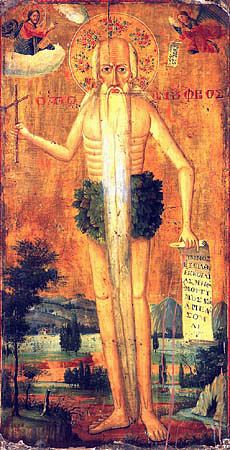
The Vitae/Lives of the Monk Onuphrios the Great and of other
hermits of the IV Century, asceticising in the inner Thebaid
wilderness in Egypt (among them
were the Monk Timothy the Wilderness-Dweller, and the Monks John, Andrew,
Herakleimon (Heraklambonos), Theophilos and others) – was
written down by their contemporary and fellow monk of the Thebaid,
the Monk Paphnutios.
One time the thought occurred to Saint Paphnutios to go off into the depths
of the wilderness, in order to see for himself the fathers asceticising there
and to hear from them, as to how they sought after salvation. He set out from
his monastery and went into the wilderness. Over the span of four days the
monk reached a cave and found in it the body of a long since dead elder. Having
buried the hermit, the Monk Paphnutios went on further. After another four
days he came across yet another cave and from the marks in the sand he realised,
that the cave was inhabited. At sundown he saw an herd of buffalo and walking
amidst them a man. This man was naked, but covered over literally as though
by clothing by long hair. This was the Monk Timothy the Wilderness-Dweller.
Catching sight of a fellow man, the Monk Timothy thought that he was seeing
an apparition, and he began to pray. Saint Paphnutios finally convinced the
hermit, that he was actually a live man and a fellow Christian. The Monk Timothy
readied him a guest-place and related, that he had been already asceticising
in the wilderness for 30 years, and this was the first he had seen of another
man. In his youth, the Monk Timothy had lived in a common-life monastery, but
he was troubled by thoughts of being saved alone. The Monk Timothy left his
monastery and went to live nearby a city, sustaining himself by the work of
his own hands (he was a weaver). One time a woman came to him with an order
and he fell into sin with her. Having come to his senses, the fallen monk went
far off into the wilderness, where with patience he underwent tribulation and
sickness as a merited chastisement from God. And when he was already at the
point of dying from hunger, just then in a miraculous manner he received healing.
From that time the Monk Timothy had lived peacefully in complete solitude,
eating dates from the trees, and quenching his thirst with water from a spring.
The Monk Paphnutios besought the elder that he might remain with him in the
wilderness. But he was told, that he would be unable to bear the demonic temptations
which beset wilderness-dwellers, and instead he blessed him and supplied him
on his way with dates and water.
Having rested up at the wilderness monastery, the Monk Paphnutios undertook
a second journey into the depths of the wilderness. He went on for 17 days.
His supply of bread and water was exhausted, and the Monk Paphnutios twice
collapsed from weakness. An Angel strengthened him. On the 17th day the Monk
Paphnutios reached an hilly place and sat down to rest. Here he caught sight
of a man approaching him, from head to foot covered with white hair and with
a belt of leaves about the loins. The sight of the elder frightened Saint
Paphnutios, and he jumped up and fled off towards the hill. The elder sat
down at the foot
of the hill. And when, lifting his head, he caught sight of the Monk Paphnutios,
he called out to him to come over. This was the great wilderness-dweller – the
Monk Onuphrios. At the request of Saint Paphnutios, he told him about himself.
The Monk Onuphrios had lived in complete isolation in the wilds of the wilderness
for 60 years. In his youth he had been raised at the Erita Thebaid monastery.
Having learned from the elders about the hardships and lofty life of the wilderness-dwellers,
to whom the Lord dispatched help through His Angels, the Monk Onuphrios blazed
up in his spirit to copy their exploits. By night he secretly left the monastery
and saw before himself a ray of light. Saint Onuphrios became frightened and
decided to go back, but the voice of his Guardian Angel urged him on upon his
utmost path. In the depths of the wilderness the Monk Onuphrios came upon a
wilderness dweller and he stayed with him to learn of the wilderness manner
of life and the struggle with demonic temptations. When the elder was convinced,
that Saint Onuphrios was strong enough in this terrible struggle, he then led
him off to this bidden place of exploits and left him alone. Once a year the
elder was wont to come to him, and after several years, having finally come
to the Monk Onuphrios, he then died.
At the request of the Monk Paphnutios, the Monk Onuphrios told about his exploits
and efforts and about how the Lord had cared for him: roundabout the cave where
he lived, there grew a date-palm tree and a spring of pure water issued forth.
Twelve different branches of the palm tree in succession bore fruit, and so
the monk endured neither hunger nor thirst. The shade of the palm tree sheltered
him from the noonday heat. An Angel brought the saint bread and each Saturday
and Sunday communed him, as also with the other wilderness dwellers, with the
Holy Mysteries.
The monks conversed until evening. At evening there appeared amidst the saints
white bread, and they partook of it with water. The elders spent the night
at prayer. After the singing of matins the Monk Paphnutios saw, that the
face of the Monk Onuphrios had become transformed, which frightened him.
Saint Onuphrios
was saying: "God, Merciful to all, hath sent thee to me, so that thou
might give burial to my body. On this present day I shalt finish my earthly
course and pass over to life unending, in rest eternal, going to my Christ".
The Monk Onuphrios bid Saint Paphnutios, that he should tell the account
about him to his brother ascetics and to all Christians, for the sake of
their salvation.
The Monk Paphnutios besought blessing to remain in the wilderness, but Saint
Onuphrios said, that this was not the will of God, and he ordered him to
return to the monastery and relate to everyone about the lives of the Thebaid
Wilderness-Dwellers.
Having then blessed the Monk Paphnutios and made farewell, Saint Onuphrios
prayed long with tears, and then he lay down upon the earth, uttering his
final words: "Into Thine hands, my God, I commend my spirit", – and
he died.
The Monk Paphnutios with weeping tore off a portion of his garb and with it
wrapped the body of the great wilderness dweller, which he placed in the crevice
of a large rock, and in the semblance of a grave, he covered it over with a
multitude of small stones. Then he began to pray, whether it was that the Lord
had decided he should stay til his life's end at the place of the exploits
of the Monk Onuphrios. Suddenly the cave fell in, the palm tree withered, and
the water spring dried up.
Realising that he had not been given the blessing to remain, the Monk Paphnutios
set out on his return journey.
After 4 days the Monk Paphnutios reached a cave, where he met a wilderness
dweller, who was there in the wilderness for more than 60 years. Except for
the two other elders, with whom he asceticised, this wilderness dweller had
seen no one in that time. Each week these three had gone on their solitary
paths into the wilderness, and on Saturday and Sunday they gathered for psalmody.
They ate the bread, which an Angel brought them. And since it was Saturday,
they had gathered together. Having partaken of the bread from the Angel,
they spent the whole night at prayer. In leaving, the Monk Paphnutios asked
the
names of the elders, but they said: "God, Who knoweth all, knoweth also
our names. Remember us, that we be vouchsafed to see one another in God's habitations
on high".
Continuing on his way, the Monk Paphnutios came upon an oasis, which impressed
him with its beauty and abundance of fruit-bearing trees. And then the four
youths inhabiting this place came to him from out of the wilderness. The
youths told the Monk Paphnutios, that in their childhood they had lived in
the city
of Oxyrhynchus (Upper Thebaid) and they had studied together. They had been
ardent with the desire to devote their lives to God. Making their plans to
go off into the wilderness, the youths left the city and after several days
journey they reached this wilderness area. A man radiant with light met them
and led them to a wilderness elder. "We are living here six years already, – said
the youths, – Our elder dwelt here one year and then he died. We live
here at present alone, we eat of the fruit of the trees, and we have water
from a spring". The youths gave him their names: they were Saints John,
Andrew, Heraklambonos (Herakleimon) and Theophilos. The youths asceticised
separately from one another the whole week long, but on Saturday and Sunday
they gathered at the oasis and offered up common prayer. On these days an Angel
would appear and commune them with the Holy Mysteries. This time however, because
of the Monk Paphnutios, they did not go off into the wilderness, but spent
the whole week together at prayer. On the following Saturday and Sunday Saint
Paphnutios together with the youths was granted to commune the Holy Mysteries
from the hands of the Angel and to hear the words of utterance of the Angel: "Receive
ye the Food Imperishable, the Bliss Unending and Life Eternal, the Body and
Blood of the Lord Jesus Christ, our God".
The Monk Paphnutios made bold to ask of the Angel the permission to remain
to the end of his days in the wilderness. The Angel answered, that God had
decreed for him another path – to return to Egypt and to make report
to all Christians about the life of the wilderness dwellers.
Having made his farewell of the youths, the Monk Paphnutios after three days
journey reached the edge of the wilderness. Here he found a small skete monastery,
and the brethren received him fondly. The Monk Paphnutios related everything,
that he had learned about the holy fathers, whom he had encountered in the
depths of the wilderness. The brethren wrote down in detail the account of
the Monk Paphnutios and spread it about through other sketes and monasteries.
The Monk Paphnutios gave thanks to God, Who had granted him to learn about
the lofty lives of the hermits of the Thebaid wilderness, and he returned to
his own monastery.
Venerable Peter of Mt. Athos (734)
Commemorated on June 12/June 25
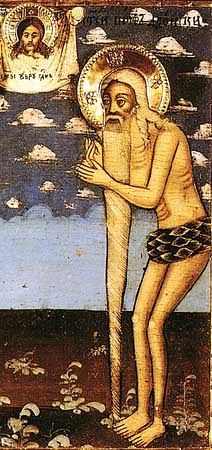
The Monk Peter of Athos, a Greek by birth, served as a soldier
in the imperial armies and he lived at Constantinople. In the year
667 during the time of a war with the Syrians, Saint Peter was
taken captive and locked up in a fortress in the city of Samara
on the River Euphrates.
For a long time he languished in prison and he pondered over what sins of his
had incurred the chastisement of God. Saint Peter remembered, that once upon
a time he had the intention to leave the world and go off to a monastery, but
he had not done so. He began to observe strict fast in the prison and to pray
fervently, and he besought of Saint Nicholas the Wonderworker to intercede
before God for him. Saint Nicholas appeared in a dream to Saint Peter and advised
him to call for help on Saint Simeon the God-Receiver. And encouraging the
prisoner in patience and hope, Saint Nicholas once more appeared to him in
a dream. The third time it was not in a dream that he appeared with Saint Simeon
the God-Receiver. Saint Simeon touched his staff to the chains of Saint Peter,
and the chains melted away, literally like wax. The doors of the prison opened
up, and Saint Peter emerged to freedom. Saint Simeon the God-Receiver became
invisible, but Saint Nicholas conveyed Saint Peter to the borders of the Greek
lands. And reminding him of his vow, Saint Nicholas likewise became invisible.
Saint Peter then journeyed to Rome to assume the monastic form at the tomb
of the Apostle Peter. And even here Saint Nicholas did not leave without his
help: he appeared in a dream to the Pope of Rome and informed him about the
circumstances of Saint Peter's liberation from captivity, and he commanded
the Pope to tonsure the former prisoner into monasticism.
On the following day, amidst a numerous throng of the people during Divine-services,
the Pope loudly exclaimed: "Peter, thou who art come from the Greek lands,
and whom Saint Nicholas hath freed from prison in Samara, come thou forth unto
me". Saint Peter stood forth in front of the Pope, who tonsured him
into monasticism at the tomb of the Apostle Peter. The Pope taught Saint
Peter the
rules of monastic life and kept the monk by him. And then with a blessing
he sent off Saint Peter thither, whence God had blessed him to journey.
Saint Peter boarded a ship, sailing to the East. The ship-owners, during a
time of having come ashore, besought Saint Peter to come and pray at a certain
house, wherein the owner and all the household lay sick. Saint Peter healed
them through his prayer.
The MostHoly Mother of God then appeared in a dream to Saint Peter and indicated
the place, where he should live til the very end of his days – Holy
Mount Athos. When the ship sailed alongside Athos, it then halted of its
own accord.
Saint Peter realised, that this was the place he had to go, and so he went
ashore. This was in the year 681. The Monk Peter then dwelt in the desolate
places of the Holy Mountain, not seeing another person for 53 years. His
clothing had tattered, but his hair and beard had grown out and covered his
body in
place of clothes.
At first the Monk Peter was repeatedly subjected to demonic assaults. Trying
to force the saint to abandon his cave, the devils took on the form at times
of armed soldiers, and at other times of fierce beasts and vipers that seemed
ready to tear apart the hermit. But through fervent prayer to God and the
Mother of God, the Monk Peter conquered the demonic assaults. Then the enemy
began
to resort to trickery. Appearing under the guise of a lad, sent to him from
his native home, he with tears besought the monk to leave the wilderness
and return to his own home. The monk was in tears, but without hesitation
answered: "Hither
have the Lord and the MostHoly Mother of God led me, and without Her leave
I go not from hence". Hearing the Name of the Mother of God, the demon
vanished.
After seven years the devil came before the monk in the guise of a luminous
angel and said, that God was commanding him to go into the world for the enlightening
and salvation of people needful of his guidance. The experienced ascetic again
replied, that without the permission of the Mother of God he would not forsake
the wilderness. The devil disappeared and did not bother more to approach the
saint. The Mother of God appeared to the Monk Peter in a dream together with
Saint Nicholas and said to the brave hermit, that each 40 days an Angel would
bring him Heavenly manna. From that time the Monk Peter fasted for 40 days,
and on the fortieth day he fortified himself with the Heavenly manna, receiving
the strength for further forty-day abstinence.
One time an hunter, chasing after a stag, caught sight of the naked man, covered
about with hair and girded about the loins with leaves. He took fright and
was about to flee. The Monk Peter stopped him and told him about his life.
The hunter asked leave to remain with him, but the saint sent him off home.
The Monk Peter gave the hunter a year for self-examination and forbade him
to tell about the meeting with him.
A year later the hunter returned with his brother, afflicted with a demon,
and together with several other companions. When they entered the cave of
the Monk Peter, they then saw, that he had already reposed to God. The hunter
amidst
bitter sobs told his companions about the life of the Monk Peter, and his
brother, with but a touch to the body of the saint, received healing. The
Monk Peter
died in the year 734. His holy relics were situated on Athos at the monastery
of Saint Clement. During the Iconoclast period the relics were hidden away,
and in the year 969 they were transferred to the Thracian village of Photokami.
With the name of the Monk Peter of Athos is connected the sacred testimonial
of the Mother of God about Her earthly appenage – Holy Mount Athos, which
even now presently remains in force: "To Mount Athos let there be its
peace, for this is allotted Me by My Son and God, given unto Me, wherein let
them be separated from worldly whisperings and gathered together those spiritual
in the power of their exploits, with faith and love in soul calling out My
Name, thereupon to pass their earthly lifetime without travail, and for their
God-pleasing deeds to receive life eternal: for exceedingly do I love this
place and I do wish upon it the increase of monks, and they possessing the
mercy of My Son and God thereupon as monks shalt never be undone, if they observe
the saving commandments: and I shalt spread them forth upon the Mountain to
the south and to the north, and they shalt possess it from the world til the
end of the world, and their name throughout all under the sun I shalt make
praiseworthy and so defend those, which there with patience would asceticise
in fasting".
Martyr Aquilina of Byblos in Lebanon (293)
Commemorated on June 13/June 26
The
Holy Martyress Acelina, a native of the Phoenician city of Byblos,
suffered under the emperor Diocletian
(284-305). Her
parents
raised her in Christian piety. When the girl was but 12 years
of age, she persuaded a pagan friend to convert to Christ. One
of
the servants of the imperial governor Volusian made a denunciation,
that she was teaching her peers not to honour the religion of
their fathers. The girl firmly confessed her faith in Christ
in front
of the governor and said, that she would not renounce Him. Volusian
tried by persuasion and by flattery to sway the young confessor,
but seeing her assuredness, he then gave orders to hand her over
for torture. They struck her upon the face, and then, having
been stripped they whipped her. The torturer mockingly asked: "Where
then is thy God? Let Him come and take thee out of my hands".
The saint answered: "The Lord is invisibly here together with
me, and the more I suffer, all the more shalt He give me strength
and endurance".
With red-hot rods they drilled at the head of the martyress at
the ears. The holy martyress fell down as though dead. The torturer
decided that the girl
had actually died, and he gave orders to throw out her body outside the city
for devouring by dogs. By night an holy Angel appeared to Saint Acelina,
roused her and said: "Arise and be well. Go and denounce Volusian, that he himself
and his intent are thus come to naught before God". The martyress, offering
up praise to God, and having been restored unharmed, went to the court of
the governor and stood before Volusian. Seeing Saint Acelina, Volusian in
fright
called for his servants and ordered them to keep watch over her until morning.
In the morning he delivered a death sentence against Saint Acelina on the
grounds of being a sorceress and not obeying the imperial decrees. When they
led the
saint to execution, she prayed and gave thanks to God, for having granted
her to suffer for His Holy Name. A voice was heard in answer to her prayer,
summoning
her to the Heavenly Kingdom, after which the martyress gave up her spirit
to God (+ 293). The executioner feared to disobey the orders of the governor,
and although already dead, he cut off her head. Christians piously buried
the
body of the martyress. Later on, her relics were taken to Constantinople
and placed within a church named for her.
St. Triphyllius, bishop of Leucosia (Nicosia) in Cyprus (370)
Commemorated on June 13/June 26
Sainted
Triphyllios, Bishop of Leukyssa, was born in Constantinople, and
he received his education at Berit
(Beirut, in Lebanon).
He was very intelligent and eloquent. In spite of this, the saint
chose as his guide a man not bookish nor learned, but of profound
holiness – Sainted Spyridon of Trimiphunteia (+ 348, Comm.
12 December). The emperor Constantine II (337-340) fell grievously
ill and, having received no help from the doctors, he turned with
fervent prayer to God. In a dream he saw an Angel, directing him
to a gathering of saintly hierarchs. Pointing out two of them,
the Angel said that only through them could he receive healing.
Constantine circulated an imperial edict throughout all the districts,
commanding the bishops to gather. Saint Spyridon also received
this order. Together with his disciple Saint Triphyllios, he set
out to the emperor. The sick one immediately recognised them as
the healers pointed out by the Angel. He bowed to them and asked
them to pray for his health. Saint Spyridon with a prayer touched
the head of the emperor, and he became well. Saint Triphyllios
was charmed by the beautiful palace, the majestic figure of the
emperor, and the pomp of palace life. Saint Spyridon said to this: "Why
art thou astonished? Doth then this lustre make the emperor any
more righteous? All of them – emperors and dignitaries – will
alike die and stand together with the very poorest before the judgement-seat
of God. One ought to seek after the eternal blessings and Heavenly
glories".
Soon Saint Triphyllios was made bishop of the city of Leukyssa
on Cyprus. He often visited with Saint Spyridon. One time they
passed together through an
area of vineyards and gardens of especial beauty and abundance, named Parimnos.
Saint Triphyllios, attracted by the beauty of nature, began to consider how
they might explore this land. Saint Spyridon discerned the thoughts of Saint
Triphyllios and said: "Why dost thou incessantly think about earthly and
transitory blessings? Our habitation and riches art in Heaven, to which we
ought to strive". Thus did Saint Spyridon constantly lead his student
towards spiritual perfection, which Saint Triphyllios attained through the
prayers of his preceptor. Saint Triphyllios had a charitable soul, an heart
without malice, right faith and love towards all, and many other virtues.
One time a Council of bishops assembled on Cyprus. The father of the Council
requested that Saint Triphyllios, known for his erudition and eloquence,
give an edifying speech to the people. Speaking about the healing of the
paralytic
by the Lord (Mk. 2 : 11). in place of the word "cot" he used the
word "bed". Impatient with the imprecise rendering of the Gospel
text, Saint Spyridon roused himself and said to Saint Triphyllios: "Art
thou better than He that spake "cot", that thou be ashamed of His
wording?" – and abruptly he left the church. Thus did Saint Spyridon
give Saint Triphyllios a lesson in humility, so that he would not get puffed
up with pride over the talent of eloquence bestown on him. Saint Triphyllios
wisely shepherded his flock. From the means left him by his mother, he built
a monastery at Leukyssa. The saint died in old age in about the year 370.
At the beginning of the XII Century the Russian pilgrim Hegumen Daniel saw
the relics of Saint Triphyllios on Cyprus.
Prophet Elisha (10th c. B.C.)
Commemorated on June 14/June 27
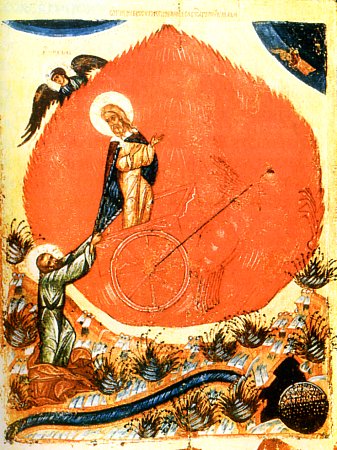
The Holy Prophet Elisha (Elisei) lived in the IX Century before
the Birth of Christ, and was a native of the village of Abelmaum,
near Jordan. By the command of the Lord he was called to prophetic
service by the holy Prophet of God Eliah (Ilias, Elijah) (Comm.
20 July).
When it became time for the holy Prophet Eliah to be taken up
to Heaven, he said to Elisha: "Ask, what shalt I do for thee, before that I be taken
from thee". Elisha boldly asked for a double portion of the grace of God: "The
Spirit, which be in thee, let it be upon me twofold". The Prophet Eliah
said: "Thou dost ask the difficult; if thou seest as I be taken from thee,
then so shalt it be for thee, but if thou seest not, it wilt not be" (4
[2] Kings 2: 12). And when they went along the way and conversed, there appeared
a fiery chariot and horses and parted them both. Elisha cried out: "My
father, my father, the chariot of Israel and its horse!" (4 [2] Kings
2: 12). Picking up the cloak (mantle) of his teacher which fell from the sky,
Elisha received the power and prophetic gift of Eliah. He spent more than 65
years in prophetic service, under six Israelite kings (from Ahab to Joash). "And
in those days he trembled not before the prince, and no one could overcome
him" (Sirach 48: 13 ["Sirach" in the canon of Old Testament
books is found in Catholic but not Protestant English translations of the Bible,
rendered as "Ecclesiasticus"]). The holy prophet worked numerous
miracles. He divided the waters of the Jordan, having smitten it with the mantle
of the Prophet Eliah; he made fit for drinking the waters of a Jericho spring;
by an abundant bringing forth of water by his prayer he saved the armies of
the kings of Israel and Judah that stood in an arid wilderness; he delivered
a poor widow from death by starvation through a miraculous increase of oil
in a vessel. The Shunamite woman showing hospitality to the prophet was gladdened
by the birth of a son through his prayer, and when the child died, he was raised
back to life by the prophet. The Syrian military-commander Namaan was healed
from leprosy but the servant of the prophet, Gehazi, was afflicted since he
disobeyed the prophet and on the sly took money from Namaan. Elisha predicted
to the Israelite king Joash the victory over his enemies and by the power of
his prayer worked many other miracles (4 [2] Kings 3-13). The holy Prophet
Elisha died in old age at Samaria. "And in life he worked miracles, and
at death astounding was his deed" (Sir. 48: 15). A year after his death,
a corpse was thrown into the cave wherein lay his remains, and came alive
by a mere touch to his bones. The Prophet Elisha, just like his teacher the
Prophet
Eliah, left behind them no books, since their prophetic preaching was but
oral. Jesus, son of Sirach, inscribed eulogistic praise to both the great
prophets
(Sir. 48: 1-15).
Saint John Damascene compiled a canon in honour of the Prophet Elisha, and
at Constantinople a church was built in his name.
Julian the Apostate (361-363) gave orders to burn the relics of the Prophet
Elisha, Abdia (Obadiah) and John the Forerunner, but the remains of the holy
relics were preserved by believers, and part of them were transferred to Alexandria.
St. Methodius, patriarch of Constantinople (847)
Commemorated on June 14/June 27
Sainted
Methodios, Patriarch of Constantinople, was born in Sicily into
a rich family. Having a vocation to
God, he went
while still
in his youth off to a monastery on the island of Chios and renovated
it with his means. During the reign of the iconoclast Leo the
Armenian (813-820), Saint Methodios held the high position of "apokrisiaros" ("advocate
for Church matters") under the holy Patriarch Nicephoros (Comm.
2 June). He was dispatched by the patriarch to Rome on a mission
to the papacy and he remained there. During this period Leo the
Armenian removed Nicephoros from the patriarchal throne and put
on it the iconoclast Theodotos of Melissinea, given the nickname "Kassiter" ("Tinman")
(815-822). After the death of Leo the Armenian, Saint Methodios
returned, and in the dignity of presbyter he struggled incessantly
against the Iconoclast heresy. The emperor Michael the Stammerer
(820-829) at first was noted for his benevolence and he set free
many imprisoned by his predecessor for their veneration of icons,
but after a while he renewed the persecution against Orthodoxy.
Saint Methodios was locked up in prison in Akrita. After the
death of Michael the Stammerer, the ruler was Theophilos (829-842),
who
also was an iconoclast. More refined a man than his father, he
set free Saint Methodios, who likewise was a man of learning,
superbly skilled in matters not only ecclesial, but also civil.
Having received
his freedom, Saint Methodios renewed the struggle with the heretics,
and for a while the emperor tolerated this.
But after defeat in a war with the Arabs, Theophilos vented his
anger against Saint Methodios, saying, that God had punished
him because he had let come
close to him an "icon-worshipper" (such was what the iconoclasts
called those who venerate holy icons). Saint Methodios objected, saying that
the Lord was angry with him for the insults upon His holy icons. They gave
the saint over to tortures, and struck him much about the face, from which
his jaw was broken. On his face remained ugly scars. Saint Methodios was
sent off to the island of Antigonos and he was locked up there with two robbers
in a deep cave. In this dark prison where the light of day penetrated not,
Saint Methodios languished for 7 years until the death of the emperor Theophilos.
During this time, the holy Icon-Confessors Theodore and Theophanes the Lettered-Upon
(Comm. 27 December), likewise banished to prison, sent Saint Methodios greetings
in verse, and the prisoner likewise answered with greetings in verse.
After the death of Theophilos, his son Michael III (842-867) began to rule,
but not being of mature age, the Byzantine empire was actually ruled by his
mother, the empress Blessed Theodora, a venerator of icons.
The empress tired to extirpate the Iconoclast heresy, and gave orders to
free the confessors imprisoned for icon veneration. The heretic Annios occupying
the patriarchal throne was banished, and Saint Methodios chosen in his place.
At Constantinople was convened a Local Council with Saint Methodios presiding
(842). The Council restored icon veneration and established an annual celebration
of the triumph of Orthodoxy. The "Rite of Orthodoxy" compiled by
Saint Methodios is done on the First Sunday of the Great Lent.
Attempting to undermine the authority of Saint Methodios, and also the love
and esteem of his flock for him, the heretics slandered him as having transgressed
chastity. The slandering was exposed as such, and the enemies of the saint
put to shame. The final years of the saint passed peacefully, he toiled much,
wisely guided the Church and his flock, renovated temples ruined by the heretics,
gathered up the relics of saints scattered about by the heretics, and transferred
the relics of Patriarch Nicephoros from the place of his imprisonment back
to Constantinople. Saint Methodios died in the year 846. He was spiritually
close to the Monk Ioannikos (Comm. 4 November), who had foretold him his
becoming patriarch and also the time of his end. Besides the "Rite of Orthodoxy",
the holy hierarch also compiled a rule for those converted to the faith,
three rites of marriage and several pastoral sermons and church songs.
Prophet Amos (8th c. B.C.).
Commemorated on June 15/June 28
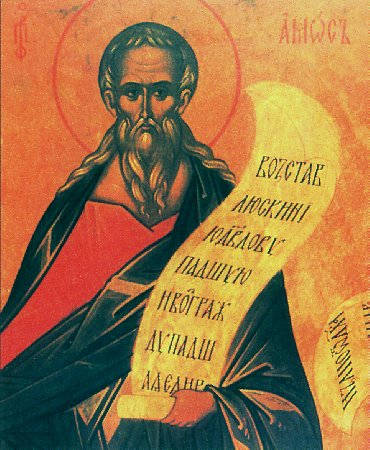
The Holy Prophet Amos, third of the 12 Lesser Prophets, lived
during the VIII Century before the Birth of Christ. At this time
the Hebrew nation was divided into two kingdoms: the Judean and
the Israelite. The Judean king Hosiah ruled in Jerusalem, but the
10 separated Israelite tribes were ruled by Jeroboam II, an idol-worshipper.
At Bethel he set up an idol in the form of a golden calf, which
they worshipped, having rejected the True God of the Israelites.
The Prophet Amos was a Judean, native to the city of Thekui.
Simple and untaught, but strongly fervent of faith and zealous
for the glory of the True God – the
shepherd was chosen by the Lord for prophetic service and sent to the Israelite
kingdom for the purpose of denouncing the impiety of King Jeroboam, and the
Israelites for falling away from God. The prophet predicted for them a great
misfortune, which would befall the Israelite kingdom, and the pagan nations
surrounding it, for their impiety. Because of his denunciations, the Prophet
Amos repeatedly suffered beatings and torture. But he again returned to Bethel,
and threatening inevitable misfortunes, he continued to call the Israelites
to repentance. The pagan-priest Amasiah of the idolatrous temple in particular
hated the prophet. The prophet predicted for him and all his household a
speedy destruction and for this he was subjected to a beating.
The son of Amasiah,
Hosiah, struck the saint on the head with a club and seriously wounded him.
The Prophet Amos, still alive, reached his native village and there he died
in about the year 787 before the Birth of Christ.
Great-martyr Tsar Venerable Lazar of Serbia (1389)
Commemorated on June 15/June 28
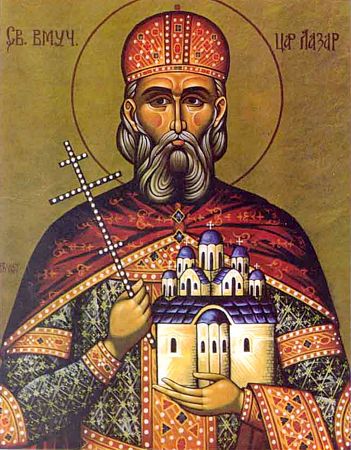
The Holy Nobleborn Prince of Serbia Lazar
(Lazarus) lived during the XIV Century – at a time when the
Turks, having conquered neighbouring lands, prepared an invasion
of
Serbia.
Saint Lazar was raised at the court of the holy king Dushan. He was appointed
governor of one of the Serbian districts. In the year 1371 he was chosen king
of all Serbia and he toiled much at strengthening the condition of the country.
He pacified neighbouring princes, which had wronged or plundered Serbian settlements.
And he was concerned for the Christian enlightenment of the nation, he built
churches, supported the monasteries and charitable establishments. In 1380
the saint established the monastery at Rovanetz. Saint Lazar petitioned the
Constantinople Patriarch for an agreement of recognition of the Archbishop
of Serbia by the Patriarch. During the course of the 10years of his rule, Serbia
was at peace.
Afterwards there began war with the Turks. At the time of the Kossovo Battle
the wounded king was taken prisoner and on orders of Sultan Bayazet was beheaded
with a sword on 15 June 1389. The body of the holy king Lazar was buried at
a nearby church. In 1391 his undecayed relics were transferred to the Rovanetz
monastery. The monastery was destroyed by the Turks in 1683, and the relics
of king Lazar were transferred to the monastery of New Rovanetz on Mount Thruzh.
St. Tychon, bishop of Amathus in Cyprus (425)
Commemorated on June 16/June 29
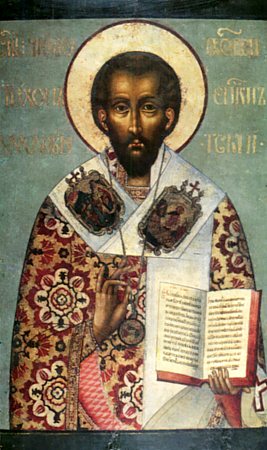
Sainted Tykhon, Bishop of Amaphuntum, was born in the city Amaphuntum
on the island of Cyprus. His parents raised their son in Christian
piety, and taught him the reading of Sacred books. There is an
account extant, that the gift of wonderworking appeared in Saint
Tykhon at a still quite youthful age.
His father was the owner of a bread bakery and he sent his son
to distribute bread. The holy lad gave bread free to the needy.
Learning about this, his
father became angry, but the son answered, that he had read in the holy books,
that "in giving to God one receiveth back an hundredfold". "I
too, – said the youth, – gave to God the bread which was taken" and
he persuaded his father to go to where the grain was stored. With astonishment
the father saw that the granary which formerly was empty, was now filled
to overflowing with wheat. From that time the father did not hinder his son
from
distributing bread to the needy.
A certain gardener brought from the vineyard the dried prunings of vines. Saint
Tykhon gathered them, planted them in his garden and besought the Lord, that
these branches might take root and yield salubrious fruit for the health of
people. The Lord did so through the faith of the holy youth. The branches took
root, and their fruit had a particular and very pleasant taste and was used
during the lifetime of the saint and after his death for the wine in making
the mystery of the Holy Eucharist.
They accepted the pious youth into the church clergy, made him a reader, and
afterwards the bishop of Amaphuntum Memnon ordained him to the dignity of deacon.
After the death of Bishop Memnon, Saint Tykhon by universal agreement was chosen
as bishop of Amaphuntum. The ordination was headed by Sainted Epiphanios, Bishop
of Cyprus (+ 403, Comm. 12 May).
Saint Tykhon laboured zealously for the eradication of the remnants of paganism
on Cyprus – he destroyed an idolatrous temple and spread the Christian
faith. The sainted-bishop was generous, his doors were open to all, and with
love he listened to and fulfilled the request of each person who came to
him. Fearing neither threats nor tortures, he firmly and fearlessly confessed
his
faith before pagans.
In the service to Sainted Tykhon it is pointed out, that he foresaw the time
of his death, which occurred in the year 425.
The name of Sainted Tykhon of Amaphuntum was accorded great honour in Russia.
In honour of the saint, temples were constructed at Moscow, at Nizhni Novgorod,
at Kazan and other cities. But the saint was particularly venerated in Voronezh
diocese, where there were three archpastors in succession sharing the name
with the Sainted-bishop of Amaphuntum: Sainted Tikhon I (Sokolov) (+ 1783,
Comm. 13 August), Tikhon II (Yakubovsky, until 1785) and Tikhon III (Malinin,
until 1788).
Martyrs Manuel, Sabel, and Ismael of Persia (362)
Commemorated on June 17/June 30
The Holy Martyrs Manuel, Sabel and Ismael, brothers by birth,
were descended from an illustrious Persian lineage. Their father
was a pagan, but their mother was a Christian, who baptised the
children and raised them with firm faith in Christ the Saviour.
Having grown into adults, the brothers entered military service.
Speaking on behalf of the Persian emperor Alamundar, they were
his emissaries in the concluding of a peace treaty with the emperor
Julian the Apostate (361-363). Julian received them with due honour
and showed them his favour. But when the brothers refused to take
part in a pagan sacrificial offering, Julian became angry, and
annulling the treaty, he locked up the peace emissaries of a foreign
country in prison, like common criminals. At the interrogation
he told them, that if they scorned the gods worshipped by him,
it would be impossible to reach any peace or accord between the
two sides. The holy brothers answered that they were sent as emissaries
of their emperor on matters of state, and not arguments about gods.
Seeing the firmness of faith of the holy brothers, the emperor
gave orders to subject them to fierce tortures. They suspended
the holy martyrs, having nailed their hands and feet to wood, at
their heads they thrust nails, and under their finger-nails and
toe-nails they wedged sharp needles. During this time of torment
the saints, as though not feeling the tortures, glorified God and
prayed. Finally, they beheaded they holy martyrs. Julian ordered
their bodies to be burned. But suddenly there occurred an earthquake,
and the ground opened up and took the bodies of the holy martyrs
into its bosom. After two days, following upon the fervent prayers
of Christians, the earth returned the bodies of the holy brothers,
from which issued forth a fragrance. Many pagans, having witnessed
the miracle, came to believe in Christ and were baptised. Christian
reverently buried the bodies of the holy Martyrs Manuel, Sabel
and Ismael. This occurred in the year 362. And since that time
the relics of the holy passion-bearers have been glorified with
wonderworking.
Having learned about the murder of his emissaries, and that the law-transgressor
Julian was marching against him with a numerous army, the Persian emperor Alamundar
gathered up his army and started off towards the border of his domain. In a
large battle the Persians vanquished the Greeks. Julian the Apostate was killed
by the holy GreatMartyr Mercurius (Mercury, Comm. 24 November).
Thirty years later the pious emperor Theodosius the Great (+ 397) built at
Constantinople a church in honour of the holy martyrs, and Sainted Germanos,
Patriarch of Constantinople (Comm. 12 May), then still a priestmonk, wrote
a canon in memory and in praise of the holy brothers.