Venerable John, disciple of St. Gregory of Decapolis (820)
Commemorated on April 18/May 1
The Monk John was born at the end of the VIII Century. At a young
age he became a disciple of the Monk Gregory Dekapolites (+ c.
820, Comm. 20 November) and accepted monastic tonsure from him
at the Soluneia (Thessalonika) monastery. Under the guidance of
this experienced teacher, the Monk John attained to high spiritual
accomplishment.
When the emperor Leo the Armenian (813-820) renewed the persecution against
Orthodox Christians because of their veneration of holy icons, the Monk Gregory
Dekapolites together with the Monk Joseph the Writer of Church-Song (+ c. 863,
Comm. 4 April) and his student the Monk John set off from Soluneia to Constantinople,
to muster opposition to the Iconoclast heresy. In spite of persecution, for
several years Saints Gregory and John fearlessly defended Orthodoxy, and preached
veneration of holy icons. After many hardships the Monk Gregory died (in about
the year 820), and soon after him his faithful student John also expired to
the Lord. The Monk Joseph the Song-Writer transferred the relics of Saints
Gregory and John and placed them in a church of Saint Nicholas the Wonderworker.
Venerable John of the Ancient Caves in Palestine (8th c.)
Commemorated on April 19/May2
The Monk John of the Old-Cave is called such because he asceticised during the VIII Century in the Laura of the Monk Chariton (+ 450, Comm. 28 September). This was called the "Old", or ancient one, as among the oldest of Palestinian monasteries. The Laura was situated not far from Bethlehem, near the Dead Sea. Saint John in his early years left the world, went to venerate at the holy places of Jerusalem and settled at the Laura, where he attained high spiritual accomplishment. He was ordained to the dignity of presbyter and glorified by his ascetic life.
Venerable Theodore Trichinas ("the Hair-shirt Wearer"),
hermit near Constantinople (400)
Commemorated on April 20/May 3
The Monk Theodore the Trikhinian was born into a rich Constantinople
family. In his youth he withdrew into a wilderness monastery
in Thrace and accepted monasticism. The monk was strict in fasting,
and he wore only a coarse prickly hairshirt, which was called
a "trikhinia" ("vlasyanitsa").
This name also was given to the monastery in which he pursued
asceticism. During his life the monk worked many miracles and healings.
After
his death there flowed from his holy relics a salubrious myrh,
which healed many of the sick and cast out impure spirits.
The years during which the monk Theodore lived is unknown.
St. Nicholas (Velimirovich), bishop of Ochrid and Zhicha, Serbia
(1956) (Serbia)
Commemorated on April 20/May 3
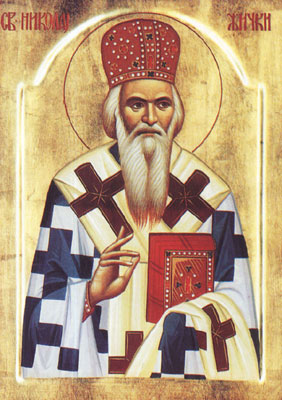
Saint Nicholas of Zhicha, "the Serbian Chrysostom," was
born in Lelich in western Serbia on January 4, 1881 (December
23, 1880). His parents were Dragomir and Katherine Velimirovich,
who
lived on a farm where they raised a large family. His pious mother
was a major influence on his spiritual development, teaching
him by word and especially by example. As a small child, Nicholas
often
walked three miles to the Chelije Monastery with his mother to
attend services there.
Sickly as a child, Nicholas was not physically strong as an adult.
He failed his physical requirements when he applied to the military
academy, but his excellent academic qualifications allowed him
to enter the St Sava Seminary in Belgrade, even before he finished
preparatory school.
After graduating from the seminary in 1905, he earned doctoral
degrees from the University of Berne in 1908, and from King's College,
Oxford in 1909. When he returned home, he fell ill with dysentery.
Vowing to serve God for the rest of his life if he recovered, he
was tonsured at the Rakovica Monastery on December 20, 1909 and
was also ordained to the holy priesthood.
In 1910 he went to study in Russia to prepare himself for a teaching
position at the seminary in Belgrade. At the Theological Academy
in St Petersburg, the Provost asked him why he had come. He replied, "I
wanted to be a shepherd. As a child, I tended my father's sheep.
Now that I am a man, I wish to tend the rational flock of my heavenly
Father. I believe that is the way that has been shown to me." The
Provost smiled, pleased by this response, then showed the young
man to his quarters.
After completing his studies, he returned to Belgrade and taught
philosophy, logic, history, and foreign languages at the seminary.
He spoke seven languages, and this ability proved very useful to
him throughout his life.
St Nicholas was renowned for his sermons, which never lasted more
than twenty minutes, and focused on just three main points. He
taught people the theology of the Church in a language they could
understand, and inspired them to repentance.
At the start of World War I, Archimandrite Nicholas was sent
to England on a diplomatic mission to seek help in the struggle
of
the Serbs against Austria. His doctorate from Oxford gained him
an invitation to speak at Westminster Abbey. He remained in England
for three short months, but St Nicholas left a lasting impression
on those who heard him. His writings "The Lord's Commandments," and "Meditations
on the Lord's Prayer" impressed many in the Church of England.
Archimandrite Nicholas left England and went to America, where
he proved to be a good ambassador for his nation and his Church.
The future saint returned to Serbia in 1919, where he was consecrated
as Bishop of Zhicha and was later transferred to Ochrid. The new
hierarch assisted those who were suffering from the ravages of
war by establishing orphanages and helping the poor.
Bishop Nicholas took over as leader of Bogomljcki Pokret, a popular
movement for spiritual revival which encouraged people to pray
and read the Bible. Under the bishop's direction, it also contributed
to a renewal of monasticism. Monasteries were restored and reopened,
and this in turn revitalized the spiritual life of the Serbian
people.
In 1921, Bishop Nicholas was invited to visit America again and
spent two years as a missionary bishop. He gave more than a hundred
talks in less than six months, raising funds for his orphanages.
Over the next twenty years, he lectured in various churches and
universities.
When Germany invaded Yugoslavia on April 6, 1941, Bishop Nicholas,
a fearless critic of the Nazis, was arrested and confined in Ljubostir
Vojlovici Monastery. In 1944, he and Patriarch Gavrilo were sent
to the death camp at Dachau. There he witnessed many atrocities
and was tortured himself. When American troops liberated the prisoners
in May 1945, the patriarch returned to Yugoslavia, but Bishop Nicholas
went to England.
The Communist leader Tito was just coming to power in Yugoslavia,
where he persecuted the Church and crushed those who opposed him.
Therefore, Bishop Nicholas believed he could serve the Serbian
people more effectively by remaining abroad. He went to America
in 1946, following a hectic schedule in spite of his health problems
which were exacerbated by his time in Dachau. He taught for three
years at St Sava's Seminary in Libertyville, IL before he settled
at St Tikhon's Monastery in South Canaan, PA in 1951.
He taught at St Tikhon's and also served as the seminary's Dean
and Rector. He was also a guest lecturer at St Vladimir's Seminary
in NY, and at Holy Trinity Monastery in Jordanville, NY.
On Saturday March 17, 1956 Bishop Nicholas served his last Liturgy.
After the service he went to the trapeza and gave a short talk.
As he was leaving, he bowed low and said, "Forgive me, brothers." This
was something unusual which he had not done before.
On March 18, 1956 St Nicholas fell asleep in the Lord Whom he had
served throughout his life. He was found in his room kneeling in
an attitude of prayer. Though he was buried at St Sava's Monastery
in Libertyville, IL, he had always expressed a desire to be buried
in his homeland. In April of 1991 his relics were transferred to
the Chetinje Monastery in Lelich. There he was buried next to his
friend and disciple Fr Justin Popovich (+ 1979).
English readers are familiar with St Nicholas's PROLOGUE FROM OCHRID,
THE LIFE OF ST SAVA, A TREASURY OF SERBIAN SPIRITUALITY, and other
writings which are of great benefit for the whole Church. He thought
of his writings as silent sermons addressed to people who would
never hear him preach. In his life and writings, the grace of the
Holy Spirit shone forth for all to see, but in his humility he
considered himself the least of men.
Though he was a native of Serbia, St Nicholas has a universal significance
for Orthodox Christians in all countries. He was like a candle
set upon a candlestick giving light to all (MT 5:15). A spiritual
guide and teacher with a magnetic personality, he attracted many
people to himself. He also loved them, seeing the image of God
in each person he met. He had a special love for children, who
hastened to receive his blessing whenever they saw him in the street.
He was a man of compunctionate prayer, and possessesed the gift
of tears which purify the soul (St John Climacus, LADDER, Step
7). He was a true pastor to his flock protecting them from spiritual
wolves, and guiding them on the path to salvation. He has left
behind many soul-profiting writings which proclaim the truth of
Christ to modern man. In them he exhorts people to love God, and
to live a life of virtue and holiness. May we also be found worthy
of the Kingdom of Heaven through the prayers of St Nicholas, and
by the grace of our Lord Jesus Christ, to Whom be glory forever.
Amen.
Hieromartyr Januarius, bishop of Benevento, and his companions:
Festus, Proclus, and Sosius, deacons; Desiderius, reader; and Eutychius
and Acutius, laymen, at Pozzuoli (305)
Commemorated on April 21/May 4
The PriestMartyr Jannuarius the Bishop, and with him the Holy
Martyrs – Deacons Proculus, Sossius and Faustus, Desiderius
the Reader, Eutychius and Acution accepted a martyr's death for
Christ about the year 305 during the time of the persecution
by the emperor Diocletian (284-305).
They arrested Saint Jannuarius and led him to trial to Timothy, the governor
of Campagna (central Italy). For his firm confession of Christian faith, they
threw the saint into a red-hot furnace. But like the Babylonian youths, he
came out from there unharmed. Then by order of Timothy they stretched him out
on a bench and beat at him with iron rods so much, that they lay bare the bone.
Among the gathered crowd were the holy deacon Faustus and the reader Desiderius,
who wept at the sight of the suffering of their bishop. The pagans surmised
that they were Christians, and threw them together into prison with the Priestmartyr
Jannuarius, in the city of Puteolum. At this prison were situated two deacons
locked up earlier for confessing Christ – Saints Sossius and Proculus,
and two laymen – Saints Eutychius and Acution.
On the following morning they led out all the martyrs into the circus to be
torn to pieces by wild beasts, but the beasts would not touch them. Timothy
declared, that all the miracle occurred from sorcery by the Christians, but
with this however he became blinded and cried out for help. The gentle Priestmartyr
Jannuarius made prayer for his healing, and Timothy recovered his sight. The
blindness of soul however did not depart the torturer and he, with a still
greater rage accusing the Christians of sorcery, gave orders to cut off the
heads of the martyrs at the walls of the city (+ 305).
Christians from surrounding cities took up the bodies of the holy martyrs for
burial, and those of each city took along one, so as to have an intercessor
before God. The inhabitants of Neopolis (Naples) took for themselves the body
of the Priestmartyr Jannuarius. Together with the body they gathered up from
the earth his dried blood. When they set the vessel with this blood upon the
relics of the holy martyr, having been put on the church of the city of Neopolis,
the blood liquified and became warm, as though only just shed. Many miracles
proceeded from the relics of the Priestmartyr Jannuarius. During the time of
the eruption of Vesuvius, when the inhabitants of the city prayed to the Priestmartyr
Jannuarius, the lava stopped, not reaching the city. A pious woman placed an
icon with the image of the priestmartyr to her dead son, and he arose.
Venerable Theodore the Sykeote, bishop of Anastasiopolis (613)
Commemorated on April 22/May 5
The Monk Theodore Sikeotes was born in the mid VI Century in
the village of Sikea, not far from the city of Anastasiupolis (Asia
Minor), in a pious family. When his mother Maria conceived the
saint, she had in a dream a vision, that a bright star had overshadowed
her womb. A perspicacious elder, to whom she turned, then explained
that this was the grace of God overshadowing the infant conceived
in her.
When the boy reached six years of age, his mother presented him a golden sash,
since she intended that her son should become a soldier. But in a dream vision
by night there appeared to her the GreatMartyr George (Comm. 23 April), and
he bid her not think about military service for her son, since the boy was
destined to serve God. The saint's father, Kosma, had served as a messenger
of the emperor Justinian the Great (527-565), and he died early. The boy remained
in the care of his mother, with whom lived also his grandmother Epidia, his
aunt Dispenia and his little sister Vlatta.
In school, Saint Theodore displayed great talents for his study, chief of which
was an unchildlike ability for reasoning and wisdom: he was quiet, mild, he
always knew how to calm his comrades, and he did not permit fights or quarrels
amongst them. At his mother's house lived also the pious elder, Stephen. Imitating
him, Saint Theodore at age 8 began during Great Lent to eat only a small morsel
of bread in the evenings. In order that his mother should not force him to
take supper with everyone, the boy returned home from school only towards evening-time,
after he had communed the Holy Mysteries together with the elder Stephen. At
the request of his mother, the teacher began to send him off to supper at the
end of lessons. But Saint Theodore nonetheless skipped off to the church of
the GreatMartyr George, where the patron saint of the temple appeared to him
in the form of a youth and ushered him into the church.
When Saint Theodore reached age 10, he fell deathly ill. They brought him to
the church of Saint John the Baptist and placed him in front of the altar.
The boy was healed by two drops of dew, fallen from the face of the Saviour
on the dome of the temple. At this time by night the GreatMartyr George began
appearing to the boy, and also leading him off to his own temple to pray until
morning. His mother, fearing the night-time dangers of the forest path, spoke
with her son about not going at night. One time, when the boy had already gone,
she angrily went after him to the church, and she dragged him out by the hair
and tied him to his bed. But that very night in a dream vision the GreatMartyr
George appeared to her, and threateningly she commanded her not to hinder the
lad from going to church. And both Elpidia and Dispenia had the same vision.
The women then became persuaded of the special vocation of Saint Theodore and
they no more hindered him from his efforts, and even his little sister Vlatta
began to imitate him.
At twelve years of age the saint was granted in a vivid dream to behold Christ
on the Throne of the Kingdom of Glory, and Who said to him: "Asceticise,
Theodore, so as to obtain perfected reward in the Heavenly Kingdom".
From that time Saint Theodore began to toil all the more fervently. Both the
First Week and the Cross-Veneration Week of Great Lent he spent in complete
silence.
The devil thought upon how to destroy him. He appeared to the saintly lad in
the form of his class-mate Gerontios, and urged him to jump off a precipice,
and even showed him in what manner how to. But his protector the GreatMartyr
George saved the boy.
One time the boy set off for a blessing to the wilderness elder Glykerios.
During this time there was a terrible drought throughout all the land, and
the elder said: "Child, on bended knee let us pray to the Lord, that He
send rain. And in such manner shalt we learn, whether our prayers be pleasing
to the Lord". The old man and the boy, on bended knee, began to pray – and
immediately it began to rain. Then the elder said to Saint Theodore, that
upon him was the grace of God, and he blessed him to become a monk, when
the time
should come.
At fourteen years of age Saint Theodore left home and lived nearby the church
of the GreatMartyr George. His mother brought him food, but Saint Theodore
left everything on the stones by the church, and he ate over the course of
a day only a single prosphora loaf of bread. And even at so young an age, the
Monk Theodore was granted the gift of healing: through his prayer a demon-possessed
youth was restored to health.
The Monk Theodore then fled human glory and he withdrew into complete solitude.
Under a large boulder not far from the church of the GreatMartyr George, he
dug out a cave and persuaded a certain deacon to cover over the entrance with
ground, leaving only a small opening for air. The deacon brought him bread
and water and he told no one, where the monk had hidden himself.
For two years the Monk Theodore lived in this seclusion and complete quiet.
His kinsfolk bewept the saint and they thought, that he had been devoured by
wild beasts.
But the deacon finally revealed the secret, since he was afraid that the Monk
Theodore would perish in the narrow cave, and moreover he pitied the weeping
mother. They plucked the Monk Theodore out of the cave half-alive.
The mother wanted to take her son home and restore him back to health, but
the saint remained nearby the church of the GreatMartyr George, and after several
days he was completely well.
News about the exploits of the youth reached the local bishop Theodosios.
And thus in the church of the GreatMartyr George he was ordained to the dignity
of deacon, and later – to priest, although the monk was only 17 years
of age.
After a certain while the Monk Theodore set off for veneration to the holy
places in Jerusalem, and there at the Khozebite Laura near Jordan, he accepted
monasticism.
When he returned to his native land, he again continued to live nearby the
church of the GreatMartyr George. His grandmother Elpidia, his sister Vlatta
and his mother on the advice of the monk withdrew to a monastery, and his aunt
died in a good confession.
The ascetic life of the young priestmonk attracted to him people seeking salvation.
The monk tonsured into monasticism the youth Epiphanios, and later on a pious
woman, healed of sickness by the saint, brought him her son Philumenos. Then
came also the virtuous youth John. Brethren thus gradually gathered around
the monk.
The Monk Theodore continued to bear his burdensome exploits. At his request
a blacksmith made for him an iron cage without a roof, and so tight that in
it, it was possible only to stand. In this cage in heavy chains the monk stood
from Holy Pascha until the Nativity of Christ. From the Baptism of the Lord
until Holy Pascha he secluded himself in his cave, from which he emerged only
for the making of Divine-services on Saturdays and Sundays. Throughout the
whole of the Forty-Day Great Lent the saint ate only greens, and on Saturdays
and Sundays spring-grain bread.
Asceticising in such manner, he received from the Lord the power over wild
animals. Bears and wolves came up to him and took food from his hand. Through
the prayer of the monk, those afflicted with leprosy were healed, and from
whole districts devils were cast out. In the nearby village of Magatia, when
locusts threatening the crops appeared, its people turned with a request for
help to the Monk Theodore. He sent them off to church. After Divine Liturgy,
which he served, the villagers returned home and learned that during this while
all the locusts had died.
When the military-commander Maurice was returning to Constantinople by way
of Galatia after a Persian war, the monk predicted to him, that he would
become emperor. The prediction came true, and the emperor Maurice (582-602)
fulfilled
the request of the monk – he sent the monastery bread each year for
the multitude of people being fed there.
The small temple of the GreatMartyr George could not accommodate all those
that wanted to pray in it. Then through the efforts of the saint a beautiful
new church was built. During this while the Anastasiupolis bishop happened
to die. The people of the city besought the Ancyra metropolitan Paul to install
the Monk Theodore as their bishop.
So that the saint should not resist, the messengers of the metropolitan and
the Anastasiupolis people dragged him out of his cell by force and carried
him off to the city.
Having become bishop, Saint Theodore toiled much for the welfare of the Church.
But his soul yearned for the solitary communion with God. After several years
he set off to venerate at the holy places in Jerusalem. And there, concealing
his identity, he settled at the Laura monastery of the Monk Sava, where he
lived in solitude from the Nativity of Christ until Pascha. Then the GreatMartyr
George led him to return to Anastasiupolis.
Secret enemies tried to poison the saint, but the Mother of God gave him three
small pieces of grain. The saint them and remained unharmed. Saint Theodore
felt weighed down with the burden of being a bishop and he besought the Constantinople
patriarch Kyriakos (595-606) for a release to return to his own monastery and
celebrate Divine-services there.
The sanctity of the monk was so evident, that during the time of his celebrating
the Eucharist, the grace of the Holy Spirit, in a visage of radiant porphyry,
overshadowed the Holy Gifts. One time, when the monk lifted the discus with
the Divine Lamb and proclaimed "Holy Things unto the Holy", – the
Divine Lamb raised itself up into the air, and then resettled itself again
upon the discus.
All the Orthodox Church venerated the Monk Theodore as a saint, even while
he was yet alive.
In one of the cities of Galatia, a terrible event occurred: during the time
of a church procession the wooden crosses being carried began of themselves
to strike and chip at one another, with the result that the Constantinople
Patriarch Thomas (607-610, Comm. 21 March) summoned to him the Monk Theodore,
asking of him the secret of this terrible portent. Having the gift of foresight,
the Monk Theodore explained, that this was a sign of coming misfortunes for
the Church of God (he was thus prophetically indicating the future heresy of
the Iconoclasts). In grief the holy Patriarch Thomas besought the monk to pray
for him for a quick death, so that he should not see the coming woe.
In the year 610 the holy Patriarch Thomas reposed, having besought blessing
of the Monk Theodore. And in the year 613 the Monk Theodore Sikeotes also expired
to the Lord.
Hieromartyr Platon of Banja Luka (1941)
Commemorated on April 22/May 5
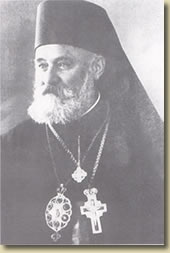
Bishop Platon (baptismal name Milivoje), the son of Ilija and
Jelka (maiden name Sokolovic) was born in Belgrade, on September
29, 1874. He attended Grammar school in Vranje and Nis, and then
continued his education in the Seminary in Belgrade. Milivoje took
monastic vows as the third-grade pupil of the Belgrade Seminary.
Having completed the Seminary he was ordained deacon and afterwards
presbyter, and then, in 1896, he was sent in the Serbian mission
in Moscow, where he continued his theological education at the
Spiritual Academy, which he completed in 1901.
Having returned from Russia, he was appointed the head of the Rakovica
Monastery, and soon afterwards the assistant professor in Belgrade.
He worked as professor in Aleksinac and Jagodina, and during that
period he obtained the ranks of syncellos, protosyncellos and archimandrite.
In 1912, during the war, Archimandrite Platon was a brigade priest,
and in World War I he was a military priest. For a short period
of time Platon was an Administrator of the Ochrid Diocese. He
spent the period of occupation in Serbia, and with the help of
his acquaintances
abroad, he managed to render aid to all the people who suffered
afflictions - especially orphans and widows. From 1932 to 1938
he was the manager of the Monastery printing office in Sremski
Karlovci, as well as the editor of "The Gazette of the Serbian
Patriarchate". Apart from his regular duties in Sremski Karlovci,
Archimandrite Platon was also the head of the Krusedol Monastery
(1934-1936). He was elected Moravian Bishop in 1936. Patriarch
Varnava ordained him in Sremski Karlovci that same year. In 1938
he was elected the Bishop of Ochrid-Bitolj, and a year later he
was transferred to Banja Luka. Platon was the Bishop of Banja Luka
when World War II started. When he was told (on April 10, 1941)
that he had to leave the Independent State of Croatia, since he
was a Serb born in Serbia, he replied: "The authorities appointed
me the Bishop of Banja Luka lawfully, according to canon law; having
such a position I took the obligation before God, Church and people,
thereat inseparably binding my life and my destiny with the life
and destiny of my spiritual flock, to take care of my spiritual
flock permanently and firmly, regardless of any events, and to
stay on its spiritual path all the time of my life given to me
by God, persevering in my staying with the flock as a good shepherd
who gives his soul for his sheep…"
When Bishop Platon was ordered to leave Banja Luka, on May 4, 1941,
under threat of arrest if he did not do that, he asked a Roman
Catholic Bishop Joza Garic to intervene with the authorised military
officer and let him stay for two or three days more so that he
could prepare for the departure. This Bishop told him to be calm
and peaceful. However, the Ustase arrested Bishop Platon the very
next night (May 5, 1941) and took him, together with priest Dusan
Subotic - hierarchal administrator from Bosanska Gradiska, somewhere
out of Banja Luka. The two of them were killed there and their
corpses were cast into the Vrbanja River. Ustasa Asim Celic committed
this repulsive deed. Bishop's corpse, which was scarred and disfigured,
was found in the village of Kumsale, on May 23, 1941. He had first
been buried in a military graveyard in Banja Luka, and in 1973
his remains were transported to the Banja Luka Cathedral.
At the regular session of the Holy Assembly of Bishops of the Serbian
Orthodox Church in 1998, Banja Luka Bishop Platon was canonized
and entered into the List of Names of the Saint people of the Serbian
Orthodox Church.
Holy Glorious Great-martyr, Victory-bearer and Wonderworker George
(303)
Commemorated on April 23/May 6
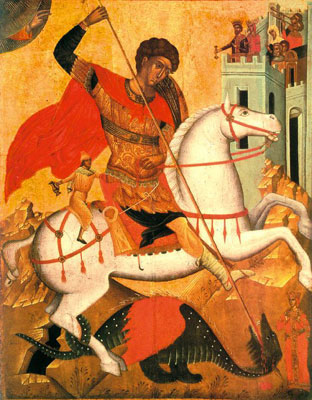
The Holy GreatMartyr George the Victory-Bearer, was a native
of Cappadocia (a district in Asia Minor), and he grew up in a deeply
believing Christian family. His father had accepted a martyr's
death for Christ, when George was yet a child. His mother, owning
lands in Palestine, resettled there with her son and raised him
in strict piety.
Having grown up, Saint George entered into the service of the
Roman army. He was handsome, brave and valiant in battle, and
he came to the notice of the
emperor Diocletian (284-305) and was accepted into the imperial guards with
the rank-title of "comites" – one of the higher military
officer ranks.
The pagan emperor, while having done much for the restoration of Roman might,
and who was quite clearly concerned, as to what sort of danger the triumphing
of the Crucified Saviour might present for pagan civilisation, in especially
the final years of his reign intensified his persecution against the Christians.
Upon the advice of the Senate at Nicomedia, Diocletian afforded all his governors
full freedom in their court proceedings over Christians and in this he promised
them all possible help.
Saint George, having learned about the decision of the emperor, distributed
to the poor all his wealth, set free his servants, and then appeared in the
Senate. The brave soldier of Christ spoke out openly against the emperor's
designs, he confessed himself a Christian and appealed to all to acknowledge
the true faith in Christ: "I am a servant of Christ, my God, and trusting
on Him, I have come amidst ye at mine own will, to witness concerning the Truth". "What
is Truth?" – one of the dignitaries said, in repeating the question
of Pontius Pilate. "Truth is Christ Himself, persecuted by ye", – answered
the saint.
Stunned by the bold speech of the valiant warrior, the emperor – who
loved and had promoted George, attempted to persuade him not to throw away
his youth and glory and honours, but rather in the Roman custom to offer sacrifice
to the gods. To this followed the resolute reply of the confessor: "Nothing
in this inconstant life can weaken my resolve to serve God". Then by
order of the enraged emperor the armed-guards began to jostle Saint George
out of
the assembly hall with their spears, and they then led him off to prison.
But the deadly steel became soft and it bent, just as the spears would touch
the
body of the saint, and it caused him no hurt. In prison they put the feet
of the martyr in stocks and placed an heavy stone on his chest.
The next day at the interrogation, powerless but firm of spirit, Saint George
again answered the emperor: "Thou wilt become exhausted sooner, tormenting
me, than I being tormented of thee". Then Diocletian gave orders to subject
Saint George to some very intense tortures. They tied the GreatMartyr to a
wheel, beneathe which were set up boards inset with sharp pieces of iron. With
the turning of the wheel the sharp edges tore at the bared body of the saint.
At first the sufferer loudly cried out to the Lord, but soon he quieted, not
letting out even a single groan. Diocletian decided that the tortured one was
already dead, and he gave orders to remove the battered body from the wheel,
and set off then to a pagan temple to offer a thank-offering. But at this very
moment it got dark all over, thunder boomed, and a voice was heard: "Fear
not, George, for I am with thee". Then a wondrous light shone, and at
the wheel appeared an Angel of the Lord in the form of a radiant youth. And
just as he lay his hand upon the martyr, saying to him: "Rejoice!" --
Saint George stood up healed. And when the soldiers led him off to the pagan
temple, where the emperor was, the emperor could not believe his own eyes and
he thought, that in front of him was some other man or even a ghost. In confusion
and in terror the pagans looked Saint George over carefully, and they became
convinced, that actually a miracle had occurred. Many thereupon came to believe
in the Life-Creating God of the Christians. Two illustrious officials, Saints
Anatolios and Protoleon, – secretly Christians, therewith openly confessed
Christ. And right away, without a trial, by order of the emperor they were
beheaded with the sword. Present also in the pagan temple was the Empress
Alexandra, the wife of Diocletian, and she too knew the truth. She was on
the point of
glorifying Christ, but one of the servants of the emperor took her and led
her off to the palace.
The emperor became all the more furious. But not having lost all hope of swaying
Saint George, he gave him over to new quite fiercesome torments. Having thrown
him down a deep pit, they covered it over with lime. Three days later they
dug him out, but found him cheerful and unharmed. They shod the saint in iron
sandals with red-hot nails, and with blows they drove him back to the prison.
In the morning, when they led him back to the interrogation, cheerful and with
healthy feet, he said to the emperor, that the sandals had fit him. Then they
beat him with ox-thongs so much, that his body and blood became mingled with
the ground, but the brave sufferer, strengthened by the power of God, remained
unyielding.
Having decided, that magic was helping the saint, the emperor summoned the
sorcerer Athanasias, so that he should try to deprive the saint of his miraculous
powers, or else poison him. The sorcerer gave Saint George two goblets with
drugged ingredients, the one of which should have quieted him, and the other – to
kill him. But the drugs also did not work – and the saint as before
continued to denounce the pagan superstitions and glorify the True God.
To the question of the emperor, what sort of power it was that helped the
saint, Saint George answered: "Think not, that the torments do me no harm thanks
to human powers, – I am saved only by calling upon Christ and His Power.
Whoso believeth on Him hath no regard for tortures and is able to do the deeds,
that Christ did" (Jn. 14: 12). Diocletian asked, what sort of deeds were
they that Christ did. – "To give sight to the blind, to cleanse
the leprous, to grant walking to the lame, and to the deaf – hearing,
to cast out devils, and to raise up the dead".
Knowing, that never whether by sorcery, nor by any of the gods known to him,
never had they been able to resurrect the dead, and wanting to test the trust
of the saint the emperor commanded him to raise up a dead person right in
front of his eyes. To this the saint replied: "Thou wouldst tempt me, but for
the salvation of the people which shalt see the deed of Christ, my God wilt
work this sign". And when they led Saint George down to the graveyard,
he cried out: "O Lord! Show to those here present, that Thou art the One-Only
God throughout all the world, let them know Thee as the Almighty Lord".
And the earth did quake, a grave opened up, the dead one came alive and emerged
from it. Having seen with their own eyes the Almighty Power of Christ, the
people wept and glorified the True God. The sorcerer Athanasias, falling
down at the feet of Saint George, confessed Christ as the All-Powerful God
and besought
forgiveness of his sins, committed in ignorance. The obdurate emperor in
his impiety thought otherwise: in a rage he commanded to be beheaded both
the new-believer
Athanasias and likewise the man resuscitated from the dead, and he had Saint
George again locked up in prison. The people, weighed down with their infirmities,
began in various ways to penetrate the prison and they there received healings
and help from the saint. There resorted to him also a certain farmer named
Glycerios, whose ox had collapsed. The saint with a smile consoled him and
assured him, that God would restore his ox to life. Seeing at home the ox
alive, the farmer began to glorify the God of the Christians throughout all
the city.
By order of the emperor, Saint Glycerios was arrested and beheaded.
The exploits and the miracles of the GreatMartyr George had increased the
number of the Christians, and therefore Diocletian decided to make a final
attempt
to compel the saint to offer sacrifice to the idols. They began to set up
a court at the pagan temple of Apollo. On the final night the holy martyr
prayed
fervently, and when he dozed off, he beheld the Lord Himself, Who raised
him up with His hand, and hugged him in giving him a kiss of greeting. The
Saviour
placed on the head of the GreatMartyr a crown and said: "Fear not, but
rather make bold and be vouchsafed My Kingdom".
In the morning at the court the emperor offered Saint George a new test – he
proposed to him to become his co-emperor. The holy martyr with a feigned willingness
answered, that from the very beginning the emperor had seemed inclined not
to torture him but rather shew mete mercy, and with this he expressed the wish
to go forthwith into the pagan temple of Apollo. Diocletian decided, that the
martyr was accepting his offer, and he followed after him into the pagan temple
with his accompanying retinue and the people. Everyone waited, whether Saint
George would offer sacrifice to the gods. He however, in going up to the idol,
made the sign of the Cross and turned towards it, as though it were alive: "Thou
wishest to receive from me sacrifice befitting God?" The demon inhabiting
the idol cried out: "I am not God and none of those like me are God. The
One-Only God is He Whom thou preachest. We are of those servant-angels of His,
which became apostate, and in the grips of jealousy we do tempt people". "How
dare ye to be here, when hither have come I, the servant of the True God?" – asked
the saint. Then was heard a crash and wailing, and the idols fell down and
were shattered.
There began a general confusion. In a frenzy pagan-priests and many of the
throng pounced upon the holy martyr, they tied him up and began to beat him
and demand his immediate execution.
Into the noise and the shouts rushed the holy empress Alexandra. Pushing
her way through the crowd, she cried out: "Thou God of George, help me, in
as Thou Alone art All-Powerful". At the feet of the GreatMartyr the
holy empress glorified Christ, Who had humiliated the idols and those worshipping
them.
Diocletian in a rage immediately pronounced the death sentence against the
GreatMartyr George and the holy Empress Alexandra, who without being accompanied,
followed Saint George to execution. Along the way she collapsed and slumped
senseless against a wall. Everyone thought, that the empress was dead. Saint
George offered up thanks to God and he prayed, that he should end his path
worthily. At the place of execution the saint in heated prayer besought the
Lord, that He would forgive the torturers that knew not what they did, and
that He would lead them to the knowledge of Truth. Calmly and bravely, the
holy GreatMartyr George bent his neck beneathe the sword. This occurred on
23 April 303.
In confusion the executioners and the judges catch glimpse of their Conqueror.
In a bloody agony and mindless thrashing about ended the era of paganism.
It lasted for all of ten years more – up until the time of the holy Equal-to-the-Apostles
Constantine, who was one of the successors to Diocletian upon the Roman throne,
and who gave orders to imprint the Cross on his military-banners, as a testament
also sealed by the blood of the GreatMartyr George and that of the blood of
thousands of unknown martyrs: "By this sign thou wilt conquer".
Of the many miracles, worked by the holy GreatMartyr George, the most famous
are depicted in iconography. In the native-region of the saint, at the city
of Beirut, were many idol-worshippers. Outside the city, near Mount Lebanon,
was situated a large lake, in which lived an enormous dragon-like serpent.
Coming out of the lake, it devoured people, and there was nothing the people
could do, since from one of its nostrils it infected the very air.
On the advice of the demons inhabiting the idols, the ruler there adopted
this decision: each day the people would draw lots to give over as food their
own
children, and when the turn reached him, he promised to hand over his only
daughter. That time indeed did come, and the ruler, having dressed her in
her finest attire, sent her off to the lake. The girl wailed bitterly, awaiting
the moment of death. Unexpectedly for her, the GreatMartyr George rode up
on
his horse and with spear in hand. The girl implored him not to leave her,
lest she perish. But the saint, having caught sight of the serpent, signed
himself
with the Sign of the Cross and with the words "In the Name of the Father
and of the Son and of the Holy Spirit", he rushed off after it. The GreatMartyr
George pierced the throat of the serpent with his spear and trampled it with
his horse. Then he bid the girl bind the serpent with her sash, and like a
dog, lead it into the city. The people fled in terror, but the saint halted
them with the words: "Be not afraid, but rather trust on the Lord Jesus
Christ and believe in Him, since it be He Who hath sent me to you, to save
you". Then the saint killed the serpent with a sword, and the people
burned it outside the city. Twenty-five thousand men, not counting women
and children,
were then baptised, and there was later built a church in the name of the
MostHoly Mother of God and the GreatMartyr George.
Saint George went on to become a talented military officer and to amaze the
world by his military exploits. He died, when he was not even 30 years old.
Hastening to unite with the Heavenly army, he entered into the history of
the Church as the Victory-Bearer ("Pobedonosets").
Martyr Sabbas Stratelates ("the General")
of Rome, and 70 soldiers with him (272)
Commemorated on April 24/May 7
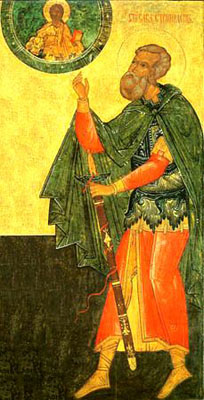
The Martyr Sava came from a Gothic tribe. For his bravery he
attained the high rank of military-commander or "stratilates",
and he served under the Roman emperor Aurelian (270-275).
From the time of his youth Sava was a Christian and he fervently
followed the commands of Christ, – he helped the needy
and visited Christians locked up in prison. For his pure and
virtuous life the saint received from the Lord
the gift of wonderworking and in the Name of Christ he healed the sick and
cast out demons.
When the emperor learned that Saint Sava was a Christian, he demanded that
he apostacise. The martyr threw down his military sash and declared, that he
would not forsake his faith. They beat him, burnt at him with torches, threw
him in a cauldron with tar, but the martyr remained unharmed.
Looking on at his torments, 70 Soldiers came to believe in Christ, who then
were beheaded by the sword. Saint Sava they threw in prison. At midnight during
the time of prayer, Christ appeared to the martyr and shone on him the Light
of His Glory. The Saviour bid him not to fear, but rather stand firm. Encouraged,
the Martyr Sava underwent new torture in the morning and was drownded in a
river (+ 272).
Hieromartyr Branko Dobrosavljevic
Commemorated on April 24/May 7
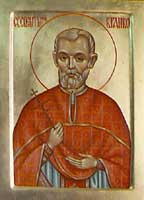
Branko Dobrosavljevic was born in the village of Skadar near Vojnic
on January 4, 1886. He completed Grammar school as well as the
Seminary in Sremski Karlovci in 1908. He was ordained deacon on
March 15, and presbyter on March 22, 1909. He performed his duties
in the villages of Buvaca, Radovica and Veljun. Branko received
St. Sava's Order and Yugoslav Crown Order of the Fifth Degree.
On the Feast of St. George, May 6, 1942, - the very day of his
own Slava - Branko was arrested by the Ustase, headed by Ivan
Sajfor from Veljun. Over 500 Serbs were arrested that day, among
them
Dimitrije Skorupan, parish priest of Cvijanovic Brdo, and Nebojsa,
priest Branko's son. At first they were imprisoned in police
station in Veljun, and next day (May 7) they were taken away
and killed
in the woods called "Kestenovac", near Hrvatski Blagaj.
The Ustase forced priest Branko to perform the service for the
repose of the soul of the dead to his own son Branko, who was
alive at the time. In 1946 priest Branko's martyr relics and
the remains
of the other killed Serbs were transported to a common grave
in Veljun.
At the regular session of the Holy Assembly of Bishops of the Serbian
Orthodox Church, priest Branko Dobrosavljevic was canonized and
his name was entered into the List of Names of the Serbian Church
Saints.
TROPARION TO HIEROMARTYR BRANKO (Fourth Tone)
O holy Hieromartyr Branko, you lent yourself to the apostles' way
of life and succeeded them on their throne. Inspired by God, you
found confirmed your meditation by practice and prayer; wherefore
you became a perfect teacher of truth, fighting for the faith unto
the shedding of your blood. Intercede with Christ God that He may
save our souls.
Holy Apostle and Evangelist Mark (63)
Commemorated on April 25/May8
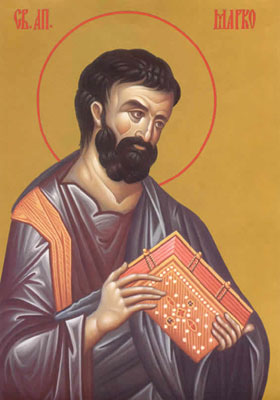
The Holy Disciple and Evangelist Mark, named also John-Mark (Acts
12: 12), was a Disciple from among the Seventy, and was also a
nephew of the Disciple Barnabas (Comm. 11 June). He was born at
Jerusalem. The house of his mother Mary adjoined the Garden of
Gethsemane. As Church Tradition relates, on the night of the Sufferings
of Christ on the Cross he followed after Him, wrapped in a linen
winding-cloth, and he fled from the soldiers catching hold of him
(Mk. 14: 51-52). After the Ascension of the Lord, the house of
his mother Saint Mary became a place of prayerful gatherings of
Christians and a lodging for certain of the Apostles (Acts 12:
12).
Saint Mark was a very close companion of the Apostles Peter and Paul (Comm.
29 June) and of the Disciple Barnabas. Saint Mark was at Seleucia together
with Paul and Barnabas, and from there he set off to the island of Cyprus,
and he crossed over the whole of it from East to West. In the city of Paphos
Saint Mark was an eye-witness, of how the Apostle Paul had struck blind the
sorcerer Elymas (Acts 13: 6-12).
After working with the Apostle Paul, Saint Mark returned to Jerusalem, and
then with the Apostle Peter he arrived in Rome, from whence at the latter's
bidding he set out for Egypt, where he became founder of the Church.
During the time of the second evangelic journey of the Apostle Paul, Saint
Mark met up with him at Antioch. From there he set out preaching with the Disciple
Barnabas to Cyprus, and then he went off again to Egypt, where together with
the Apostle Peter he founded many churches, and then also at Babylon. From
this city the Apostle Peter directed an Epistle to the Christians of Asia Minor,
in which he points to Saint Mark as his spiritual son (1 Pet. 5: 13).
When the Apostle Paul came in chains to Rome, the Disciple Mark was at Ephesus,
where the cathedra-seat was occupied by Saint Timothy (Comm. 4 January). The
Disciple Mark arrived together with him in Rome. There also he wrote his holy
Gospel (c. 62-63).
From Rome Saint Mark again set off to Egypt. At Alexandria he made the beginnings
of a Christian school, from which later on emerged such famous fathers and
teachers of the Church, as Clement of Alexandria, Sainted Dionysios (5 October),
Sainted Gregory Thaumatourgos ("Wonderworker", Comm. 5 November),
and others. Zealous with the arranging of Church Divine-services, the holy
Disciple Mark compiled the order of Liturgy for the Alexandrian Christians.
Later on in preaching the Gospel, Saint Mark also visited the inner regions
of Africa, and he was in Libya at Nektopolis.
During the time of these journeys, Saint Mark received inspiration of the
Holy Spirit to go again to Alexandria and confront the pagans. There he visited
at the home of the dignitary Ananias, for whom he healed a crippled hand.
The
dignitary happily took him in, hearkened with faith to his narratives, and
received Baptism. And following the example of Ananias, many of the inhabitants
of that part of the city where he lived were baptised after him. This roused
the enmity of the pagans, and they gathered to kill Saint Mark. Having learned
of this, the holy Disciple Mark made Ananias bishop, and the three Christians:
Malchos, Sabinos and Kerdinos – presbyters.
The pagans pounced upon Saint Mark when he was making Divine-services. They
beat him, dragged him through the streets and threw him in prison. There
Saint Mark was granted a vision of the Lord Jesus Christ, Who strengthened
him before
his sufferings. On the following day the angry crowd again dragged the holy
disciple through the streets towards the court-room, but along the way Saint
Mark died with the words: "Into Thy hands, O Lord, I commend my spirit".
The pagans wanted to burn the body of the holy disciple. But when they lit
up the bon-fire, everything grew dim, thunder crashed and an earthquake occurred.
The pagans fled in terror, and Christians took up the body of the holy disciple
and buried it in a stone crypt. This was on 4 April in the year 63. The Church
celebrates his memory on 25 April.
In the year 310, a church was built over the relics of the holy Disciple Mark.
In the year 820, when the Mahometan Arabs had established their rule in Egypt
and those of this different faith oppressed the Christian Church, the relics
of Saint Mark were transferred to Venice and placed in the church of his name.
In the ancient iconographic tradition, which adopted symbols for the holy
Evangelists borrowed from the vision of Saint John the Theologian (Rev. 4:
7), the holy
Evangelist Mark is depicted by a lion – symbolising the might and royal
dignity of Christ (Rev. 5: 5). Saint Mark wrote his Gospel for Christians
from among the gentile-pagans, since he emphasises predominantly the words
and deeds
of the Saviour, in which particularly is manifest His Divine Almightiness.
The many particularities of his account can be explained by his proximity
to the holy Apostle Peter. All the ancient writers testify, that the Gospel
of
Mark represents a concise writing-down of the preaching and narratives of
the first-ranked Apostle Peter. One of the central theological themes in
the Gospel
of Saint Mark is the theme of the power of God, doing the humanly impossible,
wherein the Lord makes possible that which of man is impossible. By the efficacy
of Christ (Mk. 16: 20) and the Holy Spirit (Mk. 13: 11), His disciples are
to go forth into the world and preach the Gospel to all creatures (Mk. 13:
10, 16: 15).
Hieromartyr Basil, bishop of Amasea (322)
Commemorated on April 26/May9
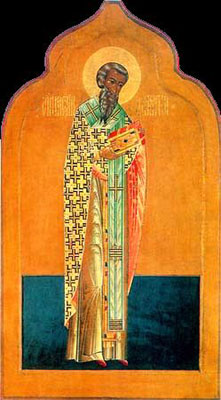
The PriestMartyr Basil, Bishop of Amasea, lived at the beginning
of the IV Century in the Pontine city of Amasea. He encouraged
and comforted the Christians, suffering persecution by the pagans.
During this time the Eastern part of the Roman empire was ruled
by Licinius (312-324), a relative by marriage to the holy Equal-to-the-Apostles
emperor Constantine the Great (306-337, Comm. 21 May). Licinius
deceitfully undersigned Constantine's "Edict of Religious
Toleration" (313), which permitted the freely open confession
of Christianity, but at heart he hated Christians and continued
to persecute them to return to paganism.
Licinius burned with passion for a maid-servant of his wife Constancia, – the
Righteous Virgin Galphyra. The holy maid reported about this to the empress
and sought her intercession. Having dressed her in men's attire and provided
her with money, the empress Constancia sent her away from the city in the
company of a devoted servant. They told the emperor, that the
maid-servant had gone
mad and lay near death. Righteous Glaphyra on the road to Armenia remained
in the city of Amasea, where the local bishop, Saint Basil, gave her shelter.
At this time the saint was building a church in the city. Righteous Glaphyra
for its construction gave over all the money that she had received from Constancia,
and in a letter to the empress she besought her to send additional funds to
complete the church. The empress fulfilled her request. But the letter of Righteous
Galphyra fell into the hands of the emperor. The enraged Licinius demanded
the governor of Amasea to send him the sainted-hierarch and the maid-servant.
Righteous Galphyra died (+ 322) before the edict arrived in Amasea. They dispatched
Saint Basil to the emperor. Two deacons, Parthenias and Thestimos, followed
after him and lodged near the prison where they locked up the saint.
The pious Christian Elpidyphoros bribed the jailer and each night together
with Parthenias and Thestimos he visited the saint. On the eve of the trial
day of the saint he sang psalms and the words "if I be at the very depths
of the sea, even there wilt Thy hand guide me and Thine right hand hold me" (Ps.
138 [139]: 9-10) – and thrice he broke down into tears. The deacons
were apprehensive that the saint would be in distress over the coming torments,
but he calmed them.
At the trial Saint Basil resolutely refused the suggestion of the emperor
to become a pagan high-priest, and therefore he was sentenced to death. Elpidyphoros
got to the soldiers with money, and they allowed the saint to pray and to
speak
with his friends before the execution. After this, the saint said to the
executioner: "Friend,
do what thou art ordered to", – and calmly he bent beneathe the
blow of the sword.
When the martyr had been beheaded, Elpidyphoros tried to ransom his remains
from the soldiers. But the soldiers were afraid of the emperor and they threw
the body and head of the saint into the sea. After this, three times in a
dream an Angel of God appeared before Elpidyphoros with the words: "Bishop Basil
is in Sinope and doth await you". Heeding this call, Elpidyphoros and
the deacons sailed to Sinope and there they hired fishermen to lower their
nets. When they lowered the net "on the suggestion" of the deacons
Thestimos and Parthenias, they came up with nothing. Thereupon Elpidyphoros
declared, that he would ask them to lower the net in the Name of the God,
Whom he did worship. This time the net brought up the body of Saint Basil.
The head
had come back together with it, and only the gash on the neck indicated the
strike of the sword. The relics of Saint Basil were conveyed to Amasea and
buried in the church built by him.
Burning of the relics of Venerable Sava I of Serbia by the Turks
(1595)
Commemorated on April 27/May 10
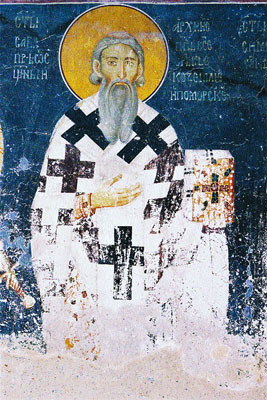
At the time of the Turkish occupation, so many Serbian Christians gathered around the relics of St Sava (at Mileseva), pleading for his intercession, that the Ottoman ruler, Sinan Pasha, feared that the relics would become the focus of a popular rebellion. He therefore had the relics brought to Belgrade and burned. The Pasha is long gone; the Saint continues to intercede for his people and for the world.
Apostles Jason and Sosipater of the Seventy, and their companions:
Martyrs Saturninus, Jakischolus (Inischolus), Faustianus, Januarius,
Marsalius, Euphrasius, Mammius, the Virgin Cercyra, and Christodolus
the Ethiopian, at Corfu (1st. c.)
Commemorated on April 28/May 11
The Disciple Jason hailed from Tarsus (Asia Minor). He was the
first Christian in the city. The Disciple Sosipater was a native
of Achaeia. They both became disciples of the Apostle Paul, who
even called them his "kinsmen" (Rom. 16: 21). Saint Jason
was made bishop in his native city of Tarsus, and Saint Sosipater – in
Iconium. They set out to the West preaching the Gospel, and in
the year 63 they reached the island of Kerkyra (Korfu) in the
Ionian Sea near Greece.
There they built a church in the name of the First-Martyr Stephen and they
baptised many. The governor of the island learned about this and locked them
up in prison, where they saw seven thieves: Satornius, Iakyscholus, Faustian,
Jannuarius, Marsalius, Euphrasius and Mammius. The disciples converted them
to Christ. For their confession of Christ the seven prisoners died as martyrs
in a cauldron of molten tar, wax and sulfur.
The prison guard, having beheld their act of martyrdom, declared himself a
Christian. For this they cut off his left hand, then both feet and finally
his head. The governor ordered the disciples Jason and Sosipater to be whipped
and again locked up in prison.
When the daughter of the governor, the maiden Kerkyra, learned how the martyrs
would suffer for Christ, she declared herself a Christian and gave away all
her finery to the poor. The infuriated governor attempted to persuade his daughter
into a renunciation of Christ, but Saint Kerkyra stood firm against both persuasions
and against threats. Then the enraged father devised a terrible punishment
for his daughter: he gave orders to situate her in a separate prison-cell and
bring in to her the robber and murderer Murinus, so that he would defile the
betrothed of Christ.
But when the robber approached the door of the prison-cell, a bear pounced
upon him. Saint Kerkyra heard the noise and in the Name of Christ she drove
off the beast, and then by her prayer she healed the wounds of Murinus. After
this Saint Kerkyra enlightened him with the faith of Christ, and Saint Murinus
declared himself a Christian and thereupon was executed.
The governor gave orders to burn down the prison, but the holy virgin remained
alive. Then by order of her enraged father, she was suspended upon a tree,
choked with bitter smoke and executed with arrows. After her death, the governor
decided to execute all the Christians on the island of Kerkyra. The Martyrs
Zinon, Eusebios, Neonos and Vitalius, having been enlightened by the Disciples
Jason and Sosipater, were burnt.
The inhabitants of Kerkyra, escaping from the persecution, crossed over to
an adjoining island. The governor set sail with a detachment of soldiers,
but was swallowed up by the waves. The governor succeeding him gave orders
to throw
the Disciples Jason and Sosipater into a cauldron of boiling tar, but when
he beheld them unharmed, with tears he cried out: "O God of Jason and
Sosipater, have mercy on me!"
Having been set free, the disciples baptised the governor and gave him the
name Sebastian. With his help the Disciples Jason and Sosipater built several
churches on the island and, living there until old age, by their fervent preaching
increased the flock of Christ.
St. Basil, bishop of Ostrog in Montenegro (Serbia) (1671)
Commemorated on April 29/May 12
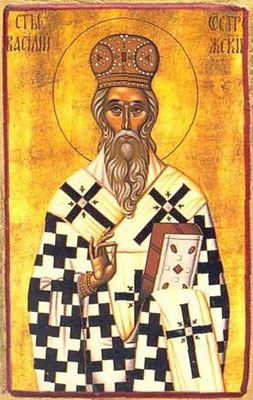
Saint Vasilii, Bishop of Zakholmsk, was born of pious parents in the XVI Century in the Popov district of Herzegovina. At the age of maturity he left his parental home and settled in the Trebinsk monastery in honour of the Uspenie-Dormition of the MostHoly Mother of God, and became a monk. For his virtuous life the saint was elevated to bishop of Zakholm and Skenderia. He occupied the bishop's cathedra-chair in the 2nd half of the XVI Century, successor to bishop Paul and predecessor to bishop Nikodim. Saint Vasilii was a good pastor of the flock of Christ, and the Lord strengthened his discourse with various miracles. For the sanctifying of soul with the wisdom of holy ascetic fathers, the saint journeyed to Athos. Saint Vasilii died peacefully and was buried in the city of Ostrog in Chernogoria on the border with Herzegovina.
Holy Apostle James, the brother of St. John the Theologian (44)
Commemorated on April 30/May 13
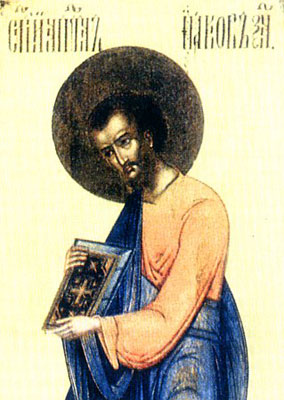
The Holy Apostle James, Son of Zebedee, one of the 12 Apostles,
was called by our Lord Jesus Christ for apostolic service together
with his brother, the Apostle John the Theologian. It was to them
and to the holy Apostle Peter pre-eminently over the other Apostles
that Jesus Christ revealed His Divine Mysteries: at the Resuscitation
of the Daughter of Jairus, on Mount Tabor (at the Transfiguration),
and in the Garden of Gethsemane.
Saint James, after the Descent of the Holy Spirit, preached in Spain and in
other lands, and then he returned to Jerusalem. He openly and boldly taught
about Jesus Christ as the Saviour of the world, and with the words of Holy
Scripture he denounced the Pharisees and the Scribes [scholars], reproaching
them with malice of heart and unbelief. The Jews had not the ability to refute
the apostolic discourse and for money they hired the pseudo-philosopher and
sorcerer Hermogenes, so that he would enter into a disputation with the apostle
and confute his arguments about Christ as the Promised Messiah having come
into the world. The sorcerer sent to the apostle his student Philip, who was
converted to belief in Christ. Then Hermogenes himself became persuaded of
the power of God, he burnt his books on magic, accepted holy Baptism and became
a true follower of Christ.
The unbelieving among the Jews persuaded Herod Agrippa (40-44) to arrest
the Apostle James and sentence him to death. Saint James calmly heard out
the death
sentence and continued to bear witness about Christ. One of the false-witnesses
against the apostle by the name of Josiah was struck by the courage of Saint
James. He came to believe in the truth of the words about the coming of Christ
the Messiah. When they led forth the apostle for execution, Josiah fell at
his feet, repenting his sin and asking forgiveness. The apostle hugged him,
gave him a kiss and said: "Peace and forgiveness be unto thee".
Then Josiah confessed before everyone his faith in Christ, and he was beheaded
together
with Saint James in the year 44 at Jerusalem.
Prophet Jeremiah (650 B.C.)
Commemorated on May 1/May 14
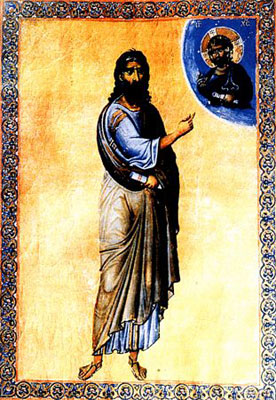
The Holy Prophet Jeremiah, one of the four great Old Testament
prophets, was son of the priest Helkiah from the city of Anathoth
near Jerusalem, and he lived 600 years before the Birth of Christ,
under the Israelite king Josiah and four of his successors. He
was called to prophetic service in his 15th year of life, when
the Lord revealed to him, that even before his birth the Lord
had assigned him to be a prophet. Jeremiah refused, pointing to
his
own youthfulness and lack of skill at speaking, but the Lord
promised to be always with him and to watch over him. He touched
the mouth
of the chosen one and said: "Lo I do put Mine words into thy
mouth, I do entrust unto thee from this day the fate of nations
and kingdoms. By thine prophetic word wilt they fall and rise up" (Jer.
1: 9-10). And from that time Jeremiah prophesied for twenty-three
years, denouncing the Jews for abandoning the True God and worshipping
idols, predicting for them woes and devastating wars. He stood
by the gates of the city, and at the entrance to the Temple,
everywhere where the people gathered, and he exhorted them with
imprecations
and often with tears. But the people answered him with mockery
and abuse, and they even tried to kill him.
Depicting the slavery to the king of Babylon impending for the Jews, Jeremiah
at the command of God put on his own neck at first a wooden, and then an iron
yoke, and thus he went about among the people. Enraged at the dire predictions
of the prophet, the Jewish elders threw the Prophet Jeremiah into an imprisoning
pit, filled with horrid slimy creatures, where he all but died. Through the
intercession of the God-fearing royal-official Habdemelek, the prophet was
pulled out of the pit but he did not cease with the prophecies, and for this
he was carted off to prison. Under the Jewish king Zedekiah his prophesy was
fulfilled: Nebuchadnezzar came, made slaughter of the nation, carried off a
remnant into captivity, and Jerusalem was pillaged and destroyed. Nebuchadnezzar
released the prophet from prison and permitted him to live where he wanted.
The prophet remained at the ruins of Jerusalem and bewailed the misfortune
of his fatherland. According to tradition, the Prophet Jeremiah took the Ark
of the Covenant with the Law-Tablets and hid it in one of the caves of Mount
Nabath (Nebo), such that the Jews were no more able to find it (2 Mac. 2).
Afterwards a new Ark of the Covenant was fashioned, but it lacked in the glory
of the first.
Among the Jews remaining in their fatherland there soon arose internecine clashes:
the viceroy of Nebuchadnezzar, Hodoliah, was murdered, and the Jews, fearing
the wrath of Babylon, decided to flee into Egypt. The Prophet Jeremiah disagreed
with their intention, predicting that the punishment which they feared, would
befall them in Egypt. But the Jews would not hearken to the prophet, and taking
him by force with them, they went into Egypt and settled in the city of Tathnis.
And there the prophet lived for four years and was respected by the Egyptians,
since with his prayer he killed crocodiles and other nasty creatures infesting
these parts. But when he began to prophesy, that the king of Babylon would
invade the land of Egypt and annihilate the Jews settled in it, the Jews then
murdered the Prophet Jeremiah. In that very same year the prophesy of the saint
was fulfilled. There exists a tradition, that 250 years later Alexander the
Great of Macedonia transported the relics of the holy Prophet Jeremiah to Alexandria.
The Prophet Jeremiah wrote his Book of "Prophesies" ("Jeremiah"),
and also the Book of "Lamentations", – about the Desolation
of Jerusalem and the Exile. The times in which he lived and prophesied are
spoken of in the 4th (2nd) Book of Kings (Ch. 23-25) and in the 2nd Book
of Chronicles (36: 12) and in 2 Maccabbees (Ch. 2).
In the Gospel of Matthew it points out, that the betrayal of Judas was foretold
by the Prophet Jeremiah: "And they took thirty pieces of silver, the price
of Him on Whom the sons of Israel had set a price, and they gave them over
for the potter's field, as did say the Lord unto me" (Mt. 27: 9-10).
St. Athanasius the Great, archbishop of Alexandria (373)
Commemorated on May 2/May 15
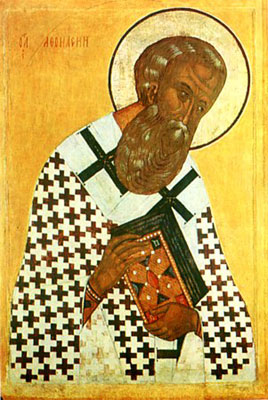
Sainted Athanasias the Great, Archbishop of Alexandria, was a
great father of the Church and a pillar of Orthodoxy. He was
born in about the year 297 in the city of Alexandria into a family
of
pious Christians. He received a fine secular education, but still
more he acquired profound knowledge by diligent study of the
Holy Scripture. From his childhood years the future great hierarch
Athanasias
became known to the Alexandrian Patriarch, Saint Alexander (Comm.
29 May), through the following circumstances. One time a group
of children, among whom was the lad Athanasias, was playing at
the shore of the sea. The Christian children decided to baptise
their pagan playmates. The lad Athanasias, whom the children
chose as "bishop", performed the baptism, precisely repeating
the words, heard by him in church during this sacrament. Patriarch
Alexander observed all this from a window. He then commanded
that there be brought him the children and their parents, and having
conversed with them for a long while, and having attested that
the baptism performed by the children at play was in everything
in accord with the Church ustav (rule), he acknowledged the Baptism
as real and supplemented it with the sacrament of Chrismation.
From this moment the Patriarch looked after the spiritual upbringing
of the youth Athanasias and in time brought him into the clergy,
at first as a reader, and then he ordained him to the dignity
of
deacon.
It was in this dignity of deacon that Saint Athanasias accompanied
Patriarch Alexander in the year 325 to the First OEcumenical
Council at Nicea. At the
Council, Saint Athanasias stepped forth with a refutation of the heresy of
Arius. This speech met with the approval of the Orthodox fathers of the Council,
but the Arians – those openly so and those concealed – came to
hate Athanasias and subjected him to persecutions for all the rest of his
life.
After the death of holy Patriarch Alexander, Saint Athanasias was unanimously
chosen his successor to the Alexandria cathedra-seat. He long refused, accounting
himself unworthy, but at the insistence of all the Orthodox populace that
it was in agreement, at age 28 he was ordained to the dignity of bishop and
put
at the head of the Alexandrian Church. For 47 years Saint Athanasias guided
the Church, and during this time he suffered much persecution and grief from
his antagonists. Several times he was expelled from Alexandria and hid himself
from the Arians in desolate places, since they repeatedly tried to kill him.
Saint Athanasias spent more than 20 years in his exiles, and returned then
to his flock, and then again was subjected to banishment. There was a moment
in time when he remained as the only Orthodox bishop, a moment when all the
other bishops had deviated into heresy. At the false-councils of Arian bishops
he was declared deprived of the bishop's dignity. Despite the persecution
of many years, the saint continued firmly to defend the purity of the Orthodox
faith, and he wrote incessantly both missives and tracts against the Arian
heresy. When Julian the Apostate (361-363) began a persecution against Christians,
his wrath then first fell upon Saint Athanasias, whom he considered the great
pillar of Orthodoxy. Julian intended to kill the saint so as to strike Christianity
a grievous blow, but he himself soon perished infamously. Mortally wounded
by an arrow during the time of a battle, he cried out with despair: "Thou
art victorious, Galilean". After the death of Julian, Saint Athanasias
guided the Alexandrian Church for seven years and died in 373, at age 76.
Numerous works of Saint Athanasias have been preserved: four "Orations",
directed against the Arian heresy; likewise an Epistle to Epictetos, bishop
of the Church of Corinth, about the Divine and Human natures in Jesus Christ;
four Epistles to Serapion, bishop of Thmuis, about the Divine Holy Spirit and
Its Equality with the Father and the Son – directed against the heresy
of Macedonias. There have been preserved also other works of apologetical
character in defence of Orthodoxy, among which is the Letter to the emperor
Constantius.
Commentaries of Saint Athanasias on Holy Scripture are known of, and also
books of a moral didactic character, as well as a detailed biography of the
Monk
Anthony the Great (Comm. 17 January), with whom Saint Athanasias was very
close. Saint John Chrysostom advised every Orthodox Christian to read this
life. The
memory of Sainted Athanasias is celebrated also on 18 January conjointly
with the memory of Sainted Cyril of Alexandria.
St. Boris-Michael, prince of Bulgaria (907)
Commemorated on May 2/May 15
The Holy Nobleborn Equal-to-the-Apostles Tsar Boris, in Holy Baptism Michael: His Equal-to-the-Apostles exploits were foretold him by an uncle, Saint Boyan. The first years of the reign of tsar Boris unfolded with misfortune. The Bulgarians happened frequently to be at war with surrounding nations, famine and plague beset the land, and in the year 860 Bulgaria found itself in dire straits. Tsar Boris saw the salvation of his land, which dwelt in paganism, in its enlightenment by the faith in Christ. During the time of one of the battles of the Bulgarians with the Greeks he took captive the illustrious courtier Theodore Kuphares, who earlier had taken monastic vows. He was the first man planting the seed of the Gospel in the soul of the Bulgarian tsar. In one of the campaigns with the Greeks the young sister of tsar Boris was taken captive and raised at the court of the Byzantine emperor in the Orthodox faith. When the emperor Theophilos died, tsar Boris decided to take advantage of the favourable circumstance so as to take revenge upon the Greeks for his former defeats. But the widow of the emperor, Theodora, showed courage and sent a messenger to the Bulgarian tsar with the suggestion, that she herself was prepared to defend the empire and humiliate its opponents. Tsar Boris chose to have a peace alliance, and in sign of conciliation exchange was made of the captives Theodore Kuphares for the Bulgarian princess, who all the more swayed her brother towards the Christian faith. A while later there was sent into Bulgaria Saint Methodios, who together with his brother Saint Cyril was enlightening the Slavic peoples with the light of faith in Christ. Saint Methodios baptised tsar Boris, his family and many of the boyar-nobles. The pagan Bulgarians, having learned of this, wanted to kill tsar Boris, but their plot was frustrated by the tsar, and deprived of their rebellious leaders, the Bulgarian people voluntarily accepted Baptism. Between Byzantium and Bulgaria was concluded a peace, based on an oneness of faith, which was not broken until the end of the reign of the noble tsar. The Greek Patriarch Photios took great interest in the spiritual confirmation of the Bulgarian nation. In 867 preachers from the Roman pope were sent into Bulgaria, from which time over the course of three years discord prevailed in Bulgaria between the Greek and Roman Churches. A Council at Constantinople in 869 put an end to the quarrel, and on 3 March 870 Bulgaria was definitively conjoined to the Eastern Church, and Orthodoxy in it was affirmed even more. In Bulgaria were glorified the holy ascetics: Saints Gorazd (Comm. 27 July) and Clement of Okhrid (Comm. 27 July). Nobleborn tsar Boris adorned the land with churches and furthered the spread of piety, and afterwards in Bulgaria was established a Patriarchal cathedra-seat. In his declining years, holy tsar Boris withdrew to a monastery, leaving the throne to his sons Vladimir and Simeon. While in the monastery the saint learned that Vladimir, who succeeded to reign after him, had started on a path of renunciation from Christianity. Distressed by this, Saint Boris again donned his garb as tsar, punished his disobedient son and placed him in prison. Having entrusted the rule to his younger son Simeon, Saint Boris returned to the monastery. But he came out from it once more for the repelling of an invasion of the Vengrians/Hungarians. Holy tsar Boris, in holy Baptism named Michael, – reposed on 2 May 907.
Martyrs Timothy the Reader and his wife Maura of Antinoe in Egypt
(286)
Commemorated on May 3/May 16
Saints Timothy and Maura suffered for the faith during the time
of persecution under the emperor Diocletian (284-305). Saint
Timothy came from the village of Perapa (Egyptian Thebaid), and
was the
son of a priest by the name of Pikolpossos. He was made a reader
among the church clergy and likewise a keeper and copyist of
Divine-service books. Saint Timothy came under denunciation that
he was a keeper
of Christian books, which by order of the emperor were to be
confiscated and burned. They brought Saint Timothy before the governor
Arian,
who demanded him to hand over the clergy books. For his refusal
to obey the command, they subjected the saint to horrible tortures.
They shoved into his ears two red-hot iron rods, from which the
sufferer lost his eyesight and became blind. Saint Timothy bravely
endured the pain and he gave thanks to God, for granting him
to suffer for Him. The torturers hung up the saint head downwards,
putting in his mouth a piece of wood, and they tied an heavy
stone
to his neck. The suffering of Saint Timothy was so extreme, that
the very ones executing the torment began to implore the governor
to ease up on the torture. And about this time they informed
Arian, that Timothy had a young wife by the name of Maura, whom
he had
married a mere 20 days before. Arian gave orders to bring Maura,
hoping, that with her present they could break the will of the
martyr. At the request of Maura, they removed the piece of wood
from the mouth of the martyr, so that he could speak. Saint Timothy
urged his wife not to be afraid of the tortures and to go the
path with him. Saint Maura answered: "I am prepared to die with
thee", – and boldly she confessed herself a Christian.
Arian gave orders to tear out the hair from her head and to cut
off the fingers from her hands. Saint Maura with joy underwent
the torment and even thanked the governor for the torture, suffered
in the redemption of sins. Then Arian gave orders to throw Saint
Maura into a boiling cauldron, but she did not sense any pain and
she remained unharmed. Suspecting that the servants out of sympathy
for the martyress had filled the cauldron with cold water, Arian
went up and ordered the saint to splash him on the hand with water
from the cauldron. When the martyr did this, Arian screamed with
pain and drew back his scaulded hand. Then, momentarily admitting
the power of the miracle, Arian confessed God in Whom Maura believed
as the True God, and he gave orders to release the saint. But the
devil still held great power over the governor, and soon he again
began to urge Saint Maura to offer sacrifice to the pagan gods.
Having gotten nowhere, Arian was overcome all the more by a satanic
rage and he began to come up with new tortures. Then the people
began to murmur and demand a stop to the abuse of this innocent
woman. But Saint Maura, turning to the people, said: "Let
no one defend me, I have one Defender – God, on Whom I trust".
Finally, after long torments Arian gave orders to crucify the martyrs. Over
the course of ten days they hung on crosses face to face with each other.
On the tenth day of martyrdom the saints offered up their souls to the Lord.
This occurred in the year 286. Afterwards at Constantinople there began solemn
celebration of the memory of the holy Martyrs Timothy and Maura, and a church
was built in their honour.
Virgin-martyr Pelagia of Tarsus in Asia Minor (287)
Commemorated on May 4/May 17
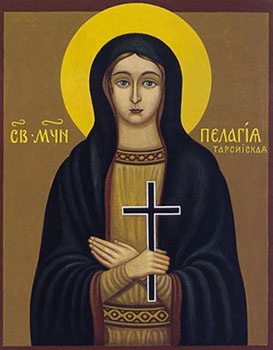
The Holy Virgin Pelagia lived during the III Century in the city of Tarsis in the Cilician district of Asia Minor. She was the daughter of illustrious pagans and when she heard preaching from her Christian acquaintances about Jesus Christ the Son of God, she believed in Him and desired to preserve her chastity, dedicating her whole life to the Lord. The heir of emperor Diocletian (a youth adopted by him), having seen the maiden Pelagia, was captivated by her beauty and wanted to take her to be his wife. But the holy virgin told the youth, that she was betrothed to the Immortal Bridegroom, – the Son of God, and therefore she had renounced earthly marriage. This answer of Pelagia caused great anger in the imperial youth, but he decided to leave her in peace for awhile, hoping, that she would change her frame of mind. This same while Pelagia convinced her mother to send her off to her nurse who had raised her in childhood – secretly hoping to locate the bishop of Tarsis Klinon, who had fled to a mountain during a time of persecution against Christians, and to accept Holy Baptism from him. In a dream vision there appeared the form of the bishop – Klinon, profoundly impressing itself upon her memory. Saint Pelagia set off to her nurse in a chariot, in rich clothes and accompanied by a whole retinue of servants, as her mother had desired her to. Along the way Saint Pelagia, through some particular ordering of events by God, met bishop Klinon. Pelagia immediately recognised the bishop, whose image had appeared to her in the dream. She fell at his feet, requesting baptism. At the prayer of the bishop there flowed from the ground a spring of water. Bishop Klinon made the sign of the cross over Saint Pelagia, and during the time of the mystery (sacrament) Angels appeared and covered the chosen one of God with a bright mantle. Having communed the pious virgin with the Holy Mysteries, bishop Klinon raised himself up in prayer of thanksgiving to the Lord together with her, and then sent her off to continue her journey. Having returned to the servants awaiting her, Saint Pelagia preached to them about Christ, and many of them were converted and believed. She tried to convert her own mother to faith in Christ, but the obdurate woman sent a message to the imperial youth, – that Pelagia was a Christian and did not wish to be his spouse. The youth comprehended that Pelagia was lost for him, and not wishing to give her over to torture, he fell upon his sword. Pelagia's mother thereupon became fearful of the wrath of the emperor, tied her daughter and led her to the court of Diocletian as being a Christian and also the probable cause of the death of the heir to the throne. The emperor was captivated by the unusual beauty of the maiden and tried to sway her from her faith in Christ, promising her every earthly blessing and to make her his own wife. But the holy maiden refused the offer of the emperor with contempt and said: "Thou art insane, emperor, telling me such a speech. Know, that I wilt not do thine bidding, and I loathe thy vile marriage, since I have a Bridegroom – Christ, the King of Heaven. I desire not thy imperial, worldly, short-durationed crowns, since my Lord in the Heavenly Kingdom has prepared for me three imperishable crowns. The first for faith – since I have believed with all my heart in the True God; the second for purity – because I have entrusted to Him my virginity; the third for martyrdom – since I want to accept for Him every suffering and to offer up my soul because of my love for Him". Diocletian thereupon sentenced Pelagia to be burnt in a glowing red-hot copper oven. Not permitting the executioners to touch her body, the holy martyress herself – signing herself with the sign of the cross, went with a prayer into the red-hot oven – in which her flesh melted like myrh, filling all the city with fragrance; the bones of Saint Pelagia remained unharmed and were removed by the pagans to outside the city. Four lions then came from out of the wilderness and sat around the bones – letting get at them neither bird nor wild beast. The lions protected the remains of the saint until such time as bishop Klinon came to that place. He gathered them up and buried them with honour. During the reign of emperor Constantine (306-337), when the persecutions against Christians had stopped, there was built a church at the place of burial of Saint Pelagia.
Great-martyr Irene of Thessalonica (1st-2nd c.)
Commemorated on May 5/May 18
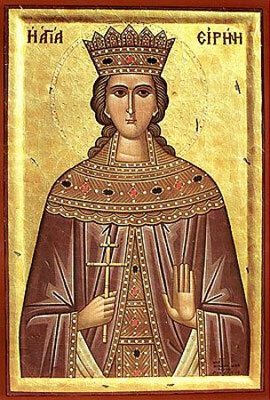
The Holy Great-Martyress Irene lived during the I Century and
until baptism had the name Penelope. She was daughter of the pagan
Licinius, governor of the city of Migdonia (in Macedonia, or Thrace).
Licinius built for his daughter a separate splendid palace, where
she lived with her governess Karia, surrounded by her peers and
her servants. Daily there came to Penelope a tutor by the name
of Apelian, who taught her the sciences. Apelian was a Christian,
and during the time of study he told the maiden about Christ the
Saviour and taught her the Christian teaching and the Christian
virtues.
When Penelope became an adolescent, her parents began to think
about her marriage. During this period of her life the Lord instructed
her in a miraculous manner:
to her at the window there flew one after the other of three birds – a
dove with an olive twig, an eagle with a garland, and a raven with a snake.
Penelope's teacher Apelian explained to her the meaning of these signs: the
Dove, symbolising the virtues of the maiden, – humility, meekness and
chasteness, – bearing an olive twig, – the grace of God received
in Baptism; the Eagle, – symbol of sublimity of spirit, attained through
meditation upon God, – bearing a garland for victory over the invisible
enemy as a reward from the Lord. The Raven, however, bearing the snake was
a sign that the devil would rise up against her and would cause her grief,
sorrow and persecution. At the end of the conversation Apelian said, that the
Lord wished to betroth her to Himself and that Penelope would undergo much
suffering for her Heavenly Bridegroom. After this Penelope refused marriage,
accepted Baptism from the hands of the Disciple Timothy, – who was
a disciple of the holy Apostle Paul, and she was named Irene. She began even
to urge her own parents to accept the Christian faith. The mother was pleased
with the conversion of her daughter to Christ; the father at first did not
hinder his daughter, but then he began to demand of her the worship to the
pagan gods. When however Saint Irene firmly and decisively refused, the enraged
Licinius then gave orders to tie up his daughter and throw her beneathe the
hooves of frenzied horses. The horses remained motionless. But one of them
got loose from its harness, threw itself at Licinius, seized him by the right
hand and tore it from his arm, then knocked Licinius down and began to trample
him. They then untied the holy maiden, and through her prayer Licinius in
the
presence of eye-witnesses rose up unharmed, with his hand intact. Seeing
such a miracle, Licinius with his wife and many of the people, in number
about 3000
men, believed in Christ and refrained from the pagan gods. Resigning the
governance of the city, Licinius settled into the palace of his daughter,
intending to
devote himself to the service of the Lord Jesus Christ. Saint Irene however
began to preach the teaching of Christ among the pagans and she converted
them to the path of salvation. She lived in the house of her teacher Apelian.
Having learned of this, Sedecius, – the new governor of the city, summoned
Apelian and questioned him about the manner of life of Irene. Apelian answered
that Irene, just like other Christians, lived in strict temperance, in constant
prayer and reading of holy books. Sedecius summoned the saint to him and began
to urge her to cease preaching about Christ and to offer sacrifice to the gods.
Saint Irene staunchly confessed her faith before the governor, not fearing
his wrath, and prepared to undergo suffering for Christ. By order of Sedecius
she was thrown into a pit, filled with vipers and serpents. The saint spent
10 days in the pit and remained unharmed, since an Angel of the Lord protected
her and brought her food. Sedecius ascribed this miracle to sorcery and he
subjected the saint to a cruel torture: he gave orders to saw her with an iron
saw. But the saws broke one after the other and caused no harm to the body
of the holy virgin. Finally, a fourth saw reddened the body of the holy martyress
with blood. Sedecius with derision said to the martyress: "Where then
is thy God? If He be powerful, let Him help thee!" Suddenly a whirlwind
shot up, gave forth a blinding lightning-flash, striking down many of the
torturers, thunder crashed, and a strong rain poured down. Beholding such
a sign from
Heaven, many believed in Christ the Saviour. Sedecius did not understand
the obvious display of the power of God and he subjected the saint to new
torments,
but the Lord preserved her unharmed. Finally the people rebelled having to
look upon the sufferings of the innocent virgin, and they rose up against
Sedecius and expelled him from the city.
Having replaced Sedecius as governor, they still subjected Saint Irene to various
cruel torments, during which while by the power of God she continued to remain
unharmed, and the people under the influence of her preaching and accomplishing
of miracles all the more in number were converted to Christ, having turned
away from the worship of soul-less idols. Over 10,000 pagans were converted
by Saint Irene.
The saint went from her native city Migdonia to Kallipolis, and there she continued
to preach about Christ. The governor of the city by the name of Babadonos subjected
the martyress to new punishments, but seeing that the saint remained unharmed,
he came to his senses and believed in Christ. A large number of pagans believed
together with him, all whom received holy Baptism from the Disciple Timothy.
After this Saint Irene settled in other cities of Thrace – Konstantinos
and then Mesembros, preaching about Christ and working miracles, healing
the sick and undergoing suffering for Christ.
In the city of Ephesus the Lord revealed to her, that the time of her end was
approaching. Then Saint Irene in the company of her teacher the elder Apelian
and other Christians went out from the city to an hilly cave and, having signed
herself with the sign of the cross, she went into it, having directed her companions
to close the entrance to the cave with a large stone, which they did. Four
days after this, when Christians visited the cave, they did not find the body
of the saint in it. Thus reposed the holy Great-Martyress Irene.
Righteous Job the Long-suffering
Commemorated on May 6/May 19
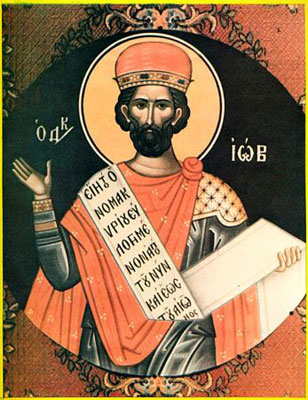
Saint Job the Righteous lived about 2000-1500 years before the
Birth of Christ, in Northern Arabia, in the country of Austidia
in the land of Uz. His life and sufferings are recorded in the
Bible (Book of Job). There exists an opinion, that Job was by
descent a nephew of Abraham, and that he was the son of a brother
of Abraham – Nakhor.
Job was a man God-fearing and pious. With all his soul he was devoted
to the Lord God and in everything conducted himself in accord with
God's will, refraining from everything evil not only in deeds,
but also in thoughts. The Lord blessed his earthly existence and
rewarded Righteous Job with great wealth: he had many cattle and
all kinds of possessions. Righteous Job's seven sons and three
daughters were amiable amongst themselves and gathered for common
repast all together in turns at each of their homes. Every seven
days Righteous Job made for his children offerings to God, saying: "If
perchance any of them hath sinned or offended God in their heart".
For his justness and honesty Saint Job was held in high esteem
by his fellow citizens and he had great influence in public matters.
One time however, when the Holy Angels did stand before the Throne
of God, Satan appeared amongst them. The Lord God asked Satan,
whether he had seen
His servant Job, a man righteous and without blemish. Satan answered audaciously,
that it was not for nothing that Job was God-fearing – since God was
watching over him and multiplying his riches, but if misfortune were sent him,
he would then cease to bless God. Then the Lord, wishing to prove Job's patience
and faith, said to Satan: "Everything, that Job hath, I give into thine
hand, but only he himself touch not". After this Job suddenly lost all
his wealth, and then also all his children. Righteous Job turned to God and
said: "Naked did I emerge from the womb of my mother, and naked shalt
I be returned to my mother the earth. The Lord giveth, and the Lord taketh
away. Blest be the Name of the Lord!" And thus did Job not sin before
the Lord God, nor utter even an unthinking word.
When the Angels of God again did stand before the Lord and amongst them Satan
also, then said the devil, that Job was righteous, since that he himself
was without harm. Thereupon declared the Lord: "I permit thee to do with him,
what thou wishest, sparing only his soul". After this Satan inflicted
upon Righteous Job an horrid illness, leprous boils, which covered him head
to foot. The sufferer was compelled to remove himself from the company of people,
he sat outside the city on an heap of ashes and had to scrape at his pussing
wounds with an shard of clay. All his friends and acquaintances abandoned him.
His wife had to see after her own welfare, toiling and roaming from house to
house. She not only did not support her husband with patience, but rather she
thought, that God was punishing Job for some kind of secret sins, and she wept,
and wailed against God, she reproached also her husband and finally advised
Righteous Job to curse God and die. Righteous Job sorrowed grievously, but
even in these sufferings he remained faithful to God. He answered his wife: "Thou
speakest, like someone hysterical. Shalt we have from God only the good, and
have nothing bad?" And Righteous Job did sin in nothing before God.
Hearing about the misfortunes of Job, three of his friends came afar off
to comfort his sorrow. They reckoned, that Job was being punished by God
for his
sins, and they urged this righteous man though innocent to repent. The righteous
one answered, that he was suffering not for sins, but that these tribulations
were sent him from the Lord in accord with the Divine Will, which is inscrutable
for man. His friends however did not believe him and they continued to think
that the Lord was dealing with Job in accord withe the laws obtaining under
human standards, thus punishing Job for the committing of sins. In begrieved
sorrow of soul Righteous Job turned with a prayer to God, beseeching Him
Himself to bear witness before them of his innocence. God thereupon manifested
Himself
in a tempestuous whirlwind and reproached Job, in that he had tried to penetrate
by his reason into the mystery of the world-order and the judgemental-purposes
of God. The Righteous Job with all his heart repented himself in these thoughts
and said: "I am as nothing, and I foreswear and repent myself in dust
and ashes". The Lord thereupon commanded the friends of Job to have recourse
to him in asking him to offer sacrifice for them. "Since, – said
the Lord, – only the person Job do I accept it of, lest I spurn ye for
this, that ye did speak concerning Me not thus rightly, as hath instead My
servant Job". Job offered sacrifice to God for his friends, and the
Lord accepted his intercession, and the Lord likewise returned to Righteous
Job
his health and gave him twice over more than he had previously. In place
of his deceased children was born to him seven sons and three daughters,
more
beautiful than any other in that land. After bearing his sufferings, Job
lived yet another 140 years (altogether he lived 248 years) and he lived
to see his
descendants down to the fourth generation.
Saint Job prefigures the Lord Jesus Christ, having come down to earth and suffering
for the salvation of mankind, and then glorified in His glorious Resurrection.
"I know, – said Righteous Job, afflicted with the leprous boils, – I
know, that my Redeemer liveth and He wilt raise up from the dust on the last
day my decayed skin, and I in my flesh shalt see God. I shalt see Him myself
with mine own eyes, and not through the eyes of some other see Him. In expectation
of this, my heart doth jump within my bosom!" (Job 19: 25-27).
"Know ye, the judgement, in which be justified only those having true wisdom – the
fear of the Lord, and true understanding – the departing from evil" (Job
28: 28).
Saint John Chrysostom says: "There was no human misfortune, which this
man did not undergo. He was the firmest and most adamant, beset by sudden tribulation
by hunger, and by woe, and sickness, and bereft of children, and loss of riches,
and then suffering abuse from his wife, insult from his friends, reproach from
his servants, and in everything he showed himself more solid than a stone,
and a source before the Law also of Grace".
Translation of the relics (1238) of Venerable Sava I of Serbia
Commemorated on May 6/May 19
Commemoration of the Apparition of the Sign of the Precious Cross
over Jerusalem in 351 A.D.
Commemorated on May 7/May 20
Remembrance of the Appearance in the Heavens of the Cross of
the Lord at Jerusalem (351): After the death of the first Christian
emperor, Constantine the Great, the imperial throne was occupied
by his son Constantius, who inclined towards the heresy of Arius,
which denied the one self-same essence of the Son of God with the
Father. In the reaffirming of holy Orthodoxy, the Lord manifest
at Jerusalem a wondrous sign. On the day of Holy Pentecost, 7 May
351, at the third hour of the morning in the heavens there appeared
the image of the equal-proportioned Cross of the Lord, shining
with an inexpressible light, and brighter than the light of the
sun. All the people were eye-witness to this, and they were struck
with great dread and amazement. The appearance of the Sign of the
Cross began over holy Mount Golgotha, whereupon it was that the
Lord had been crucified (Mt. 27: 32-33; Jn. 19: 17, 41; Heb. 13:
12), and it reached to the Mount of Olives (Jn. 8: 1; 18: 1-2),
extending from Golgotha a distance of 15 stadia. The Sign was transfused
with all the colours of the rainbow and it caught the sight of
all the people. Many of the people, leaving off from whatever they
were doing, went outside the houses and with awe stood contemplating
the wondrous sign. Then a numerous throng of the people of Jerusalem
with trembling and joy hastened to the holy Church of the Resurrection.
The holy Jerusalem Patriarch Cyril (350-387) advised the emissary of the emperor
Constantius about this miraculous occurrence of the appearance of the Sign
of the Cross, and he urged him to return to the Orthodox faith. And Sozomen,
an historian of the Ancient Church, likewise testifies, that through this appearance
of the Holy Cross many of the Jews and pagan Greeks came to the true faith,
repenting in Christ God, and accepted Holy Baptism.
Holy Apostle and Evangelist John the Theologian (98-117)
Commemorated on May 8/May 21
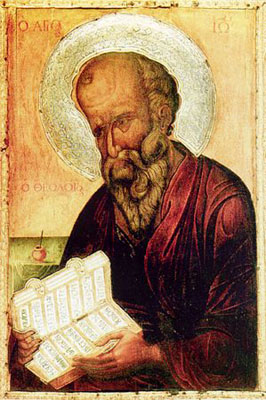
The Holy Apostle and Evangelist John the Theologian occupies
an unique place in the ranks of the chosen disciples of Christ
the Saviour. Often in iconography the Apostle John is depicted
as a gentle, majestic and spiritual elder, with features of innocent
tenderness, with the imprint of complete calm upon his forehead
and the deep look of a contemplator of unuttered revelations.
Another main trait of the spiritual countenance of the Apostle
John is
revealed through his teaching about love, for which the title "Apostle
of Love" is preeminently designated to him. Actually, all
his writings are permeated by love, the basic concept of which
leads to the comprehension, that God in His Being is Love (1
Jn. 4: 8). In his writings, Saint John dwells especially upon
the manifestations
of the inexpressible love of God for the world and for mankind,
the love of his Divine Teacher. He constantly exhorts his disciples
to mutual love one for another.
The service of Love – was the entire pathway of life of
the Apostle John the Theologian.
The qualities of calmness and profound contemplation were in him combined
with an ardent fidelity, tender and boundless love with intensity and even
a certain
abruptness. From the brief indications of the Evangelists it is apparent,
that he was endowed in the highest degree with an ardent nature, and his
hearty
passionateness sometimes reached such a stormy zealousness, that Jesus Christ
was compelled to give the admonishment, that it was discordant with the spirit
of the new teaching (Mk. 9: 38-40; Lk. 9: 49-50, 54-56) and He called the
Apostle John and his brother by birth the Apostle James "Sons of Thunder" ("Boanerges").
During this while Saint John shows scant modesty, and besides his particular
position among the Apostles as "the disciple whom Jesus loved", he
did not stand out among the other disciples of the Saviour. The distinguishing
features of his character were the observance and sensitivity to events, permeated
by a keen sense of obedience to the Will of God. Impressions received from
without rarely showed up in his word or actions, but they penetrated deeply
and powerfully into the inner life of the holy Apostle John. Always sensitive
to others, his heart ached for the perishing. The Apostle John with pious tremulation
was attentive to the Divinely-inspired teaching of his Master, to the fulness
of grace and truth, in pure and sublime comprehending the Glory of the Son
of God. No feature of the earthly life of Christ the Saviour slipped past the
penetrating gaze of the Apostle John, nor did any event occur, that did not
leave a deep impression on his memory, since in him was concentrated all the
fulness and wholeness of the human person. The thoughts also of the Apostle
John the Theologian are imbued with suchlike an integral wholeness. The dichotomy
of person did not exist for him. In accord with his precepts, where there is
not full devotion, there is nothing. Having chosen the path to service to Christ,
to the end of his life he fulfilled it with complete and undivided devotion.
The Apostle John speaks about wholistic a devotion to Christ, about the fulness
of life in Him, wherefore also sin is considered by him not as a weakness and
injury of human nature, but as evil, as a negative principle, which is completely
set in opposition to the good (Jn. 8: 34; 1 Jn. 3: 4, 8-9). In his perspective,
it is necessary to belong either to Christ or to the devil, it is not possible
to be of a mediocre lukewarm, undecided condition (1 Jn. 2: 22, 4: 3; Rev.
3: 15-16). Therefore he served the Lord with undivided love and self-denial,
having repudiated everything that appertains to the ancient enemy of mankind,
the enemy of truth and the father of lies (1 Jn. 2: 21-22). Just as strongly
as he loves Christ, just as strongly he contemns the Anti-Christ; just as intensely
he loves truth, with an equal intensity does he contemn falsehood, – for
light doth expel darkness (Jn. 8: 12; 12: 35-36). By the manifestation of
the inner fire of love he witnesses with the unique power of spirit about
the Divinity
of Jesus Christ (Jn. 1: 1-18; 1 Jn. 5: 1-12).
To the Apostle John was given to express the last word of the Divine Revelation
(i.e. the final book of the Holy Scripture), ushering in the most treasured
mysteries of the Divine inner life, known only to the eternal Word of God,
the Only-Begotten Son.
Truth is reflected in his mind and in his words, wherein he senses and grasps
it in his heart. He has comprehension of eternal Truth, and as he sees it,
he transmits it to his beloved spiritual children. The Apostle John with simplicity
affirms or denies and speaks always with absolute precision (1 Jn. 1: 1). He
hears the voice of the Lord, revealing to him what He Himself hears from the
Father.
The theology of the Apostle John abolishes the borderline between the present
and the future. Looking at the present time, he does not halt at it, but
transports his gaze to the eternal in the past time and to the eternal in
the future time.
And therefore he, exhorting for holiness in life, solemnly proclaims, that "all,
born of God, sin not" (1 Jn. 5: 18; 3: 9). In communion with God the
true Christian partakes of life Divine, whereby the future of mankind is
accomplished
already on earth. In his explanation and disclosing of the teaching about
the Economia of salvation, the Apostle John crosses over into the area of
the eternal
present, in which Heaven would co-incide with earth and the earth would be
enlightened with the Light of Heavenly Glory.
Thus did the Galilean fisherman, this son of Zebedee, become Theologian proclaiming
through Revelation the mystery of world-existence and the fate of mankind.
The celebration on 8 May of the holy Apostle John the Theologian was established
by the Church in remembrance of the annual drawing forth on this day at the
place of his burial of fine rose ashes, which believers gathered for healing
from various maladies. The account about the life of the holy Evangelist John
the Theologian is situated under 26 September, the day of his repose.
Prophet Isaiah (8th c. B.C.)
Commemorated on May 9/May 22
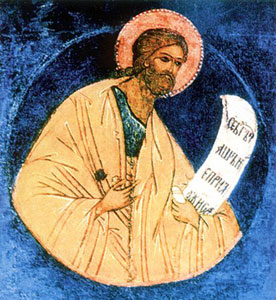
The holy Prophet Isaiah lived 700 years before the Birth of Christ,
and was descended of royal lineage. The father of Isaiah, Amos,
raised his son in the fear of God and in the law of the Lord. Having
attained the age of maturity, the Prophet Isaiah entered into marriage
with a pious maiden-prophetess (Is. 8: 3) and had a son Jashub
(Is. 8: 18).
Saint Isaiah was called to prophetic service during the reign
of Oziah (Uzziah), king of Judea, and he prophesied for 60 years
during the reign of kings Joatham,
Achaz (Ahaz), Hezekiah and Manasseh. The start of his service was marked
by the following vision: he beheld the Lord God, sitting in a
majestic heavenly
temple upon an high throne. Six-winged Seraphim encircled Him. With two wings
they covered their faces, and with two wings – they covered their feet,
and with two wings they flew about crying out one to another "Holy, Holy,
Holy Lord Sabaoth, heaven and earth art filled of His Glory!" The pillars
of the heavenly temple did shake from their shouts, and in the temple swelled
the smoke of incense. The prophet cried out in terror: "Oh, accursed a
man am I, granted to behold the Lord Sabaoth, and having impure lips and living
amidst an impure people!" Then was sent him one of the Seraphim, having
in hand a red-hot coal, which he took with tongs from the altar of the Lord.
He touched it to the mouth of the Prophet Isaiah and said: "Here, I have
touched it to thine lips and the Lord doth do away with thine offences and
doth cleanse thy sins". After this Isaiah heard the voice of the Lord,
directed towards him: "Whom shalt I send and who wilt go to the Jews,
who wilt go for Us?" Isaiah answered: "Here am I, send me, Lord,
and I shalt go" (Is. 6: 1ff). And the Lord sent him to the Jews to exhort
them to turn from the ways of impiety and idol-worship and to offer repentance.
To those that repent and turn to the True God, the Lord promised mercy and
forgiveness, but punishment and the judgement of God are appointed the unrepentant.
Then Isaiah asked the Lord, how long would the falling-away of the Jewish nation
from God continue. The Lord answered: "Until that time, as they neglect
the city, nor be there people in the houses and this land be made desolate.
Just as when a tree be felled and from the stump come forth new shoots, so
also from the destruction of the nation wilt remain an holy remnant, from which
emergeth a new tribe".
Isaiah left behind him a book of prophecy, in which he denounces the Jews
for their unfaithfulness to the God of their fathers, and he predicts the
captivity
of the Jews and their return from captivity during the time of the emperor
Cyrus, the destruction and renewal of Jerusalem and of the Temple. Together
with this he predicts the historical fate also of the other nations bordering
the Jews. But what is most important of all for us, the Prophet Isaiah with
particular clearness and detail prophesies about the coming of the Messiah – Christ
the Saviour. The prophet names the Messiah as God and Man, Teacher of all the
nations, Founder of the Kingdom of Peace and Love. The prophet foretells the
Birth of the Messiah from a Virgin, and with particular clearness he describes
the Suffering of the Messiah for the sins of the world, he foresees His Resurrection
and the universal spreading of His Church. By his clear foretelling about Christ
the Saviour, the Prophet Isaiah merited being called an Old Testament Evangelist.
To him belong the words: "This One beareth our sins and is smitten for
us... He was wounded for our sins and tortured for our transgressions. The
chastisement of our world was upon Him, and by His wounds we were healed..." (Is.
53: 4-5. Vide Book of Prophet Isaiah: 7: 14, 11: 1, 9: 6, 53: 4, 60: 13,
etc.).
The holy Prophet Isaiah had also a gift of wonderworking. And thus so, when
during the time of a siege of Jerusalem by enemies the besieged had become
exhausted with thirst, he by his prayer drew out from beneathe Mount Sion
a spring of water, which was called Siloam, i.e. "sent from God".
It was to this spring afterwards that the Saviour sent the man blind from
birth
to wash, and for whom was restored sight by Him. By the prayer of the Prophet
Isaiah, the Lord prolonged the life of Hezekiah for 15 years.
The Prophet Isaiah died a martyr's death. By order of the Jewish king Manasseh
he was sawn through by a wood-saw. The prophet was buried not far from the
Pool of Siloam. The relics of the holy Prophet Isaiah were afterwards transferred
by the emperor Theodosius the Younger to Constantinople and installed in the
church of Saint Lawrence at Blakhernai. At the present time part of the head
of the Prophet Isaiah is preserved at Athos in the Khilendaria monastery.
About the times and the events which occurred during the life of the Prophet
Isaiah, the 4th Book of Kings [alt. 2 Kings] speaks (Ch. 16, 17, 19, 20, 23,
etc.), and likewise 2 Chronicles (Ch. 26-32).
Translation of the relics of St. Nicholas the Wonderworker from
Myra to Bari, in 1087
Commemorated on May 9/May 22
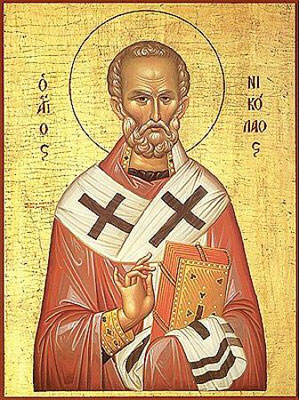
Sainted Nicholas the Wonderworker, Archbishop of Myra in Lycia – the
Transfer of the Relics from Lycian Myra to Bari in Italy: The
Vita about his life is located under the 6 December feastday.
In the XI Century the Byzantine Greek empire was living through some terrible
times. The Turks put an end to its influence in Asia Minor, they destroyed
cities and villages, the murdered the inhabitants, and they accompanied their
cruel outrage with the desecration of churches, holy relics, icons and books.
The Mussulmen attempted also to destroy the relics of Saint Nicholas, deeply
venerated by all the Christian world.
In the year 792 the caliph Aaron Al'-Rashid sent Khumeid at the head of a fleet
to pillage the island of Rhodes. Having lain waste this island, Khumeid set
off to Lycian Myra with the intent to rob from the tomb of Saint Nicholas.
But instead of it he robbed another, standing alongside the crypt of the saint.
Just as they succeeded in committing this sacrilege, a terrible storm lifted
upon the sea and almost all the ships were shattered into pieces.
The desecration of holy things shocked not only Eastern, but also Western Christians.
Christians in Italy were particularly apprehensive for the relics of Saint
Nicholas, and among them were many Greeks. The inhabitants of the city of Bari,
located on the shores of the Adriatic Sea, decided to save the relics of Saint
Nicholas.
In the year 1087 merchants from Bari and Venice set out to Antioch for trade.
Both these and others also had proposed on the return trip to take up the
relics of Saint Nicholas and transport them to Italy. In this plan the men
of Bari
commissioned the Venetians to land them at Myra. At first two men were sent
in, who in returning reported that in the city – all was quiet, and in
the church where rested the glorified relics, they encountered only four monks.
Immediately 47 men, having armed themselves, set out for the church of Saint
Nicholas. The monk-guards, suspecting nothing, showed them the raised platform,
beneathe which was concealed the tomb of the saint, where by custom, they anointed
foreigners with myrh from the relics of the saint. The monks told them during
this about an appearance of Saint Nicholas that evening to a certain elder.
In this vision Saint Nicholas ordered the cautious preserving of his relics.
This account encouraged the barons, – they saw an avowal for them in
this vision and as it were a decree from the saint. In order to facilitate
their activity, they revealed their intent to the monks and offered them money – 300
gold coins. The monk-guards refused the money and wanted to warn the inhabitants
about the misfortune threatening them. But the newcomers bound them and put
their own guards at the doorway. They took apart the church platform beneathe
which stood the tomb with the relics. In this effort the youth Matthew was
excessive in his especial zeal, wanting to as quickly as possible to find
the relics of Saint Nicholas. In his impatience he broke the cover and the
barons
saw, that the sarcophagus was filled with fragrant holy myrh. The compatriots
of the barons, the presbyters Luppus and Drogus, made a litany, after which
the break of Matthew began to flow with myrh from the overflowing sarcophagus
of the relics of the saint. This occurred on 20 April 1087.
Seeing the absence of a container chest, presbyter Drogus wrapped the relics
in the cover cloth, and in the company of the barons he carried them to the
ship. The monks – having been set free, alerted the city with the sad
news about the abduction of the relics of the Wonderworker Nicholas by foreigners.
A crowd of people gathered at the shore, but it was too late...
On 8 May the ships arrived in Bari, and soon the joyous news made the rounds
of all the city. On the following day, 9 May 1087, they solemnly transported
the relics of Saint Nicholas into the church of Saint Stephen, situated not
far from the sea. The solemn bearing of the relics was accompanied by numerous
healings of the sick, which inspired still greater reverence for the Saint
of God. A year afterwards a church was built in the name of Saint Nicholas
and consecrated by Pope Urban II.
This event, connected with the transfer of the relics of Saint Nicholas, evoked
a particular veneration for the Wonderworker Nicholas and was marked by the
establishing of a special feastday on 9 May. At first the Feastday of the Transfer
of the Relics of Saint Nicholas was observed only by the people of the city
of Bari. In the other lands of the Christian East and West it was not adopted,
despite the fact that the transfer of the relics was widely known about. This
circumstance is to be explained by the custom in the Middle Ages of venerating
primarily the relics of local saints. Moreover, the Greek Church did not establish
the celebration of this remembrance, since for it the loss of the relics of
Saint Nicholas was a sad event.
The Russian Orthodox Church celebration of the memory of the Transfer of the
Relics of Saint Nicholas from Lycian Myra to Bari in Italy on 9 May was established
soon after the year 1087, on the basis of an already established veneration
by the Russian people of the great Saint of God, brought over from Greece simultaneously
with the acceptance of Christianity. The glorious accounts about the miracle-workings,
done by the saint on both land and sea, were widely known to the Russian people.
Their inexhaustible strength and abundance testify to the especially graced
help of the great Saint of God for suffering mankind. The image of Saint Nicholas,
a mighty Wonderworker and Benefactor, became especially dear to the heart of
the Russian people, since it inspired deep faith and hope for his intercession.
The faith of the Russian people in the abundant aid of the Saint of God was
marked by numerous miracles.
A significant body of literature was compiled about him very early in Russian
writings. Accounts about the miracles of Saint Nicholas done in the Russian
land were recorded early on in deep antiquity. Soon after the Transfer of the
Relics of Saint Nicholas from Lycian Myra to Bari, there appeared a Russian
redaction of his Vita and an account about the Transfer of his holy relics,
written by one contemporary to this event. Earlier still was written a laudation
to the Wonderworker. And each week on Thursday, the Russian Orthodox Church
honours his memory in particular.
In honour of Sainted Nicholas were erected numerous churches and monasteries,
and with his name Russian people are wont to name their children at Baptism.
In Russia are preserved numerous wonderworking icons of the saint. Most reknown
among them are the images of Mozhaisk, Zaraisk, Volokolamsk, Ugreshsk and
Ratny. There was neither house nor temple in the Russian land, in which there
was
not an image of Saint Nicholas the Wonderworker. The significance of the
graced intercession of the great Saint of God is expressed by the ancient
compiler
of the Life-Vita, in the words of whom Sainted Nicholas "did work many
glorious miracles both on land and on sea, aiding those downtrodden in misfortune
and rescuing the drowning, carried to dry land from the depths of the sea,
raising up others from corruption and bringing them home, liberating from chains
and imprisonment, averting felling by the sword and freeing from death, and
granting much healing to many: sight to the blind, walking to the lame, hearing
to the deaf, and speech to the mute. He brought riches to many suffering in
abject poverty and want, he provided the hungry food and for each in their
need he appeared a ready helper, an avid defender and speedy intercessor and
protector, and such as appeal to him he doth help and deliver from adversity.
Both the East and the West know of this great Wonderworker, and all the ends
of the earth know his miracle-working".
Venerable Shio Mgvime, monk, of Georgia (6th c.) (Georgia)
Commemorated on May 9/May 22
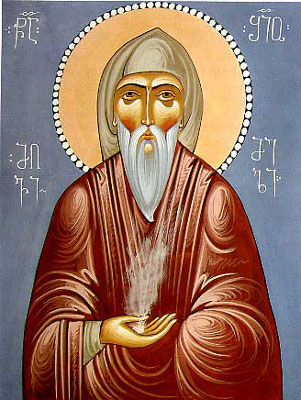
The Monk Shio (Simeon) of Mgvim was born in Syrian Antioch. His
parents were Christians and raised their son as the only heir.
The youth received a fine education, he studied the Holy Scripture
and already in his early years he became accomplished in the ability
of expounding the Word of God. Having learnt about an holy ascetic
named John, Shio secretly left his parental home and set out to
the saint. The Monk John made the youth return to his parents,
after foretelling that his parents would become monastics. The
prediction was soon fulfilled: Shio distributed his inheritance
and accepted tonsure from the Monk John.
The Monk Shio 20 years later, amidst 12 other chosen disciples of Saint John,
set off to Iveria (Gruzia or Georgia) to preach the Word of God. With the blessing
both of his teacher and of the Gruzinian Katholikos Eulabios, the Monk Shio
settled into a cave west of the city of Mtskheta, where he made austere ascetic
efforts and was vouchsafed miraculous visions. The solitary life of the ascetic
became known of, and soon the place of the saint's efforts was transformed
into a monastery, at which a church in the Name of the MostHoly Trinity was
established by the monk. Later on other churches were built: in honour of the
Mother of God and John the Forerunner. All the churches were consecrated by
the Katholikos Makarios. The number of brethren increased, and the monk gave
his blessing for them to found the Mgvim monastery, while he himself continued
his deeds of salvation in seclusion. The Monk Shio reposed on 9 May, having
the evening before communed the Holy Mysteries and given the brethren a final
salvific instruction. The remains of the Saint of God were buried in the monastery
founded by him. The Monk Shio is known, as the author of 160 precepts for the
brethren.
Apostle Simon the Zealot (1st. c.)
Commemorated on May 10/May 23
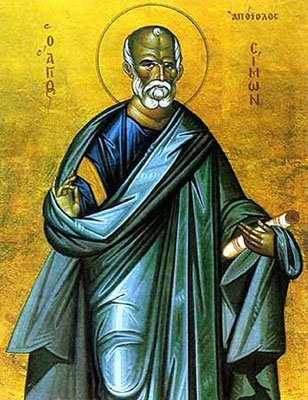
The Holy Apostle Simon Zelotes hailed from Cana of Galilee. He was a son of Joseph the Betrothed, and hence a brother of the Lord after the flesh, and he was also one of the 12 Apostles. The first miracle which the Saviour worked, – the transforming of water into wine, occurred at the house of Simon: at the time of a wedding-feast there was insufficient wine for the guests. Then the Lord, at the prompting of the MostHoly Mother of God, transformed water into wine. Struck by the miracle, Simon with all his heart and soul believed in the Lord Jesus as the Promised Messiah and, having left behind everything, he followed after Him. Simon received the title "Zelotes", i.e. a zealot, meaning a person who is zealous. On the day of Pentecost he received the gift of the Holy Spirit together with the other Apostles. The holy Apostle Simon preached the teaching of Christ at Judea, Egypt, Libya, Cyrenia and Britain. At Abkhazia he accepted a martyr's death, and was crucified on a cross. He was buried at the city of Nikopsia around Sukhum. Afterwards (in the XIX Century), at the place where the holy Apostle Simon asceticised near Mount Iveria, there was established the Novoathonite monastery of Simon the Canaanite. To the present day is preserved the cave wherein the holy Apostle Simon asceticised.
Venerable Isidora the Fool of Tabenna (Egypt) (365)
Commemorated on May 10/May 23
The Nun Isidora, Fool-for-Christ, asceticised in the Tabenea
monastery (Egypt) during the VI Century. The maiden Isidora took
upon herself the feat of folly, she acted like one insane and did
not partake of food together with the sisters of the monastery.
Many of them regarded her with contempt, but Isidora bore all this
with great patience and meekness, blessing God in everything. She
toiled in the kitchen and fulfilled at the monastery the very dirty
and hard tasks, cleansing the monastery of every impurity. The
Nun Isidora covered her head with a plain dish-rag, and in place
of cooked food she drank the soapy wash-water from the pots and
dishes. She never became angry, never insulted anyone with a word,
never grumbled against God or the sisters, and was given to silence.
One time a wilderness monk, Saint Pitirim, had a vision. An Angel
of God appeared to him and said: "Go to the Tabenea monastery. There thou wilt see a sister,
wearing on her head a dish-rag. She doth serve them all with love and bears
their contempt without grumbling. Her heart and her thoughts rest always with
God. By comparison thou dost sit in solitude, but thine thoughts flit about
all over the world".
Holy Equals-to-the Apostles Methodius (885) and Cyril (869), first
teachers of the Slavs
Commemorated on May 11/May 24
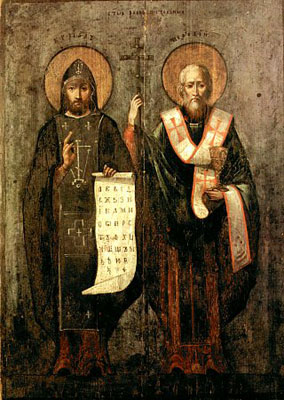
The Holy Equal-to-the-Apostles First-Teachers and Enlighteners
of the Slavic Peoples, the Brothers Cyril and Methodius came
from an illustrious and pious family living in the Greek city of
Soluneia
(Thessalonika). Saint Methodius was the oldest of seven brothers,
Saint Contantine (Cyril – was his monastic name) was the
youngest. Saint Methodius was at first in the military profession
and was governor in one of the Slavic principalities dependent
to the Byzantine empire – probably Bulgaria, which made it
possible for him to learn the Slavic language. Having dwelt there
for about 10 years, Saint Methodius afterwards accepted monastic
orders at one of the monasteries on Mount Olympos (Asia Minor).
Saint Constantine from his early years distinguished himself by
great aptitude and he studied together with the emperor Michael
during that one's youth – under the finest teachers in Constantinople,
among which were Photios, future Patriarch of Constantinople. Saint
Constantine, having attained knowledge in all the sciences of his
time and also many languages, also with particular diligence studied
the works of Sainted Gregory the Theologian. Because of his keen
mind and penetrating perception, Saint Constantine received the
title "Philosopher" (wise). Upon the completion of
his education, Saint Constantine accepted the dignity of priest
and
was appointed curator of the patriarchal library at the church
of Saint Sophia, but he soon quit the capital and went off secretly
to a monastery. Discovered there and having returned to Constantinople,
he was appointed teacher of philosophy in the highest level of
the Constantinople schools. The wisdom and strength of faith
for the still rather young Constantine was so great, that he
won the
victory in a debate with the leader of the heretic-iconclasts
Ananias. After this victory Constantine was sent by the emperor
to dispute
in a debate about the Holy Trinity with the Saracens (musselmans)
and again he gained the victory. Having returned, Saint Constantine
went off to his brother Saint Methodius on Olympos, spending
the time in unceasing prayer and reading the works of the holy
fathers.
The emperor soon summoned forth both of the holy brothers from
the monastery and dispatched them to preach the Gospel to the
Khazars. Along the way they
stayed for some time in the city of Korsun, making preparations for preaching.
There the holy brothers in miraculous manner discovered the relics of the
Priestmartyr Clement, Pope of Rome (Comm. 25 November). There
also at Korsun Saint Constantine
found a Gospel and Psalter written in "Russian letters" [i.e. Slavonic],
and a man speaking in Slavic, and he began to learn from this man to read and
to speak in his language. After this, the holy brothers set off to the Khazars,
where they gained the victory in a debate with Jews and Moslems by preaching
the Gospel teaching. On the way home the brothers again visited Korsun and,
taking up the relics of Saint Clement there, they returned to Constantinople.
Saint Constantine remained in the capital, but Saint Methodius received the
hegumenate at the small Polychronion monastery – not far from Mount
Olympos, where he pursued asceticism as before.
Soon there came to the emperor messengers from the Moravian prince Rostislav,
otherwise pressured by German bishops – with a request to send teachers
to Moravia, who would be able to preach in the vernacular Slavic tongue. The
emperor summoned Saint Constantine and said to him: "It is necessary for
thee to go thither, where it be better for thee that no one realise this".
Saint Constantine prepared for the new task with fasting and prayer. With the
help of his brother Saint Methodius and the students Gorazd, Clement, Savva,
Naum and Angelyar he composed a Slavonic alphabet and translated into the Slavic
tongue books – without which it would be impossible to celebrate Divine-services:
the Gospel, Epistles, Psalter and collected services. This occurred in the
year 863.
After completing the translation, the holy brothers set off to Moravia, where
they were received with great honour, and they began to teach the Divine-services
in the Slavic language. This aroused the malice of the German bishops, who
celebrated Divine-services in the Moravian churches in the Latin language,
and they rose up against the holy brothers, convinced that Divine-services
must be done only in one of three languages: Hebrew, Greek or Latin. Saint
Constantine answered them: "Ye recognise only three languages by which
to give glory to God. But David sang: Come to the Lord, all nations, praise
the Lord all peoples, let everything that hath breath praise the Lord! And
in the Holy Gospel it says: Go teach all nations...". The German bishops
were humiliated, but they became all the more bitter and sent off a complaint
to Rome. The holy brothers were summoned to Rome for a decision on this question.
Taking with them the relics of Saint Clement Pope of Rome, Saints Constantine
and Methodius set off to Rome. Knowing that the holy brothers were bringing
along with them these relics, Pope Adrian met them along the way with his
clergy. The holy brothers were greeted with honour, the pope of Rome gave
permission
for Divine-services in the Slavonic language, and the books translated by
the brothers he ordered to be placed in Roman churches and to make liturgy
in the
Slavonic language.
At Rome Saint Constantine fell ill and, in a miraculous vision from the Lord
advising of the nearness of death, he accepted the monastic schema-order
with the name of Cyril (Kirill). 50 days after the accepting of the schema,
on 14
February 869, Saint Cyril died at 42 years of age. In expiring to God, Saint
Cyril commanded his brother Saint Methodius to continue with their common
task – the
enlightening of the Slavic peoples with the light of the true faith. Saint
Methodius entreated the pope of Rome to send the body of his brother for
burial in their native land, but the pope commanded the relics of Saint Cyril
to be
placed in the church of Saint Clement, where miracles began to occur from
them.
After the death of Saint Cyril, the pope in fulfilling the request of the
Slavic prince Kotsel, sent Saint Methodius to Pannonia, – having ordained him
Archbishop of Moravia and Pannonia, on the ancient throne of the holy Disciple
Andronikes. In Pannonia Saint Methodius together with his students continued
to propagate Divine-services in books inscribed in the Slavonic language. This
again aroused the wrath of the German bishops. They obtained an arrest and
held a trial over Saint Methodius, who was sent in chains to Swabia, where
during the course of two and an half years he underwent many sufferings. Having
been set free by order of the Pope of Rome, John VIII, and restored to the
rule of his archdiocese, Saint Methodius continued to preach the Gospel among
the Slavs. He baptised the Czech prince Borivoi and his spouse Liudmila (Comm.
16 September), and also one of the Polish princes. The German bishops started
a persecution against the saint for a third time, – for not accepting
the Roman teaching about the procession of the Holy Spirit from both the
Father and from the Son. Saint Methodius was summoned to Rome, but he justified
himself
before the pope, and preserved in its purity the Orthodox teaching, and was
sent off again to the capital of Moravia, Velehrad.
Here in the ensuing years of his life Saint Methodius with the help of two
of his priest-students translated into the Slavonic language all the Old Testament
except for the Book of Maccabbees, and even the Nomokanon (Rule of the holy
fathers) and books of the holy fathers (Paterikon).
Sensing the nearness of death, Saint Methodius decreed one of his students – Gorazd,
as worthy successor to himself. The sainted-bishop predicted the day of his
death and he died on 6 April 885 at an age of about 60 years. The burial service
of the saint was done in three languages – Slavonic, Greek and Latin.
He was buried in the cathedral church of Velehrad.
The elder set out to the Tabenea monastery, but among the sisters gathered he did not see the one pointed out to him in the vision. Then they led Isidora to him, considering her a demoniac. Isidora fell down at the knees of the elder, asking his blessing. But the Monk Pitirim himself bowed down to the ground to her and said: " Bless me first, venerable mother!" To the astonished questions of the sisters the elder answered: "Isidora before God is higher up than all of us!" Then the sisters began to repent, confessing all the insults hurled by them at Isidora, and they asked forgiveness of her. The saint, however, distressed over her fame, secretly hid herself away from the monastery, and her ultimate fate remained unknown. They presume that she died not later than the year 365.
Sainted Nikodim, Archbishop of Serbia
Commemorated on May 11/May 24
Sainted Nikodim, Archbishop of Serbia, was hegumen of the Khilendaria monastery and was elevated to the dignity of bishop in the year 1316. Especially noteworthy is this, that in the year 1319 he translated into the Slavonic language and ordered into use in Serbia the Typikon (Ustav) of Saint Sava the Sanctified, of Jerusalem. Sainted Nikodim died in the year 1325.
St. Epiphanius, bishop of Cyprus (403)
Commemorated on May 12/May 25
Sainted Epiphanios, Bishop of Cyprus, lived during the IV Century
in Phoenicia. By descent he was Jewish, and in his youth he received
a fine education. He was converted to the Christian faith after
he saw how a certain monk, Lucian by name, gave away his own clothing
to a poor person. Struck by the compassion of the monk, Epiphanios
besought him to instruct him in Christianity. He accepted Baptism
and settled in the monastery, organised by his teacher Lucian.
At the monastery he pursued asceticism under the guidance of the
experienced elder Ilarion, and he occupied himself with the copying
of Greek books and progressing in the monastic life. Saint Epiphanios
for his ascetic deeds was granted the gift of wonderworking, but
in order to avoid human glory, he set out from the monastery into
the Spanidrion wilderness. Robbers caught him there and held him
for three months in captivity. By his talk about repentance, the
saint brought one of the gang of robbers to the holy faith in the
True God. When they set free the holy ascetic, with him also went
the robber. Saint Epiphanios took him to his monastery and baptised
him with the name John. And from that time he became a faithful
disciple of Saint Epiphanios, and he carefully recorded in writing
about the life and miracles of his preceptor. Reports about the
righteous life of Saint Epiphanios spread far beyond the bounds
of the monastery. The saint set out a second time into the wilderness
with his disciple John. But even in the wilderness disciples started
to come to him. Thus emerged a new monastery. After a certain while
Saint Epiphanios undertook a pilgrimage to Jerusalem for veneration
of its holy artifacts and from there returned to the Spanidrion
monastery. The people of the city of Lycia dispatched the monk
Polybios to Saint Epiphanios with a request to occupy the bishop's
throne of their dead archpastor. But the perspicacious ascetic,
having learned of this intention, secretly set out into the Pathysian
wilderness to the great ascetic Ilarion (Comm. 21 October), under
whose guidance he pursued asceticism in his youthful years. The
saints spent two months in mutual prayer, and then Ilarion sent
Saint Epiphanios to Salamis. Bishops were gathered there for the
selecting of a new archpastor in place of one recently died. The
Lord revealed to the eldest of them, Bishop Papios, that the Monk
Epiphanios arriving in the city should be chosen bishop. When Epiphanios
arrived, Saint Papios led him into the church, where in obedience
to the will of the participants of the Council, Epiphanios was
obliged to give his consent. Thus occurred the elevation of Saint
Epiphanios to the bishop's cathedra of Salamis in about the year
367.
Sainted Epiphanios won reknown upon the archpastoral chair by
his great zeal for the faith, love and charity towards the poor,
and simplicity of character.
He underwent much from the slander and enmity of some of his clergy. For
his purity of life, Sainted Epiphanios received the granting
to see at Divine Liturgy
the coming of the Holy Spirit upon the Holy Gifts. One time the saint, celebrating
the Mystery, was deprived of this vision. He then became suspicious of one
of the clergy and quietly said to him: "Depart, my son, since today thou
art unworthy to participate at the celebrating of the Mystery".
On this event the writings of his disciple John break off, since he then fell
sick and died. The further record of the life of Saint Epiphanios was continued
by a second of his disciples, Polybios (afterwards bishop of city of Rinocyreia).
Through the intrigues of the empress Eudoxia and the Alexandria patriarch
Theophilos, towards the end of his life Saint Epiphanios was summoned to
Constantinople
for a church council, which was convened for judgement upon the great saint,
John Chrysostom (Comm. 14 September and 13 November). But Saint Epiphanios,
not wanting to take part in a lawless council, left Constantinople. While
sailing upon the ship, the saint sensed the nearness of his death, and he
gave his
disciples final instructions – to keep the Commandments of God and to
preserve the mind from impure thoughts – and two days later he died.
The people of Salamis met the body of their archpastor with carriages, and
on 12 May 403 they buried him with reverence in a new church built by the
saint.
The Seventh OEcumenical Council (Sobor) named Sainted Epiphanios as a Father
and Teacher of the Church. In the writings of Saint Epiphanios, the "Panarion" and
the "Ankoratos" contain refutation of the Arian and other heresies.
In others of his works are encountered valuable church-historical traditions
and directives on the Greek translation of the Bible.
Sainted Germanos, Patriarch of Constantinople
Commemorated on May 12/May 25
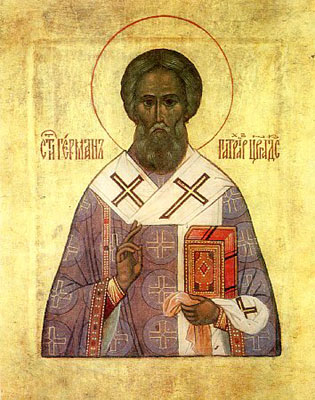
Sainted Germanos, Patriarch of Constantinople, was born at Constantinople
in the VII Century. His father, one of the foremost senators
in Byzantium, was killed by order of the emperor Constantine Pogonatos
(668-685), and the boy Germanos was emasculated and given over
to church clergy, where he deeply studied Holy Scripture. For
his
sanctity of life, Germanos was made bishop in the city of Kizikum.
Saint Germanos rose up steadfastly in defense of the Orthodox
faith against the iconoclast heretics. He was later made patriarch
of
Constantinople. Saint Germanos continued to stand up against
the iconoclasts and to their spokesman, the emperor-heretic Leo
III
the Isaurian (717-741). But the contest was unequal, and he was
forced to put his omophor upon the prestol' (altar-table) in
the altar, and to resign the archpastoral cathedra. Then the enraged
emperor, – having accused the Patriarch the day before
of heresy, sent soldiers, who subjected the saint to beatings
and
threw him out of the patriarchal residence. Saint Germanos was
Patriarch for 14 years and 5 months. He settled into a monastery,
where he spent the remaining days of his life. Holy Patriarch
Germanos died in the year 740, at age 95, and was buried in the
Khoron monastery
in Constantinople. Afterwards his relics were transferred to
France.
At the Seventh OEcumenical Council (787), the name of Patriarch
Germanos was written into the diptych-list of the saints. Written
by him was: "Meditation
on church matters or Commentary on the liturgy"; also a composition,
devoted to an explanation of difficult places of Holy Scripture, and another
work concerning
the rewards of the righteous after death. Providing a wealth of historical
accounts is his important work about the various heresies that had arisen
since apostolic times, and also about the church councils taking place during
the
reign of the emperor Leo the Iconoclast. There are preserved also three missives
from the Patriarch about the veneration of icons, which were read at the
Seventh OEcumenical Council. His other works present his hymns in praise
of the saints,
discourses on the feasts of the Entry into the Temple, the annunciation and
the Uspenie (Repose) of the MostHoly Mother of God, and on the restoration
of the church in honour of the Placing of the Venerable Belt (Poyas, Zona)
of the MostHoly Mother of God.
Virgin-martyr Glyceria at Heraclea (141) and with her Martyr Laodicius,
jailer of St. Glyceria
Commemorated on May 13/May 26
Saint Glyceria suffered as a martyr for her faith in Christ in the II Century, during the time of a persecution against Christians under the emperor Antoninus (138-161). She was descended from illustrious lineage: her father Macarius was the city-governor of Rome, and afterwards he resettled to the Thracian city of Trojanopolis. But Saint Glyceria early on lost both her father and mother. Falling in with Christians, she converted to the true faith, and daily she visited the church of God. The Trojanopolis governor, Sabinus, having received the imperial edict about compelling Christians to offer sacrifice to the idols, and so he set the inhabitants of the city a day of general worship of the idol Zeus. Saint Glyceria firmly resolved to suffer for Christ, she told the Christians about her intention, and she besought them to pray that the Lord would send her the strength to undergo the sufferings. On the festal day of Zeus Saint Glyceria, having traced on her forehead the Sign of the Cross, went into the pagan temple; the saint stood on a raised spot in the rays of the sun, and snatched from her head the veil, showing all the holy Cross, traced on her forehead. She prayed heatedly to God, that He should bring the pagans to their senses and destroy the stone idol of Zeus. Suddenly thunder was heard, the statue of Zeus crashed to the floor and smashed into little pieces. In a rage, the governor Sabinus and the pagan priests commanded the people to pelt Saint Glyceria with stones, but the stones that were thrown did not touch the saint. They locked up Saint Glyceria in prison, where the Christian priest Philokrates came to her and encouraged the martyress in the deed before her. In the morning, when the tortures had started, suddenly amidst the torturers there appeared an Angel, and they all fell to the ground, overcome with terror. When the vision vanished, then by order of Sabinus, himself hardly able to speak, they again led off the saint to prison. They securely shut the door and sealed it with the personal ring of the governor, so that no one could get in to her. During all her time of being thus locked in, Angels of God brought Saint Glyceria food and drink. Some many days afterwards Sabinus came to the prison and he himself removed the seal. Going in to the saint, he was shaken, seeing her alive and well. Setting off for the city of Heraclium, Sabinus gave orders to bring along there also Saint Glyceria. From this city there came out to meet her the Christians of Heraclium with the bishop Dometius at the head, and in front of everyone he uttered a prayer to the Lord for strengthening the saint in the act of martyrdom. At Heraclium they cast Saint Glyceria into a red-hot furnace, but the fire in it at once extinguished. Then the governor, in a mindless fury, gave orders to strip the skin from the head of Saint Glyceria. Then they threw the bared martyress into prison onto sharp stones, where she prayed incessantly, and at midnight in the prison there appeared an Angel which healed her of her wounds. The prison guard Laodicius, having come in the morning for the saint, at first did not recognise her, and thinking that the martyress had been hidden away he wanted to kill himself in fear of punishment, but Saint Glyceria stopped him. Shaken by the miracle, Laodicius believed in the True God and he besought prayers of the saint, that he also might suffer and die for Christ together with her. "Follow Christ and thou wilt be saved", – the holy martyress answered him. Laodicius placed upon himself the chains, with which the saint was bound, and at the trial he declared to the governor and everyone present about the miraculous healing of Saint Glyceria by an Angel and he confessed himself a Christian. The newly chosen one of God was immediately beheaded by the sword. Christians, having secretly taken up his remains, reverently gave them burial, but Saint Glyceria was given over for devouring by wild beasts. She went to execution with great joy, but the lioness set loose upon the saint meekly crawled up to her and, curling up, lay at her feet. Finally, the saint turned with a prayer to the Lord, imploring that He take her unto Himself. In answer she heard a Voice from Heaven, summoning her to the Heavenly bliss. At this moment there was set loose upon the saint another lioness, which pounced upon the martyress and killed her, but did not rend her apart. Bishop Dometius and the Heraclium Christians reverently buried the holy Martyress Glyceria. She suffered for Christ in about the year 177. Her holy relics were glorified with a flow of curative myrh.
Martyr Isidore of Chios (251)
Commemorated on May 14/May 27
The Holy Martyr Isidor lived during the III Century on the Island
of Chios, and was a native of Alexandria. During the first year
of rule of the emperor Decius (249-251) there was issued an edict
to make a census of all those capable to serve in the armies
of the Roman empire. Saint Isidor, tall and strong of body, was
drafted
into the regiment of the military-commander Numerius. Saint Isidor
was a Christian, he led a life of temperance and abstinence,
he was chaste and he shunned all the pagan customs. Another imperial
edict then commanded, that all the soldiers were to worship the
Roman pagan gods and to offer them sacrifice. Not to obey the
edict
carried the penalty of torture and death. The centurion reported
to the military-commander Numerius, that Isidor was a Christian.
At the interrogation before Numerius Saint Isidor without flinching
confessed his faith in Christ the Saviour and refused to offer
sacrifice to idols. Numerius urged the saint not to expose himself
to tortures and to obey the will of the emperor, but Saint Isidor
answered, that he would obey only the will of the eternal God,
Christ the Saviour, and never would he renounce Him. The saint
was handed over to torture. During the time of torments he praised
Christ God and denounced the pagan idols. The military-commander
gave orders to cut out the tongue of the saint, but even after
this the saint continued distinctly to give glory to Christ.
Numerius in fright fell to the ground and himself lost the gift
of speech.
Getting up with the help of soldiers, by means of gestures he
demanded a small board and on it wrote an order – to cut off the head
of Saint Isidor. Saint Isidor welcomed his death sentence with
joy and said: "I glorify Thee, O my Master, that by Thy mercy
Thou hast accepted me in Thine Heavenly Habitation!" The
death of the martyr occurred in the year 251. After execution
his body
was cast out without burial, but another saint, the secret Christian
Ammonios, took up his body and committed it to earth. Later on
Ammonios himself accepted a martyr's death in the city of Kyzikos
(Comm. 4 September).
At the beginning of the XII Century the Russian pilgrim Daniel saw the relics
of the holy Martyr Isidor on the Island of Chios. His relics were later transferred
to Constantinople and placed in the church of Saint Irene.
Martyr Maximus, under Decius (250)
Commemorated on May 14/May 27
The Holy Martyr Maximos suffered under the emperor Decius (249-251). Maximos was a layman and plied the trade of merchant. He was a pious Christian and he led many pagans to faith in Christ the Saviour, and persuaded them to accept Baptism. One time, when the pagans had gathered for offering to their gods an human sacrifice, Saint Maximos plucked up his courage, and unable to bear the sight of such a spectacle, he rushed at them, loudly denouncing their impiety and error, calling the idols soulless creations of mankind. The frenzied pagans stoned the martyr to death.
The Ascension of our Lord Jesus Christ
Commemorated on May 15/May 28
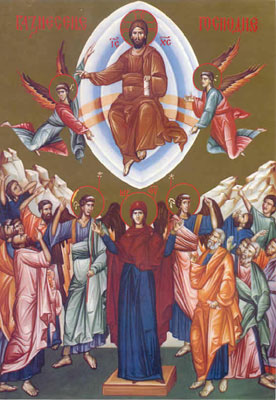
Venerable Pachomius the Great, founder of cenobitic monasticism
(346)
Commemorated on May 15/May 28
The Monk Pachomios the Great, together with Anthony the Great
(Comm. 17 January), Makarios the Great (Comm. 19 January), and
Euthymios the Great (Comm. 20 January), was both an exemplar
of wilderness dwelling, and a founder of the monastic "life-in-common" coenobitism
in Egypt. The Monk Pacholios was born in the III Century in the
Thebaid (Upper Egypt). His parents were pagans and he received
an excellent secular education. From youth he had the traits
of good character, he was prudent of sensible in mind. When Pacholios
reached age 20, he was called up into the army of the emperor
Constantine
(apparently, in the year 315). They settled the new conscripts
into the edifice of a city prison under a guard of sentries.
The local Christians came with supplies of food, they fed the soldiers
and they took sincere care of them. When the youth learned, that
these people acted thus for the sake of their God, fulfilling
His
commandment about love for neighbour, this made a deep impression
upon his pure soul. Pacholios made a vow to become a Christian.
Having returned from the army after the victory, Pacholios accepted
holy Baptism, resettled himself into the lonely settlement of
Shenesit and immediately he began to lead a strict ascetic life.
Sensing
the need for spiritual guidance, he turned to the Thebaid wilderness
dweller Palamon. He was fondly accepted by the elder, and he
began to proceed through monastic efforts on the example of his
instructor.
One time, after 10 years of wilderness life, the Monk Pacholios was making
his way through the desert, when he halted at the ruins of the former village
of Tabennis and here he heard a Voice, ordering him to form at this place a
monastery. Pachomios reported about this to the elder Palamon, and they both
considered the words heard to be a command from God. They set out to Tabennis
and began by building there a small monastic hovel. The holy elder Palamon
blessed the beginning foundations of the monastery and made a prediction of
its future glory. But soon also the Monk Palamon expired to the Lord. An Angel
of God then appeared to Saint Pacholios in the form of a schemamonk and entrusted
to him an ustav-rule of monastic life. And soon his own elder brother John
came and settled there together with him.
The Monk Pachomios underwent many a temptation and assault from the enemy of
the race of man, but the Monk Pachomios bravely warded off all the temptations
by his prayer to God and endurance.
Gradually there began a gathering of followers to the Monk Pachomios. Their
teacher impressed everyone by his love for work, whereby he managed to accomplish
all kinds of monastic tasks: he cultivated a garden, he conversed with those
that arrived seeking guidance, and he tended to the sick. The Monk Pachomios
introduced a monastic rule of "life-in-common", making everything
the same for everyone in food and attire. The monks of the monastery were
to toil at the obediences assigned them for the common good of the monastery.
Among the various obediences was the re-copying of books. The monks were
not
to possess their own money nor to accept anything from their kinsfolk. The
Monk Pachomios considered that an obedience, fulfilled with zeal, was higher
than fasting or prayer, and he demanded from the monks an exact observance
of the monastic rule, strictly chastising flaggards.
To the Monk Pachomios one time came his sister Maria, who for a long time had
wanted to see her brother. But the strict ascetic refused seeing her and via
the gate-keeper he gave her the blessing to enter upon the path of monastic
life, promising his help with this. Maria wept, but did as her brother had
ordered. The Tabennis monks built her an hut on the opposite side of the River
Nile. And to Maria also there began to gather nuns, and soon there was formed
a women's monastery with a strict monastic rule, provided by the Monk Pachomios.
The number of monks at the monastery grew quickly, and it necessitated the
building of 7 more monasteries in the vicinity. The number of monks reached
7,000, – all under the guidance of the Monk Pachomios, who visited
at all the monasteries and administered them. But at the same time Saint
Pachomios
remained a deeply humble monk, who was always ready to comply with and accept
the remarks of each brother.
Severe and strict towards himself, the Monk Pachomios had great kindness and
condescension towards the spiritually immature deficiencies of monks. One of
the monks was ardent for the deed of martyrdom, but the Monk Pachomios swayed
him from this yearning and instructed him quietly to fulfill his monastic obedience,
taming the pride in himself and training him in humility. One time a monk would
not heed his advice and went off from the monastery, during which time he was
set upon by brigands, who under the threat of death forced him to offer sacrifice
to the pagan gods. Filled with despair, the monk returned to the monastery.
The Monk Pachomios ordered him to pray intensely night and day, keep strict
fast and live in complete solitude. The monk followed his advice, and this
saved his soul from despair.
The monk taught to avoid against judging others and he himself feared to be
judgemental of anyone even in thought.
It was with an especial love that the Monk Pachomios concerned himself over
the sick monks. He visited them, he cheered up the disheartened, he urged them
to be thankful to God and put their hope in His holy will. For the sick he
lightened the fasting, if this should aid in their recovery of health. One
time in the absence of the monk, the cook did not prepare the monks any cooked
food, on the presumption that the brethren loved to fast. Instead of doing
his obedience, this monk plaited 500 mats, something which the Monk Pachomios
had not encouraged. In punishment for the disobedience, all the mats prepared
by the cook were ordered burnt.
The Monk Pachomios always taught the monks to have hope only upon the help
and mercy of God. At the monastery it happened that there was an insufficiency
of grain. The saint spent the whole night at prayer, and in the morning there
came from the main city a large quantity of bread for the monastery, at no
expense. The Lord granted the Monk Pachomios the gift of wonderworking and
healing the sick.
The Lord revealed to him the ultimate fate of monasticism. The monk learned,
that successive monks would not have such zeal in their efforts as did the
first, and they would walk in the darkness of not having experienced guides.
Prostrating himself upon the ground, the Monk Pachomios wept bitterly, calling
out to the Lord and imploring mercy for them. In answer he heard a Voice: "Pachomios,
be mindful of the mercy of God. About the monks to come, know that they shalt
receive recompense, since that they too shalt have occasion to suffer the life
burdensome for the monk".
Towards the end of his life the Monk Pachomios likewise fell ill from a pestilence
that afflicted the region. His closest and beloved disciple, the Monk Theodore
(Comm. 17 May), tended to him with a filial love. The Monk Pachomios died in
about the year 348 at age 53, and he was buried on an hill near the monastery.
Venerable Theodore the Sanctified (368), disciple of St. Pachomius
the Great
Commemorated on May 16/May 29
The Monk Theodore was called "Sanctified" because he
was the first in his monastery ordained to the priesthood.
The Monk Theodore came from Egypt and was the son of rich and illustrious Christian
parents. The yearning for monastic life early showed up in him. One time at
the house of his parents during the feast of Theophany there was a large party,
and the lad did not want to take part in the festivities, grieving that because
of earthly joys he would be deprived of joys in the life to come. At 14 years
of age he secretly left home and settled in one of the monasteries. Hearing
about Pakhomios the Great, he burned with the desire to see the ascetic. The
Monk Pakhomios received the arriving lad with love, having been informed by
God beforehand about his coming. Remaining at the monastery, the Monk Theodore
quickly succeeded in all his monastic tasks, particularly in the full obedience
to his guide and in his compassion towards the surrounding brethren. Theodore's
mother, learning that he was at the Tabennisa monastery, came to the Monk Pakhomios
with a letter from the bishop, imploring a meeting with her son. But the Monk
Theodore, fearing to break his vow of renunciation from the world, refused
to meet with his mother.
Seeing the strength of mind and ability of Saint Theodore, the Monk Pakhomios
once directed him to speak an instruction to the brethren on Holy Scripture.
Saint Theodore was then but 20 years old. He unquestioningly obeyed and began
to speak, but certain of the older brethren took offence that a newly begun
monk should read them a discourse, and they departed. The Monk Pakhomios
thereupon said to them: "Ye have given in to the devil and by your conceit your
efforts art come to naught. Ye rejected not Theodore, but rather the Word of
God, and have deprived yourselves of the Holy Spirit".
Saint Pakhomios appointed the Monk Theodore as overseer of the Tabennisa monastery,
and withdrew to a more solitary monastery. Saint Theodore with filial love
continued to concern himself over his instructor, and in the final illness
of the Monk Pakhomios he looked after him, and when the great abba reposed
to the Lord, he closed his eyes. After the death of the Monk Pakhomios, Saint
Theodore directed the Tabennisa monastery, and later on he was at the head
of all the Thebaid monasteries. The Monk Theodore the Sanctified was famed
for holiness of life and a copious gift of wonderworking, and he was well known
to Saint Athanasias, Patriarch of Alexandria. Saint Theodore reposed in his
old age in the year 368.
Hieromartyr Theodore of Vrsac in Banat, Serbia (1595)
Commemorated on May 16/May 29
Martyr Vukasin from the Village of Klepci
Commemorated on May 16/May 29
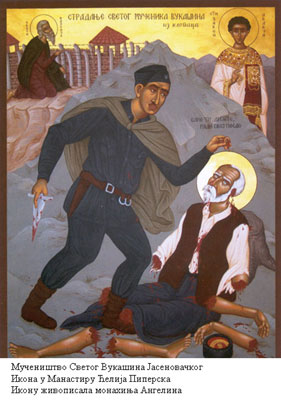
Little is known about Vukasin, the Serb from Herzegovina. He was
born in the village of Klepci, in Herzegovina, at the end of
the last or at the beginning of this century. At the beginning
of World
War II, the Ustase arrested him and transported him, together
with other Serbs of that region, into the notorious concentration
camp
of Jasenovac. After horrible days full of torturing, he was brought
in front of an Ustasa who was supposed to execute him, but who
said he would spare Vukasin's life if Vukasin cried loudly: "Long
live our Head Ante Pavelic!". Vukasin replied calmly: "Child,
you just do your job". Ustasa cut off his ear and repeated
his request. Vukasin repeated his answer. Ustasa then cut off Vukasin's
other ear and nose and scarred his face. The next body part was
tongue. After repeating the request to Vukasin to utter the vicious
words and hail the Head of Ustase, Vukasin once again calmly replied: "Child,
just do your job!". Distracted Ustasa killed him, and afterwards
went mad.
At the regular session of the Holy Assembly of Bishops of the Serbian
Orthodox Church in 1998, Vukasin from the Klepci village was entered
into the List of Names of the Serbian Orthodox Church as the Confessor.
Apostle Andronicus of the Seventy and his fellow laborer Junia
(1st c.)
Commemorated on May 17/May 30
The Holy Disciple from the 70 Andronicus and his helper in apostolic
works, Saint Junia (June), were relatives of the holy Apostle
Paul. They laboured much, preaching the Gospel to pagans, about
which
the Apostle Paul makes mention in his Epistle to the Romans: "Greet
Andronicus and Junia, my kinsfolk and prisoners with me, acknowledged
amongst the Apostles and having still before me believed in Christ" (Rom.
16: 7). Saint Andronicus was ordained bishop of Pannonia, but
the preaching took Saint Junia and him also to other lands, far
from
the boundaries of his diocese. By the efforts of Saints Andronicus
and Junia the Church of Christ was strengthened, pagans were
converted to the knowledge of God, many pagan temples ceased
functioning,
and in their place were erected Christian churches. From the
service in honour of these saints it is known, that they suffered
martyrdom
for the Name of Christ.
In the V Century, during the reign of the emperors Arcadius and
Honorius, their holy relics were uncovered on the outskirts of
Constantinople together with
the relics of other martyrs "at the Eugenius gate" (Comm. 22 February).
It was revealed to the pious cleric Nicholas Kalligraphos that among these
17 martyrs were also the relics of the holy Disciple Andronicus. Afterwards
on this spot was built a magnificent church.
Martyr Theodotus of Ancyra and seven virgin-martyrs: Alexandra,
Tecusa, Claudia, Phaine, Euphraisa, Matrona, and Julia (303)
Commemorated on May 18/May 31
The Holy Martyr Theodotos
and the Holy Seven Virgins – Tecusa,
Thaina, Claudia, Matrona, Julia, Alexandra and Euphrasia, lived
during the 2nd half of the III Century in the city of Ancyra, Galatia
district, and died as martyrs for Christ at the beginning of the
IV Century. Saint Theodotos was "an inn-keeper", had
his own inn and was married. Then already he had attained to high
spiritual accomplishment: he maintained prudence and purity, cultivated
temperance in himself, subjugated the flesh to the spirit, and
became practised in fasting and prayer. By his conversations he
brought Jews and pagans to the Christian faith, and sinners – to
repentance and improvement. Saint Theodotos received the gift of
healing from the Lord and he treated the sick by placing his hands
on them.
During the time of the persecution under the emperor Diocletian
(284-305), there was appointed as governor in the city of Ancyra – Theoteknes,
known for his cruelty. Many Christians fled from the city, having
forsaken their
homes and property. Theoteknes made a proclamation to all Christians that they
were under obligation to offer sacrifice to idols, and in the event of refusal
they were to be given over to torture and death. Pagans delivered Christians
over to torture, and then divided up their property.
A famine befell the country. During these grim days, Saint Theodotos gave shelter
in his inn to Christians left homeless. he fed them, hid away those being pursued,
and from his supplies gave to devastated churches everything necessary for
making the Divine Liturgy. He fearlessly went into the prisons, rendering help
to the innocently condemned – encouraging them to be faithful to Christ
the Saviour to the very end. Theodotos did not fear to bury the remains of
holy martyrs, either carrying them off secretly or ransoming them from the
soldiers for money. When the Christian churches at Ancyra were destroyed and
closed, Divine Liturgy began to be celebrated in his inn. Perceiving that the
deed of martyrdom awaited him too, Saint Theodotos in conversation with the
priest Phrontonos predicted, that in a short while they would bring to him
the relics of martyrs, at a place chosen by both of them. In surety of his
words, Saint Theodotos gave his ring to the priest.
During this while seven holy virgins had accepted death for Christ, of whom
the eldest – Saint Tecusa – was an aunt of Saint Theodotos. The
holy virgins – Tecusa, Thaina, Claudia, Matrona, Julia, Alexandra and
Euphrasia – from their youth had dedicated themselves to God, and lived
in constant prayer, fasting, temperance and good deeds. All of them had attained
to an elderly age. Brought to trial as Christians, the holy virgins in front
of Theoteknes bravely confessed their faith in Christ and were given over to
torture, but remained steadfast. The governor thereupon gave them over to shameless
youths for desecration. The holy virgins prayed intensely, asking help from
God. Saint Tecusa fell down at the feet of a youth, and taking back her head-veil
she showed him her greyed hair. The youths became startled, started weeping
and ran off. The governor then ordered, that the saints take part in "the
ablution of the idols", which was done by pagan priests, but again the
holy virgins refused. For this they were sentenced to death. An heavy stone
was tied to the legs of each, and all seven of the holy virgins was drowned
in a lake. On the following night Saint Tecusa appeared in a dream to Saint
Theodotos, asking him to take up her body and give it Christian burial. Saint
Theodotos, taking with him his friend Polychronios and several other Christians,
set off to the lake. It was dark, and a burning torch led the way. Amidst them
in front of the guard, posted by the pagans at the shore of the lake, appeared
the holy martyr Sosander. The frightened guard ran off in terror. The wind
drove the water towards the other side of the lake. The Christians took up
the bodies of the holy martyresses and carried them to church, from whence
they were given over to burial. Learning about the theft of the bodies of the
holy martyresses, the governor went into a rage and gave orders to strike at
all Christians and give them over to torture. Polychronios also was seized.
Not able to endure the torture, he informed on Saint Theodotos, as the perpetrator
of the theft of the bodies. Saint Theodotos began to prepare to die for Christ;
having come up together with all the Christians zealous in prayer, he made
bequest of his body to the priest Phrontonos, to whom earlier he had given
his ring. The saint came before the judge. They showed him various instruments
of torture and instead of them they promised him honours and riches, if he
recanted from Christ. Saint Theodotos glorified the Lord Jesus Christ, and
confessed his faith in Him. In anger the pagans gave the saint over to constant
torture, but the power of God sustained the holy martyr. He remained alive
and was cast into prison. On the following morning the governor again gave
orders to torture the saint, but he soon perceived, that it was impossible
to break his courage. He then gave orders to behead the martyr. The execution
was done, but sensing that a storm was approaching, the soldiers set fire to
the body of the martyr. And soldiers, sitting in a tent, remained to guard
the body. At this point the priest Phrontonos appeared from a nearby way, leading
a donkey with a load of wine from his vineyard. The donkey suddenly fell down
near the place where lay the body of Saint Theodotos. The soldiers helped get
the donkey back up and they told Phrontonos that they were guarding the body
of the executed Christian Theodotos. The priest perceived, that the Lord had
intentionally sent him hither. He placed the holy remains on the donkey and
took them to the place, indicated by Saint Theodotos for his burial, and with
honour he committed them to the earth. Afterwards he built up a church on this
spot. Saint Theodotos accepted death for Christ on 7 June 303 or 304, and his
memory is commemorated on 18 May, on the day of death of the holy virgins.
The account of the life and martyr's act of Saint Theodotos and the suffering
of the holy virgins was compiled by the contemporary and companion of Saint
Theodotos, and an eye-witness of his death – Nilos, living in the city
of Ancyra during the period of persecution of Christians under the emperor
Diocletian.