Serbian Church in History
By Very Reverend Dr. Radomir Popovic
Serbian Church in History
DOWNLOAD PDF FILESrpska Crkva u Istoriji
STAMPAJTE I CITAJTE NA SRPSKOMTABLE OF CONTENTS
RENEWAL OF THE PATRIARCHATE OF PEC
POPULAR UPRISINGS AGAINST THE TURKS
ABOLISHMENT OF THE PATRIARCHATE OF PEC
SERBIAN CHURCH FROM 1766 TO 1920
Serbs belong to the grand family of Slav nations. As early as 5th and 6th centuries AD they migrated from their ancient lands in Northern Europe to the Balkan Peninsular which, at the time, constituted northern regions of the Byzantine Empire. There they found a mostly deserted, devastated and pillaged territory since, prior to their arrival, it had been affected by the Grand Migration of the Euro-Asian peoples in 4th and 5th centuries AD.
Being pagan, the South Slav nations considerably contributed towards the destruction of the Christian Church organization which, in its turn, had functioned well on the Balkan Peninsular several centuries before their arrival.
It is without doubt that first Christian influences on the Serbs occurred after their arrival to the Balkans. Of course, Serbs were not the first pagan nation in this region to have come into contact with Christianity; one should also mention the Goths, Huns, Langobards, Avars, Gepids, Herulians…
Very early upon their arrival Slavs, i.e. Serbs inhabiting northern regions of Byzantium, had shown willingness to stay in the area indefinitely. This decision to stay might have been taken during the rule of Emperor Justinian (527-565) if not even earlier.
Adoption of Christianity in the already mostly Christianised Europe was, as far as the Slav tribes were concerned, a long and a complex process, but, at the same time, an unavoidable one. The neighbouring environment of Serbs, Bulgars, Croats and others had become Christian centuries before. Being pagan, these Slav nations sharply stood out against this christianized milieu and it was only a matter of time and circumstances before they also would become Christian.
According to a Byzantine writer, the emperor-historian Constantine VII (913-959), Serbian tribes adopted the new faith very slowly, i.e. it took them quite a while to renounce their ancient pagan customs and convictions. Same author recorded that the first occurrence of an en-masse baptism among the Serbs happened during the reign of Emperor Heraclius (610-641). First Christian missionaries among the Serbs came from the East, arriving from renowned Byzantine Christian and spiritual centres such as Constantinople and Thessalonica. However, there is no doubt that Christian influences also arrived from Adriatic coastal towns where, despite barbarian devastations, a pre-Slav church organization still remained well intact.
Serb tribes were finally all baptized after spending more than two hundred years in their newly inhabited homeland; Christian faith and Church organization developed to such an extent that it was not possible to talk about Christian spirituality and culture in the real sense of those words. In other words, it is possible to follow a historical development of Christianity among Serbs as a Christian European nation. Serb adoption of Christian faith ran parallel to the process of the establishment of their first organized state during the first half of 9th century. Christian and spiritual enlighteners of Serbs, as well as other Slav nations, were the Holy brothers Cyril and Methodius - Equals to the Apostles*. It is thought that the baptism of Serbs occurred during the reign of Knez** Mutimir (before the year 891). Bulgars had been baptized several years prior to that point in time. This was the time of the rise of the Frankish medieval state in Western Europe and, simultaneously, the rise in grand power of the bishops of Rome, i.e. the popes. It is precisely around this time that the ambitious pope Nicholas I (+867) tried, with the aid of the Franks, to subdue the whole of Balkan Peninsular and place it under the spiritual jurisdiction, which he had been deprived of back in 732 owing to the iconoclastic crisis within the Church itself. Immediately after, or simultaneous to the baptism of Bulgars in 864, the Christian mission of the Holy brothers in Moravia - the state of Knez Rastislav - took place.
That which crucially effected baptism of not only the Serbs but also other Slav nations was the invention of the Slavonic script, i.e. Glagolitic and Cyrillic alphabet, around the middle of the 9th century. Beginnings of literacy among Slavs are closely connected with their adoption of Christianity in their own popular language. It has rightly been said long ago that the very first words written in Slav language and script came from the Bible: "In the beginning was the Word, and the Word was with God. And the Word was God; and without Him nothing was made that was made…" (John I;1-3). Bible was immediately translated from Greek into Slavonic, as were all the necessary ecclesiastical offices, i.e. service books. Therefore, in-depth christianization of the Slavs began not in Greek language or, even less so, in Latin but in the popular Slavonic language, the language and the script that would soon become third (after Greek and Latin) on the list of the most commonly used languages in the contemporary world.
It is also an important fact that the Serbs adopted Christianity during the reign of Knez Mutimir, when Emperor Basil I the Macedonian (867-886) ruled Byzantium, and when Photius was Patriarch of Constantinople. It was Photius who blessed the Holy brothers and their disciples in their endeavour to christanise the South Slavs. It had been rightly said that Photius had become the Godfather of all Slavs. It should be said that there was a real threat at the time that all newly baptised South Slav nations: Serbs, Bulgars, Croats would be placed under Roman, i.e. Papal, spiritual jurisdiction. This was eventually accomplished with Croats.
First dioceses in Serbian lands are mentioned in 9th century. In 878 Beograd we have bishop Sergius, whilst in the Dicoese of Branicevo (Branychevo) we have another Slav, bisho Agathon. Some time later, in 10th century, documents mention bishops in Ston, Ras, Lipljan (Liplyan), Nis (Nish), Prizren and some other towns which had been bishoprics even before the arrival of Slavs.
Consolidation of Christianity among the Serbs before the age of St. Sava owed its success to the fact that Church services and sermons were delivered in the popular language of the time, which was the only one understood by the public at large. After the death of St. Methodius, bishop of Pannonia (885), Frankish-Latin clergy expelled his disciples from Moravia, reason being that these disciples did not agree to preach Christian faith in Latin. It should be remembered that Latin was a language foreign to the local population. Thus, the expelled disciples of Cyril and Methodius suddenly found themselves in those Balkan regions that were occupied by Bulgars, Serbs, and Croats. Prominent among them were Clement and Naum, both of whom were active for several decades in the regions of Lakes Ohrid (Ochrdi) and Prespa. They nurtured and developed Slavonic literacy, educated and trained native clergy who, in their turn, went among ordinary people and thus conveyed faith to the local population.
"Diocese of Velic" (Velich) is the first purely Slav diocese to be mentioned in historical documents, and its first bishop, from 893, was St. Clement himself. This diocese was under jurisdiction of the already established autonomous Bulgarian Church (870). Some time later a Patriarchate was formed within the state ruled by Emperor Samuel (976-1014), its See being in Ohrid. However, Byzantine Emperor Basil II the Bulgar-Slayer destroyed this short-lived empire in 1018 and degraded the Patriarchate to the level of an Archbishopric. Since then, archbishops of Ohrid had to be only Greeks and were to be appointed by Byzantine emperors themselves. Before the life and times of St. Sava (1219) all dioceses in Serbia were under spiritual jurisdiction of the Archbishopric of Ohrid.
Serbian tribes in Zeta, i.e. Duklja (Duklya, Doclea), including the Littoral, were united in 9th century into a single state - Zeta, known earlier under its old name Duklja. King of Duklja was Jovan (John) Vladimir (+1016), Emperor Samuilo's (Samuel) son-in-law (he married emperor's daughter Kosara). He came to be acknowledged as the very first Serbian ruler-saint by the virtue of his righteous martyrdom and his exposition of Christian patience. Holy King Jovan Vladimir was initially laid in the church of the Holy Theotokos of Krajina (Krayina). Today, his holy relics are to be found in a church in Elabasan, Albania ("Sin Jon")
By the middle of the 11th century Duklja liberated itself from Byzantine rule. In 1077 Vojislav's (Voyslav) son Mihailo (Michael, 1051-1081) managed to acquire king's crown from the Bishop of Rome, who in 1067 installed an archbishop in the town of Bar. All this occurred almost immediately after Rome had separated from the Church in 1054 and signaled a serious threat of a Latinisation of Serbian lands under the influence of the Archbishopric of Bar. This was prevented only in 1183 when the Grand Zupan* (Zhupan) of Raska (Rashka, Rascia) Stefan Nemanja (Stephan Nemanya) incorporated Zeta into his state, which was, in its turn, and since its establishment, under Byzantine spiritual, cultural and ecclesiastical influence.
Serbian lands in regions of Bosna (Bosnia) and Hercegovina (Herzegovina) became independent under the reign of Ban** Kulin (1180-1204). Bosna was geographically far removed from Byzantium and its direct influence. A much stronger political and spiritual influence often came from neighbouring Hungary, which was a Roman Catholic kingdom. As far as the Orthodox Christian Church in Bosna and Hercegovina was concerned, it was, from the beginnings of Serb christianisation, included into the same Church organisation which was later (early 13th century) to be definitely structured by St. Sava. Ecclesiastical officers were carried out in Slavonic, and all of literature was in Slavonic. The sparse Roman Catholic population of Bosna was under jurisdiction of the dioceses of Split, Bar, or Dubrovnik. It should also be said that the influence exercised by these dioceses on the local population was very slight, almost unnoticeable. Orthodox clergy in Bosna kept their titles as named by the old popular custom, and this practice continued throughout medieval times. Thus, bishop was called djed (dyed), archpriest gost, and presbyter starac* (starats). The whole of clergy, i.e. hierarchy, were called strojnici (stroynitsi), i.e. those entrusted to run the Church. Monasticism was also present and monastic life was actualized according to the monastic rules of St. Basil the Great (379) which were coenobite in their character - monks lived in a monastic community headed by an abbot.
When talking about the Orthodox Church in medieval Bosna and Hercegovina it should be mentioned that there is a rising tendency among contemporary historians to dismiss as erroneous a century old opinion, which attempted to affirm existence of the so-called “Bosnian Church” in medieval times. This church was apparently Bogumil, i.e. heretic (Patarin), in its character. Such Manichaean-Paulician heresies were present both within the borders of the Byzantine Empire and in the West (especially so in the South of France). Briefly — there are no domestic, i.e. autochthonous sources that mention anything about any existence of either Bogumils or their church in medieval Bosna. It is true that Latin sources in Dubrovnik, and of Western provenience in general, mention the so-called Patarines, schismatics, heretics, and Bogumils in Bosna. Furthermore, the same sources say that these heretics refused to yield and accept spiritual jurisdiction of the Church of Rome. When taking into consideration sources of this kind we should always be aware that contemporary Latin sources also called the Orthodox Church in Nemanjic Serbia both schismatic and heretic, and all because it was not Roman Catholic. It should also be remembered that the whole of the Orthodox Church in Serbian lands after their fall under Turkish rule came under spiritual jurisdiction of the Patriarchate of Pec (Pech), and this, of course, included Bosna and Hercegovina. There are no traces of any mention of Bogumils in the official records of this Patriarchate and this is probably the best indication that there were no Bogumils in Bosna and Hercegovina at all.
.
The tower of Chilandar Monastery - Serb monastery on Mount Athos
Studenica Monastery - in the heart of Serbian Christian tradition
TIMES OF SAINT SAVA
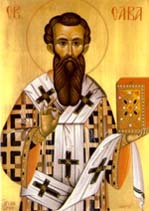
By the end of 12th century, Grand Zupan of Raska Stefan Nemanja (Stephan Nemanya, 1169-1196) managed to unite most Serbian lands into a single state. In his foreign policy he opted for Byzantium, although he went to war with it several times. It is also very important that he opted for Byzantine spiritual (Orthodox-Christian) and cultural influences too. Stefan Nemanja was a devoutly religious person and from the very beginnings unreservedly keen on Eastern Orthodoxy, which had, without any doubt, already set firm roots in his lands and among his people centuries before. Even today there stand churches and monasteries which were founded by him. They represent a clear sign of his religious zeal: monastery of the Holy Theotokos (Sveta Bogorodica) and monastery of Saint Nicholas (Sveti Nikola) in Toplica; monastery called George's Pillars (Djurdjevi stupovi) in the vicinity o f Ras and Novi Pazar; church of Saint Panteleimon (Svetog Pantelejmona) in Nis; church of the Holy Archangel (Sveti Arhangel) in Skoplje. He also built the famous Studenica (Studenitsa) monastery, which has rightly been named "mother of all Serbian churches". It was in this monastery that Stefan Nemanja had taken his monastic vows and it was there that his body was laid when brought back from Hilandar monastery. It is still to be found there today.
It is essential to consider the person and accomplishments of Saint Sava, the first Serbian Archbishop (+1236), when reflecting upon Serbian Christianity and not only when medieval times are concerned. Stefan Nemanja had three sons: Vukan, Stefan and Rastko. Having been born around 1175, Rastko (Saint Sava's baptismal name) was youngest of the three.
Since the days of his early childhood he exhibited an affinity towards Christian devotion and book reading. It is not, therefore, by coincidence that at the age of 16, and against his parent's wishes, he had left the court accompanied by a Russian monk and entered the monastery of Saint Panteleimon (the old Rusik monastery) on Mount Athos — the Holy Mountain. It is there that he took monastic vows and became monk Sava. From the very beginnings of his monastic days he unreservedly dedicated himself to austere asceticism and devout prayer thus swiftly gaining attention of all monastic communities on Mount Athos, especially so for being a member of a royal family.
The aged Stefan Nemanja soon followed his son's example and footsteps. He abdicated his title at a nobleman's assembly in Ras in 1196 and chose his middle son Stefan as his successor. Immediately upon doing so he took monastic vows and, accompanied by his son Sava, spent the rest of his life in peace and monastic tranquility of the Holy Mountain as Simeon the monk.
Living on the Holy Mountain, father and son attracted attention not only as devoted monks, but also as founders and donators of many a monastery on Mount Athos. Establishment of the Serbian monastery of Hilandar on Mount Athos came as a natural consequence to such activity on their part. Hilandar was built in 1199 on a site occupied by an older, previously abandoned monastery. Only a year later, on the day of February 13th 1200, Simeon the monk departed from this life. Council of monks of the Holy Mountain immediately had him canonized as Saint Simeon the Myrovlyete. His son Sava composed a Service to him and also wrote his biography. Saint Sava also wrote the Typikon* of Karyes for monastic use at the Karyes hermitage of Saint Sabas the Sanctified. Furthermore, he was the author of the Hilandar Typikon which he based upon the one in use at the Monastery of the Most Holy Theotokos in Constantinople. This Typikon is in effect even today in the monastery of Hilandar.
During the lifetime of Saint Sava the whole of the Holy Mountain, including monastery Hilandar, felt severe repercussions of the Fourth Crusade, when Latin armies sacked the capital city of Byzantium — City of Constantinople, and established the so-called "Latin Empire" (1204-1261). During the course of these events, Latin crusaders also pillaged many a monastery on the Holy Mountain. Taking safety precautions, and intending to effect reconciliation among his brothers who were in conflict back home, Saint Sava relocated the body of Saint Simeon and laid it in the monastery Studenica in 1208. Then he composed the Studenica Typikon, very similar in its contents to the one he introduced in Hilandar. Sava was archimandrite* in Studenica until 1217. Taking into consideration that Saint Sava ceaselessly traveled Serbian lands, taught Orthodox faith, spread literacy and religious zeal, built churches and monasteries, educated and trained priests, monks and teachers, it is considered that Saint Sava's stay in Serbia on that occasion was one of the most fruit-bearing of all. It is from this period of life that many a story and legend about him came into existence, depicting him as the illuminator and the teacher of the Serbian nation as a whole, a miracle-worker, and deliverer of the sick, the poor and the destitute.
Until the appearance of Saint Sava the Church in Serbian lands had been under the spiritual jurisdiction of the Archbishopric of Ohrid. Sources mention only three dioceses: Ras, Prizren and Lipljan, and all three were headed by Greek bishops. Accordingly, Saint Sava decided to make the Church in Serbia fully independent and to recruit and train local priests, monks and bishops. This was not an easy task since Serbia at that time felt great pressure both from the south (Latin Empire) and the north (Roman Catholic Hungary).
Grand Zupan Stefan, Sava's brother, was in 1217 compelled to receive his royal blessing form the pope in Rome. That same year, by no coincidence, Sava left Serbia to take up residence in Hilandar once again. It is from there that he journeyed to Nicaea to visit the Byzantine Emperor Theodore Lascaris and Patriarch of Constantinople Manuel, both of whom had taken refuge there after the fall of Constantinople to the Latins. His intention was to negotiate with them on the matter of independence (autocephality) for the Church in Seriba. His petition for autocephality was granted, this being the best possible solution when considering general circumstances in the region. In Nicaea Sava was ordained archbishop of the Church in Serbia receiving the title "Archbishop of Serbian and Maritime Lands".
Thus, almost four centuries after having adopted Christianity the Serbian nation received its spiritual independence — Church autocephality. This international and ecclesiastic recognition confirmed Serb spiritual maturity and ability as a nation to have its own Church organisation according to the model already set by other Eastern autocephalous Churches (those of Jerusalem, Alexandria, Antioch).
After completing his task in Nicaea, Saint Sava returned to Serbia via Hilandar where he stopped to pick up his best disciple-monks, whom he foresaw as future bishops in Serbia. He also made a stopover in Thessalonica where he managed to complete the Krmcija (Krmchya, Constitution) which regulated legislation concerning the newly independent Serbian Church. One of Saint Sava’s first tasks was to bring this Constitution to life. Apart from the three existing dioceses, Sava immediately established eight new ones: Diocese of Zica (Zhicha, which became the See of the Archbishopric of Serbia), and dioceses of Zeta, Hvostan, Hum, Topolica (Toplitsa), Budimlje (Budimlye), Dabar and Moravica (Moravista). Each of these dioceses had located its See in a monastery. Their founders and donators richly endowed these monasteries. All of them owned extensive land — fields, forests, vineyards, pasture, orchards etc. in order to be able to support their very important spiritual and educational mission among the people. Each of the newly ordained bishops received his own copy of Krmcija, which was to direct him in exercising his rights and duties.
On the day of the Feast of Ascension of Our Lord in 1221 a State-Church Council was held in Zica monastery, which was the See of the Archbishopric. On that occasion Saint Sava crowned his brother Stefan Prvovencani** (Stephan Prvovenchany) as first king of the Serbs, thus making Serbia a kingdom. After the ceremony, Saint Sava held his famous “Sermon of Zica” in which he extensively elaborated on Orthodox faith. He taught the king, nobility, newly ordained bishops, abbots, and all that gathered basic truths of the Orthodox Christian faith, which were founded upon the Bible, deeds of the Holy Fathers, Oecumenical and local Church Councils.
Of course, all these changes and new moments in Church and State affairs in Serbia could not go ahead so smoothly, i.e. without problems from within and without. First obstacle to Saint Sava’s accomplishments came from the Archbishopric of Ohrid, headed by the learned Demetrius Khomatian who delivered a written objection to Saint Sava. He accused “Sava the Monk” for leaving the Holy Mountain to “return to the world”, and for making himself an archbishop without his (Khomatian’s) knowledge and explicit approval. However, these accusations could not hold water, since Saint Sava always took meticulous care to honour all Church rules and canons before taking action to change Serbian internal structure and international posture when both State and Church affairs were concerned.
First Serbian king, Stefan Prvovencani, took monastic vows in his old age, thus following in his father’s and his younger brother’s footsteps. He died as Simon the Monk in 1228, and his body rests even today in monastery Studenica. His son Radoslav succeeded him on the throne. It was during the first year of his reign that Saint Sava decided to undertake his first journey to the Holy Land (1229). This event was not only a personal act of pilgrimage. It meant a great deal for the whole of the Serbian Church, then a young Archbishopric. Saint Sava visited Jerusalem and the monastery of Saint Sabas the Consecrated. He purchased monastery of Saint George in Akona and monastery of Saint John the Theologian in Zion, both to be inhabited by Serbian monks. Saint Sava utilised his stay in these and other monasteries to learn their monastic rules and constitutions so that these could be applied in churches and monasteries of Serbia. From then on, the Serbian Church was more influenced by the Typikon of Jerusalem than that of the monastery of Studion of Constantinople. Saint Sava returned to Serbia bearing great gifts of icons, oil lamps, priestly vestments, church decorations, books, holy relics, etc.
In 1233 there occurred a change on the royal throne in Serbia. After a period of short disturbances Radoslav’s brother and Saint Sava’s nephew Vladislav was crowned king. This internal crisis was quickly overcome due to Saint Sava’s undisputed spiritual authority and reputation.
Apart from being a great Christian and a spiritual leader, wise and practical, Saint Sava knew how to make shrewd estimates on what was good and beneficial for the future life of the Church and the people. Sava entered a mature age. The end of his fruit-bearing earthly life was nearing and he knew this well. He thus decided, in the interest of the Church and the State, to undertake another journey and not only to the Holy Land, but also to other sanctuaries of the East. Possibly feeling that he would not return alive form this journey, he abdicated his archbishop’s throne at the occasion of the Church council in 1233 and appointed Arsenius of Srem (+1266) to be his successor. Taking such and similar precautions in order to insure the safety of the Church he departed for Holy Land during the spring of 1234. This time he visited Alexandria and Patriarch Nicholas, ancient monasteries of Egypt, Mount Sinai and monasteries located there. He took the return journey via Jerusalem, Antioch and Constantinople, where he procured many a needy thing for the Church back home. He left Constantinople to travel through Bulgaria and to meet the Bulgarian Emperor John Asen in Trnovo. He celebrated his last Holy liturgy one day ahead of the Feast of Epiphany in 1236 never to return to Serbia alive. He became ill and died in Trnovog on the 14th/27th of January and his body was laid in one of the local churches. His nephew, King Vladislav, managed to move his body back to Serbia and to have it entombed on the on the 6th/19th of May 1237 in the church that he (King Vladislav) intended to be his own mausoleum — that of monastery Mileseva (Milesheva).
Gradac Monastery - endowement of the Serbian queen Helen de Anjoy, 13th century
Serbian Church existed as an Archbishopric from 1219-1346. During that period twelve consecutive archbishops occupied the throne of Saint Sava and each of them headed the Church during the reign of some of the most famous kings of Nemanjic (Nemanyich) Dynasty.
Archbishopric See was originally in monastery Zica, but in 1252, owing to impending dangers of Tatar and Kuman invasions, it was, for security reasons, moved to Pec (Pech) — a monastery located at the entrance to the remote Rugova Canyon. All archbishops heading the Serbian Church were experienced spiritual fathers and monks who were previously abbots either at Hilandar or at Studenica monasteries. Two of them, Nicodim (1317-1324, Nicodemus) and Danilo II (1324-1337, Daniel), both archbishops during reigns of King Milutin and King Stefan Decanski, were prominent literary authors and translators. Archbishop Danilo II, previously abbot of Hilandar and a diplomat, left behind him his famous “Biographies of Serbian Kings and Archbishops”, known also as “Ancient Books” (Knjige Starostavne). Period of the Archbishopric coincided with the epoch in Serbian history when many a famous king ruled the Serbian Kingdom: King Vladislav (1233-1243), King Uros I (1243-1276, Urosh), King Dragutin (1276-1282). Numerous famous monasteries were erected then: Mileseva (founder and patron — King Vladislav), Sopocani (Sopochany; 1265, founder and patron — King Uros), Moraca (Moracha; 1252, founder and patron Knez Stefan), King Dragutin’s memorials were monasteries Raca (Racha), Tronosa (Tronosha), Lovnica (Lovnitsa), Ozren, and Tavna. King Milutin (1282-1321) built the Church of the Theotokos (Bogorodicina crkva) in Skoplje, the new Hilandar church, Theotokos of Ljevis (Lyevish, Bogorodica Ljeviska) in Prizren, Old Nagoricano (1313, Nagorichano, Staro Nagoricano), Banjska (Banyska, 1313-1317), Gracanica (Grachanytsa, 1315), The Holy Archangels (1311, Sveti Arhandjeli) in Jerusalem. King Stefan Decanski built monastery Decani (1327-1331, Dechany).
THE SERBIAN PATRIARCHATE
Serbian lands greatly increased in their proportions during the reigns of Kings Dragutin, Milutin, Stefan Decanski, and, especially so, during the reign of King Dusan (Dushan). Parallel to the territorial growth of the state, so grew the total number of dioceses of the Serbian Archbishopric. During the lifetime of Saint Sava there were eleven. Those newly formed dioceses of: Lipljan, Koncul (Konchul), Lim, Macva (Machva), Branicevo (Branychevo), Beograd, and Skoplje (Skoplye). Serbian state was territorially the largest during the reign of Emperor Dusan (1331-1355). It was the largest and the most powerful among the contemporary states in the whole of the Balkans. Serbs occupied Thessaly, the region from the Holy Mountain to Christopolis, Epirus and Albania. King Dusan proclaimed himself Emperor in 1346. Byzantium was greatly weakened by internal crisis and Dusan strove to substitute once powerful Byzantine by his own Serbo-Byzantine Empire. He considered himself the Emperor of Serbs and Greeks. In order to legitimise his title he needed to elevate the Serbian Archbishopric to the level of a Patriarchate. This was done on the occasion of a Church-State council held in Skoplje in 1346, on the day of the Feast of the Entrance of Our Lord into Jerusalem. Council was attended by the Bulgarian Patriarch Simeon, Archbishop of Ohrid Nicholas, abbots and elders of the Holy Mountain, as well as those Greek bishops and metropolitans whose dioceses were included in the newly enlarged Serbian state. Council elevated the Archbishopric to a Patriarchate and the first Serbian patriarch was Joanikije I (Joannicius) carrying the title “Patriarch of Serbian and Maritime Lands”. On the Eastern day of 1346, seven days after the above mentioned Church council was held, Dusan was crowned first Serbian Emperor by the Patriarch. His son, Uros “Nejaki” (“The Frail”) was crowned King. Archbishopric of Ohrid was second in honour after the Serbian Patriarchate. Dioceses of Raska, Zeta, Prizren and Skoplje were elevated to Metropolitanates, first in honour among them being Metropolitanate of Skoplje, since Skoplje was the Capital of the Empire.
Emperor Dusan, accompanied by his wife Empress Jelena (Yellena, Helen), visited the Holy Mountain and richly endowed all monasteries there. This event was recorded in Greek and Serbian languages and could be found contained by many a charter existing even today on the Holy Mountain. Hilandar was most richly endowed, as were the Karyes Hermitage of St. Sabas and the Holy Archangels in Jerusalem. Emperor’s chief memorial was the monastery of the Holy Archangels near Prizren (1347) which also served as his mausoleum (1355).
Emperor Dusan is also remembered by his famous zakonik (Dushan’s Legislature) which was adopted by the State Assembly in Skoplje (1349), and developed by the Assembly in Ser (1354). This Legislature is considered to be one of the best and most perfect legislative acts of the period in Europe. For example, Article 172 of this Legislature — and not according to their fear of Our opinon and will”. First 38 articles of this Legislature are exclusively concerned with the Church. Patriarch’s title was similar to that of the Emperor: “By the Grace of God Archbishop of All Serbian and Maritime Lands”. According to medieval law, Patriarch’s Court was considered a place of sanctuary (refuge) for all those seeking protection from the State.
A few years after the Serbian Patriarchate was established there came a reaction to it in a form of an official objection from Byzantium, since the Byzantine Empire felt that its interests were damaged by Emperor Dusan’s political actions. Emperor John Cantakuzenos, once Dusan’s friend and collaborator, now became his opponent. He persuaded Callistus, Patriarch of Constantinople, to anathematize Serbian Emperor, Serbian Patriarch, Church and the people, and this was done in 1353. It was said that the basic reason for such an action was to safeguard “dignity and cities”, i.e. to protest against Serbian Archbishopric becoming a Patriarchate, and against such actions by which Greek bishops were substituted by Serbs in those cities that Dusan took from Byzantium.
Empero Dusan himself tried to reconcile with the Patriarchate of Constantinople. Negotiations in such a direction were continued after his sudden death (December 20th, 1355). The new Byzantine Emperor John V sent Patriarch Callistus to the court of Empress dowager Helen (who after her husband’s death became a nun and changed her name to Elisabeth) at the city of Ser to negotiate a reconciliation in face of an imminent danger both Byzantium and Serbia were faced with — that danger was the Ottoman Turks. It happened that Patriarch Callistus took ill and died in Ser, and that his funeral was officiated by those priests whom he himself had once anathematized.
The process of reconciliation lasted for years, and a partial agreement was reached first (a particular unity) with the region of Ser, i.e. that part of Serbian Empire ruled by Despot* Ugljesa Mrnjavcevic (1368, Uglyesha Mrnyavchevich). His domain was first to be directly threatened by the Turks. Final reconciliation was envisaged and achieved by monks of the Holy Mountain, those of Greek and Serbian provenience, since they both lived and prayed together. A monk delegation headed by a Serbian elder Isaija (Isaiah) and hieromonk Nikodim Grcic (Nikodemus Grchich) first visited Knez Lazar’s court in Serbia where it also met with Patriarch Sava IV. In 1375 the same delegation proceeded to Constantinople. An agreement was reached whereby canonical validity of the Serbian Patriarchate was recognised by Constantinople. Two of its representatives were dispatched to Prizren where they celebrated the Holy Liturgy in the monastery of the Holy Archangels, and, thus, officially lifted the previously imposed anathema.
After Emperor Dusan’s death in 1355 Serbia could not offer a strong ruling personality that could manage to keep together the vast Serbian Empire. Regional Lords became completely independent and tended to ignore central authority embodied by Emperor Uros “the Frail”, the last ruler of Nemanjic dynasty. Internal disunity and unavoidable external danger of Ottoman invasion became Serbian reality. During his lifetime even Emperor Dusan took some limited military action against Turks. One of the most important Serbian military defeats happened on September 26th 1371 at the battle of Marica (Marytsa) where both King Vukasin (Vukashyn) and his brother Despot Ugljesa lost their lives. Emperor Uros died by the end of the same year. It became clear that it was only a matter of time before decentralized Serbian lands would fall prey to the Mohammedan invader.
Some Serbian lands eventually came to be centralised again, this time under the rule of Knez Lazar Hrebeljanovic (Hrebelyanovich) who, himself, did not belong to the Nemanjic dynasty, but his wife Milica (Mylitsa) did. He proved to be the most energetic among nobles in defending Serbian statehood and Nemanjic spiritual heritage. North-east region of Morava and Danube river valleys now became heartlands of the new state where many of the important monasteries were to be built: Ravanica (1381, Ravanytsa), Lazarica (Lazarytsa), Gornjak (Gornyak), Ljubostinja (Lyubostinya) etc. Battle of the Field of Kosovo (28th/15th June 1389) proved to be crucial to the future of the Serbian nation. Knez Lazar lost both this battle and his life to the Ottoman Turks, together with most of his nobility, lesser nobility and soldiers. It was an honourable defeat since their resistance to the invader proved to be a consciously Christian act of martyrdom against militarily far superior forces of the foe. This sacrifice is even more noteworthy if one considers the lack of readiness on part of some other Serbian noblemen to follow Knez Lazar’s example.
Not all Serbian lands came under Ottoman rule immediately after the battle of the Field of Kosovo, but Serbia became a tributary state to the Turks. Two Serbian patriarchs, Spiridon (Spyridon) and Jefrem (Ephraem), are mentioned as contemporaries to these events. Jefrem was a great ascetic and an anchorite monk — a hesycast. It is important to say that hesychasm, as a spiritual movement, took deep roots in Serbia precisely during Knez Lazar’s rule since he, himself, took a great deal of interest in it. Many of the monks fleeing from the Ottoman peril in the East took refuge in Knez Lazar’s Serbia. There is evidence of considerable hesychastic spiritual influence on Serbian literature, icon painting, and sacred architecture of the time. Only strong and unrelenting faith could give spiritual and moral meaning to the life of the nation after the defeat of Kosovo.
Knez Lazar’s successor to the throne was his son Stefan Lazarevic (+1427, Stephan Lazarevich) under whose rule Serbia came to recover as a state managing also to restore its economy. Stefan received title of despot after the successful outcome of his participation at the battle of Angora in 1402. Spiritual and economic recovery of Despot Stefan’s Serbia is best witnessed by his memorials — monasteries of Manasija (Manasya) or Resava, Kalenic (Kalenych) etc., which were all built in the distinct Serbo-Byzantine architectural style.
Manasija became a great spiritual and educational centre of the Despotate. “Resava school”, as a style in literature, art and architecture, became a symbol of learning for centuries to come. This school engaged a great number of learned monks — writers, biographers, scribes, copyists and translators. It was a centre of literacy and spread its influence all the way to Russia and Rumania. Metropolitan Cyprian of the Russian Orthodox Church came from Serbia, as did Gregory Tzamblak — Metropolitan of Kiev, previously abbot of Decani (author of the Biography of St. Stefan Decanski). Serbian monk Pahomije (Pachomius) was also a well-known contemporary who became famous in Russia as a writer. Despot Stefan’s court was moved to Beograd, which became the principal town of Serbia. He was a very learned nobleman; he read a lot and was, himself, a successful author. His became famous for his passage “Slovo Ljubve”*.
Despot Djuradj Brankovic (1427-1456, George Brankovich) was one of the last Serbian rulers before the final fall under Turkish yoke in 1459. His was the last attempt to defend Serbia against the aggressor. Despot Djuradj was known for his strong and decisive faith in God as well as for his faithfulness to the rich spiritual and national heritage. He refused to accept Union with the Roman Catholics (Councils of Ferrara and Florence 1438-1439) who gave false promises of military assistance against Turks. His significant answer to the Franciscan John Capistranus was as follows: “Ninety years of my life I have lived with this faith that had been poured into my soul by my ancestors and have, as a result, been considered a wise, although unfortunate, man by my people. Now you would like them to think, if I should change, that I have become senile of old age and, as the commoners say, infantile. I would rather agree to die than betray the faith of my ancestors”. Patriarchal See was moved from monasteries Pec and Zica to the last free bastion — to the fortress of Smederevo.
During the medieval period Serbian Church had a significant, if not even principal, role in the lives of every individual and the state as a whole. Relationship between the Church and the State was natural and harmonious, and was most often compared to the human organism and the relationship between the soul and the body. According to his nature man is a harmonious being, if healthy, of course. Church and State interests were not in conflict but, rather, mutually compatible. This is a case where the well-known theory of symphony between Church and State was applied almost to its fullness. Church was materially and financially completely independent. Every diocese owned land, priests were entitled to “popovski bir”* and some land they could cultivate for their own needs. Priestly vocation was most commonly a hereditary right.
Monasteries and monks had especially significant and unique roles in the Serbian medieval society. Monasteries of Studenica, Zica, Pec, Mileseva, Sopocani, Decani, Ravanica, Manasija, etc., all founded by royal donators, outlived the State and centuries of captivity. They shine out in a very particular light and radiate a message witnessing eternal spiritual values which have, for centuries, served to deliver Serbian people from all calamities of life and to inspire them during both good and the bad times. Monasteries, monks and nuns, regardless of living either coenobitic or solitary lives, best witnessed the practice of life in Christ (as far as this is at all attainable considering all weaknesses, and shortcomings of every human being). It is very characteristic of Serbian monasteries that the have always been open to communal life. They served as open houses for all those who were in need. There were times when monasteries substituted schools, hospitals, all kinds of artistic and artisan workshops. They were often used as a place of refuge from enemy raiding parties, and, last but no least, they were places of eternal rest — they all had cemeteries.
Serbs were taught literacy in order to understand Christianity better. This is why monk Sava is considered both a saint and a writer. He was emulated by his brother and king Stefan Prvovencani when he wrote the Biography of St. Simeon, and also by Domentijan (Domentian) the monk and his Biography of St. Sava, and Biography of St. Simeon. Their opus was followed by Theodosius the monk with his Biography of St. Sava and Biography of St. Petar Koriski (Peter of Korish), and by many other known and unknown monk-authors. They themselves did not attain literacy just for the sake of becoming literate, nor did they teach it to others for the same reason. They did this to that they could enrich their own experience of Christianity and bring salvation in faith to others. For many of them writing was just another form of prayer. We shall mention just a few more of these remarkable people: Archbishop Nicodemus, translator of Typikon; Archbishop Daniel II (Biographies of Serbian Kings and Archbishops); Patriarch Ephrem; Patriarch Daniel III; Bishop Mark (Biography of and Service to Patriarch Ephraem, …); Despot Stefan Lazarevic (Word of Love); Eufemia the nun (Homage to Knez Lazar); Gregory Tsamblak (Biography of and Service to St. Stefan Decanski, On the Transfer of Relics of St. Paraskeve); Consantine the Philosopher (Biography of Despot Stefan, …).
Ravanica Monastery - founded by St. Prince Lazar
TURKISH ENSLAVEMENT
Turkish invasion of Christian lands was a disaster for Balkan peoplesTurkish rule lasted 4-5 centuries and this proved to be the longest period of enslavement in Serbian history. The problem was deepened by the fact that the culprit, i.e. the aggressor, was of a different faith. Many a Serb is still experiencing this slavery, and for some (those that were converted to Islam) it is never going to end. City of Constantinople and the Byzantine Empire fell to the Ottoman Turks in 1453. There quickly followed the fall of Bulgaria, of the fortress of Smederevo and the Serbian Despotate (1459), Bosnia (1463), Herzegovina (1482), and Montenegro (Crna Gora) in 1499. Serbian Orthodox Church shared the destiny of its people during those times that were marked as “cruel and precarious” and when “the living envied those that were dead”. Serbs had no legal rights whatsoever as subjects of the Islamic Ottoman Empire. They had to pay special duties just for the basic right to live in an Islamic state.
As far as the Church was concerned it could be said that Turkish yoke meant an occurrence of a long lasting abnormal state of affairs within the Church itself. Last patriarch to be mentioned was Arsenius II. Council of bishops could not convene on a regular basis and this meant that it simply became and impossible task to elect a patriarch. Some contemporary literary sources illustrated these hard times very well: “Sadness overcame the people and there occurred such a slaying of Christians as had never been seen before”. Or: “Resembling flying serpents, Turks burned all villages and cities … and churches and cities they sacked …” Christian population attempted to save itself by undertaking mass migrations in face of Turkish oppression. They took refuge to the north and to the west, across rivers Sava and Danube, and by doing this they entered territory under Austrian rule. Roman Catholic Austria did not look kindly upon “schismatic” (Orthodox) Serbs, but it allowed them to settle the border, barren areas of its Empire, form a “military frontier” and, thereby, serve as a living rampart between the Ottomans and the Empire. Included in these mass migrations of Serbian ordinary folk were also the monks and priests who carried with them the most significant national and spiritual treasures in an attempt to have them saved from oblivion. Thus, they carried holy relics of Serbian saints, books, icons etc. North of rivers Sava and Danube they established and built new monasteries and churches, which came to serve as new spiritual centres for Orthodox Serbs. Apart from those already existing in Banat* (e.g. monasteries Mesic [Mesich] and Zlatica [Zlatitsa]) more new monasteries were founded in this region: Bazjas (Bazyash), Bezdan, St. George. On the slopes of Fruska Gora** and Srem*** following monasteries were built: Grgeteg (founded by “Zmaj Ognjeni Vuk” — Vuk Grgurevic Vrankovic, a member of the last medieval, Brankovic, dynasty), Fenek (founded by Mother Angelina), Hopovo, Divsa (Divsha), Krusedol (Krushedol), Sisatovac (Shishatovats, founded by immigrant Zica monks). In 16th century Slavonia**** we have monasteries: Orahovica, Pakra, Lepavina and Marca; in other regions (Gorski Kotar and Banija) we have Gomirje (Gomirye) and Komogovina.
It should be said that the Patriarchate of Pec was not officially abolished after Turkish occupation. However there occurred such a situation where the Archbishopric of Ohrid gradually took over many a diocese of the Pec Patriarchate under its own spiritual jurisdiction. This was one in full knowledge of the Turks and often assisted both by them and even by the Oecumenical Patriarchate in Constantinople. Archbishop Prohor (1525, 1528, Prochorus) was, as far as this matter was concerned, one of the most energetic among Ohrid prelates.
Serbian Metropolitan of Smederevo Paul (“Paul of Smederevo”) resisted this infringement into Serbian spiritual jurisdiction as much as he could. He even succeeded in renewing the Patriarchate of Pec and proclaiming himself the Patriarch. However, this was a very brief affair, since two Councils of Ohrid condemned him in 1532 and 1541 and, as a consequence, had him banished from Pec.
It has been recorded that many Christian Orthodox Serbs converted to Islam, most of them under duress, and some in order to keep prior or attain new privileges. An unknown contemporary poet said: “Those that were cowardly or greedy became converted…” The population was particularly disturbed by the so-called “bloody duty”, i.e. enslavement of young Serbian boys. After being abducted from their families they were brought up and educated in Islamic tradition far away from their families and raised to form crack troops of the Turkish army — the janizaries, who, unwittingly, did most of their famed atrocities on the population inhabiting the very regions they themselves originally came from. A contemporary popular saying went: “A convert is worse than a Turk”.
Turkish atrocities and violence against Christians
RENEWAL OF THE PATRIARCHATE OF PEC
The renewed Patriarchate of Pec existed for almost two hundred years (1557-1766). By mid 16th century, Balkans, and especially those areas inhabited by Serbs, became a transitory region for conquering Turkish armies going west, and the Ottoman authorities wanted to appease Orthodox Serbs by granting concessions to their Church. It is for this reason that Patriarchate of Pec was renewed with Turkish approval. The Grand Vizier Mehmed (Muhammad) Sokolovic (Sokolovich), a janizary of Serbian stock who became very successful in climbing the Ottoman social and political ladder, played the key role in this affair. It was through his assistance that the Patriarchate was renewed in 1557, its first Patriarch being Vezier’s very brother — Makarije Sokolovic (1557-1571, Macarius). This was a grand occasion for Serbs and their Church, Patriarchate of Pec spiritually united all Serbian ethnic regions into one. Even parts of Bulgaria and Hungary came under its jurisdiction. Old dioceses were renewed and new ones formed: Dioceses of Trebinje (Trebinye) in Herzegovina, Pozega (Pozhega) in Slavonia, Marca, Jenopolis, Vrsac (Vrshats), Budim … All in all there were around 40 dioceses in the wide region covering the area from Budim (Hungary) to the river Drim in Albania, and from Western Bulgaria to the Adriatic Sea.
Serbian Church now functional under now more favourable circumstances when compared to those of the early years of Ottoman rule. New monasteries and churches were allowed to be built (Canyon of Ovcar [Ovchar] and Kablar monasteries), and many old ones restored and redecorated (Pec, Gracanica). Political status of the Serbian Patriarch was much similar to the one held by Patriarch of Constantinople. He was proclaimed “People’s Leader” and bestowed considerable “worldly” authority over his Christian subjects. He gave suggestions to the Porte concerning elections of metropolitans and bishops, judged disputes among priests, raised Sultan’s annual taxes, solved marital disputes among Christians, held inheritance rights to the property of all those who became deceased but had no lawful heirs. Patriarch was a person of high standing both in the eyes of the Turks and among the Christian population. He travelled on horseback always accompanied by an escort and his official dignitaries. It, thus, happened that under the Turkish yoke the Church and the Patriarch assumed, out of necessity, that role which was normally held by the State and the “worldly” rulers among the Serbs.
POPULAR UPRISING AGAINST THE TURKS
All patriarchs belonging to Sokolovic family tended to have correct relationships with Turks. However, although general living conditions were somewhat easier than at the beginning of Turkish occupation, Patriarch Jovan Kantul (1529-1613, John) changed this previously established attitude of his predecessors since both he and the people in general recognised the fact that the nation was still clearly enslaved. It was thought that nothing but freedom gained through a popular uprisings could set things to the right track again. This attitude prevailed by the end of the 16th century and continued to be in effect until freedom was gained three centuries later.
In 1594 an uprising of Serbs occurred in the region of Banat. Rebels carried flags bearing icons of St. Sava. A similar uprising broke out in the vicinity of Pec, and one occurred in Herzegovina in 1597. All of these were brutally put down by Turks and were ended in a terrible bloodbath. St. Theodore, Bishop of Vrsac and leader of Banat rebels, was skinned alive. As a measure of retaliation one of Turkish local rulers, Sinnan Basha, ordered relics of St. Sava to be burned in Beograd on April 27th/May 10th 1594. Patriarch Jovan Kantul also paid a heavy price — he was executed in Constantinople in 1613.
Patriarch Pajsije Janjevac (1614-1647, Paysiye Yanyevats) realized that open rebellion could not set things right. He turned for aid to Imperial Russia which had for a while already been a source of literary (service books) and some financial support. As the head of the Church he worked earnestly to strengthen the faltering spirit of the nation through constant celebration of Liturgy and by intense writing. He wrote the biography of the last Serbian emperor, Uros, and composed a Service to him. He also wrote the Service to St. Symon (King Stefan Prvovencani).
Patriarch Gavrilo I (1648-1655, Gabriel) also died a martyr’s death whilst in Turkish captivity.
MIGRATIONS
Great Serb Migration in 1690Serbian people and the Church suffered heavy consequences during and after the Austro-Turkish war when the throne of Pec was occupied by Patriarch Arsenije III Carnojevic (1674-1690; +1706, Charnoyevich). In 1683 Turks arrived at the threshold of Central Europe by besieging the City of Vienna itself. A relief army arrived from Poland, lifted the siege, and general Piccolomini drove the Turks back all the way to Skoplje in Macedonia. This victory encouraged the Serbs and the Patriarch himself to join the Austrians. However, a successful Turkish counteroffensive forced them into the so-called “Great Migration”, Patriarch Arsenije led some 40,000 men, women and children north of rivers Sava and Danube. Austrian Emperor Leopold I had agreed to accept this large wave of refugees and to extend written guarantees of religious and national freedoms to them. Subsequent history of Serbs in Austria and Hungary was marked by their struggle to effectuate their guaranteed freedoms, since Austria, as a Roman Catholic state, did its utmost to denationalise and convert Orthodox Serbs living on her territory.
During the following Austro-Turkish war of 1737-1739 Serbs, unfortunately, suffered a similar fate. Patriarch of Pec Arsenije IV Jovanovic-Sakabenta (1728-1737, Yovanovich Shakabenta) prematurely hoped that final freedom could be achieved soon and consequently decided to lead his people to revolt against the Turks. Austrian support fell short and he was forced to lead yet another great wave of refugees north of rivers Sava and Danube. This time Turkish revenge was even more ruthless than before. Monasteries and churches were torched, Bogorodica Ljeviska of Prizren was turned into a mosque, monastery Manasija church was turned into a horse stable, and great numbers of Serbs were taken into slavery to be sold in slave markets of Europe and Asia. There also occurred another great wave of forcible conversions to Islam …
If a question is put as to how the Church survived under Turkish rule at all, it could be easily answered that the Church had to suffer the same fate as the ordinary Serbian folk. As in all Islamic states Christians in Serbia had lesser rights than Mohammedans (which is a case even today in Islamic countries). There were very few priests and monks, churches and monasteries. According to Islamic laws Turks did not allow new churches to be built and allowed old ones to be restored only with great reluctance and numerous obstructions on their part. Many churches were turned into mosques and some had been torn down, the remaining building material being used to build mosques or public buildings. People were allowed to gather in churches and monasteries only on rare occasions and priests and monks could openly satisfy people’s religious needs only by special permission. This caused such a situation where heads of families had to assume roles of domestic priests in their families. This is why the celebration of the family baptismal, or patron saint day, (Krsna Slava) assumed great importance in Serbian tradition — it came as a sort of substitute for all other religious practices. Normal ecclesiastic tradition was often substituted by a practice of local popular customs.
Only monasteries that survived, apart from the most famous ones founded by members of the Nemanjic dynasty, were those that had originally been built in remote, inaccessible regions. During times of relative calm, main monasteries remained strong spiritual centres even under Turkish rule and were given some sort of autonomy in exchange for annual payments of taxes to the authorities. People went on pilgrimages to venerate the remaining relics of national saints — those of St. Simeon in Studenica; St. Sava in Mileseva; St. Stefan Decanski in Decani; Holy Knez Lazar in Ravanica; those of saints belonging to Brankovic dynasty in Krusedol etc. Regular Church services were carefully observed in all these monasteries and most of the monks were at least semi-literate, doing their utmost to spread literacy among people whilst tutoring them on faith and spiritual life. They spoke of and wrote about the glorious Serbian past and their grand and most significant rulers and predecessors. Except for the above mentioned national saints, centuries of reverence were also devoted to St. Paraskeva, St. Joanikije Devicki, St. Basil of Ostrog and others.
In such difficult times only priests and monks were able to do anything to promote spirituality and culture in general. Thus, hieromonk Macarius was able to procure in Venice a printing press for Djuradj Crnojevic (George Tsrnoyevich) in Cetinje (Cetinye). It was in use from 1493 to 1495 and became renowned for the first printing press among the South Slavs. Sometime later, during the first half of 16th century, printing presses were also in use in other Serbian monasteries such as: Rujan (1537), Gracanica (1539), Mileseva (1544), Mrksina Crkva (1566) etc. Wherever and whenever it was possible, manuscripts and illuminations continued to be produced.
As far as church building and fresco painting were concerned, previously very rich donating activity was greatly diminished during Turkish rule. That which was accomplished was done according to relatively limited means of contemporary donators. Iconography was mainly based on imitations of older art, although there were several very talented iconographers as, for example, Longin or Georgije Mitrofanovic (George Mytrophanovich).
Christians in the Balkans tried many times to liberate themselves from the Turkish rule. Although Ottoman Empire ruled Serbia for 5 centuries the Christian people have never lost their feeling that they live under the foreign rule and foreign and unfriendly Islamic civilization
ABOLISHMENT OF THE PATRIARCHATE OF PEC
After the “Great Migration” of Serbs of 1690 it is possible to follow the development of the Serbian Church and national history not only within borders of the Ottoman Empire, but also in wide regions of the Austrian Empire. Popular living conditions in regions under Turkish rule, and conditions under which the Church functioned there, were even more difficult now. Population constantly decreased in numbers. Two patriarchs were compelled to flee into Austria and Turks lost all confidence in Serbian clerics. Greeks immediately exploited this adverse state of affairs. After Patriarch Arsenije IV Sakabenta migrated to Austria, the Church in Constantinople asserted pressure on the Porte to install mainly Greeks, such as Joanikije Karadza (1739-1746), as Patriarch of Pec. In the short period of time between 1752 and 1765 eight patriarchs sat on the throne of Pec, five of whom were Greek. Patriarchate debts accumulated in Constantinople and no one was willing to pay them back. Last Serbian national to be elected patriarch before abolishment of the Patriarchate of Pec was Vasilije Brkic (1763-1765, Basil Brkych). He was banished to Cyprus as an enemy of Turkish State. He was succeeded by a Greek, Kalinik II (1765-1766), who performed an unprecedented deed — he resigned his title of Patriarch of Pec and, with other five bishops, sent a petition to the Oecumenical Patriarch in Constantinople asking for the abolishment of the Patriarchate of Pec. Accumulated Patriarchate debts were quoted as the main reason for this motion. Accordingly, Patriarch of Constantinople convinced the Sultan to abolish the Patriarchate of Pec (September 11th 1766), and place its dioceses under the spiritual jurisdiction of the Church in Constantinople: “From now on even the very name of Patriarchate of Pec is to be considered abolished, and its reestablishment forbidden under any circumstances”. Same fate was to be suffered by the Archbishopric of Ohrid only a year later. This state of affairs lasted all the way through until 1920 when the dignity of a Patriarchate was restored to the Serbian Church.
Abolishment of the Patriarchate announced grave days ahead for the Serbian Church. All Serbian bishops were removed and Greek nationals brought to take their place. These newcomers were called Phanariots (after Phanar — that part of Constantinople, i.e. Istanbul, where the Oecumenical Patriarch resided together with most of the well-to-do Greek nationals in the city) and were remembered for their lack of consideration for the welfare of Serbs under their jurisdiction. Most of them did not even speak Serbian.
Manasija Monastery - a famous scriptorium of the 15th century and a spiritual center
in subsequent times.
SERBIAN CHURCH FROM 1766 TO 1920
After the forcible abolishment of the Pec Patriarchate Serbian Church found itself ina very grave situation in relation to both spiritual and political circumstances under which it was compelled to function. Serbian State had ceased to function centuries before. Serbian lands and Serbian ethnic territories existed, but were divided up between the Ottomans, the Austrians, the Hungarians and the Venetians. This tragic state of affairs was inflated by the loss of Church independence originally gained by St. Sava in 1219. Both the Church and the general population found themselves in very dire straits, i.e. circumstances much harder than what they used to be beforehand. Two very difficult and important tasks lay ahead: resurrection of the Serbian State and reestablishment of Church autonomy, i.e. autocephality. This proved to be a set of very difficult and torturous tasks to accomplish. It was a process that would last for more than one hundred years.
After the abolishment of the Patriarchate life of the Serbian Church could be followed in several regions populated by the Serb nation. Until its reestablishment in 1920 under auspices of the Kingdom of Yugoslavia, there existed several mutually independent Church units of the Serbian Church: Metropolitanate of Karlovac, Metropolitanate of Montenegro (Crna Gora), Serbian Churches in Dalmatia, Bosnia and Herzegovina, South Serbia and Macedonia.
(i) Serbia Between 1766 and 1830 Serbian lands under Turkish rule had bishops who were Greek nationals. They were popularly called “Phanariots” and were reputed as interested neither for the real needs and problems of Serbs under Turkish rule, nor for Serb inclinations towards freedom, which also included a need for domestic and not foreign bishops. Phanariots advocated Greek as the official language to be used in church services and often safeguarded Ottoman rather than Serbian interests. Domestic, lower, clergy was very poorly educated since no one really cared about the problem of priest education. Greek bishops worried about settling their financial obligations to the Porte and about their own personal welfare. Spiritual needs of Serbian people under Turkish rule were something they least cared about.
The only luck break for the Serbs was the fact that the “Sick Man of Bosphorus” was entering last phases of “his” existence. Europe was trying to solve the so-called “Eastern Question” which posed the problem as to what should happen next after the expulsion of the Turks from Balkans and Europe. Serbian popular revolts, the first being in 1804 under leadership of Djordje Petrovic (George Petrovich) and the second under Milos Obrenovic (Mylosh Obrenovich) in 1815, forced Turks to recognise Serbian statehood, which was, thus, renewed for the first time after the fall of Despotate in 1459. Serbia received the status of an autonomous principality within the Ottoman Empire. This was the first objective precondition for any plans concerning the renewal of Serbian Church independence. First step in that direction was achieved by Knez Milos Obrenovic in 1831 when the Patriarchate of Constantinople agreed to recognise Serbian Church autonomy and to remove all Greek bishops that had come into direct conflict with leaders of popular revolts in Serbia.
The first Metropolitan of renewed Serbia was Melentije Pavlovic (1831-1833, Melentye Pavlovych). He had been the archimandrite of monastery Vracevsnica (Vrachevnytsa) and had come to be known as a prominent fighting figure during both popular revolts. He encouraged insurgents and personally took part in several battle against Turks. His example was followed by many other priests such as: Luka Lazarevic (Luke), Mateja Nenadovic (Matthew Nenadovich), Hadzi Djera (Dyera), Hadzi Ruvim, St. deacon Avakum (Avaccum), abbot Pajsije and others. Metropolitan Melentije eventually came into conflict with Knez Milos and, subsequently, died a sudden death. However, he came to be popularly remembered as a great patriot always ready to suffer martyrdom in order to promote national interests.
Metropolitan Petar Jovanovic (1833-1859, Peter Yovanovych) came from the Metropolitanate of Karlova. He had solid theological and general educational background and, as such, he tackled the difficult problem of reestablishment of Church constitution. Emerging from enslavement by the Turks, Serbian Church needed to institute Church law, Church administration, priest education, general education etc. Metropolitan Petar took care of all this and more. He managed to procure educational books, attract teaching staff from abroad, and send many a young talent to receive good education in Russia. He was supported in his efforts both by Knez Milos and Knez Aleksandar. Many churches and monasteries were restored through Serbia. There was a general sense of enthusiasm to be felt everywhere — centuries old dream of freedom was starting to come true.
Year 1859 marked a highpoint of a long-standing dynastic dispute in Serbia. After spending a considerable number of years in emigration, the aged Knez Milos returned and initiated the brief period of his second rule (1859-1860). Metropolitan Petar had to leave Serbia for political reasons and was succeeded by his ex-student, then Bishop of Sabac (Shabats) Mihailo Jovanovic (Michael Yovanovych), who was a graduate of Kiev Seminary. He was head of the Serbian Church for quite a long time (1859-1881; 1889-1898 and managed to continue the productive work of his predecessor. He especially concentrated upon Church and spiritual education, priest education and textbook writing, and became renowned for his sermons. He was a prominent advocate of national interests in those Serbian lands remaining under Turkish rule (South Serbia, Macedonia, Bosnia, Herzegovina etc.). It was during his achipastoral rule that Serbia was internationally recognised as a sovereign state (Berlin Congress of 1878), and that Serbian Church became autocephalous again (1879). However, Metropolitan Mihailo Jovanovic soon came into conflict with the Serbian government on the matters of State involvement in purely ecclesiastical affairs, and government inclination towards a pro-Austrian foreign policy. He was compelled to leave the country (1883-1889). Serbian became a Kingdom in 1882 and thus, under King Milan Obrenovic (Obrenovich), managed to renew its centuries old status for the first time after the battle of Kosovo.
The exiled Metropolitan Mihailo toured the Holy Land, the Holy Mount, also spending five years in Russia. After King Milan abdicated in 1888, Metropolitan returned to Serbia and continued his previous work: organisation of Church and parish life, education of teachers and priests, book writing and publishing, translation of ecclesiastical literature, creation of welfare foundations etc. He was very enthusiastic about the idea of pan-Slavism in the Slav South, and was renowned as such both domestically and internationally.
Church of the Kingdom of Serbia was known at the beginning of the 20th century as Metropolitanate of Beograd which, with its few dioceses, achieved great spiritual rehabilitation in every sense of the word. Together with its people it suffered great tribulation and losses during Balkan Wars (1912-1913) and the First World War (1914-1918). The liberation of 1918 was received with optimism as was the reestablishment of the Serbian Patriarchate.
(ii) Metropolitanate of Karlovac was initiated within the Austrian Empire after the Great Migration of 1690. The immigrant Patriarch Arsenije III Carnojevic constructed the very first Serbian Church organisation in Austria. It was based upon privileges that he and the people received from Emperor Leopold I in 1690, 1691 and 1695. This Church organisation was first known as the Metropolitanate of Krusedol since it was based in Krusedol monastery from 1708 to 1713. It changed its name to Metropolitanate of Karlovac after 1713 when the See was moved to Sremski Karlovci. From the point of its very initiation, Metropolitanate of Karlovac came under the spiritual jurisdiction of Patriarchate of Pec, and Patriarch of Pec, Kalinik I, granted it autonomy.
It was not an easy task to organise either ordinary or Church life in Austria. It was a matter of safeguarding both the interests of national identity and those of the Orthodox faith under difficult circumstances of living in a very strong Roman Catholic state. From its very arrival into Austria, the Serbian Church came under pressure to form a Union with Rome. There were areas where this Union was forced upon it (Diocese of Marca). Bishops and priests had to cope with this very difficult problem and they turned to Russian for support. It is from Russia that the Serbian Church in Austria received her service books and other necessary items. Teachers (Suvorov and Kozachinski) came from Russia and formed first Serbian schools. Austria did not look favourably on these connections of its Serb subjects with Orthodox Russia, and it did everything it could to have them obstructed or, even, prevented from occurring. It exerted political, educational, state, and ecclesiastical pressure in order to cancel privileges originally given to the Serbs and to have these newcomers subjugated to Hungarian and Austrian nobles. It also encouraged some tendencies within the Roman Catholic Church to convert ordinary Serbian folk to Roman Catholicism.
Serving as frontier soldiers, Serbs protected those areas of the Austrian Empire that bordered with Turkey and, when needed as such, their privileges remained intact. When Empress Maria Theresa abolished part of this military frontier as an example of her conciliatory policy towards Hungarian nobles who demanded this of her, Serbs became very dissatisfied with their new status of Hungarian nobles’ serfs. Some one hundred thousand of them decided to emigrate to Russia and they did so between 1752 and 1764. They settled in those areas that form part of today’s Ukraine naming these regions Slavjanoserbija (Slavyanoserbia) and Nova Serbija. Unfortunately, it didn’t take long for them to blend completely into their Russian surroundings and loose their national identity. Metropolitan Pavle Nenadovic (Paul Nenadovich), a contemporary to those developments, did everything he could to help his people and dissuade them from migrating en-masse into uncertainty. He also resisted all external coercive pressure to form Union with the Roman Catholic Church. He prevented forced Union of Romanian Orthodox in North Hungary, but was unable to resist the same happening to his own people in the diocese of Marca. Serbs in Zumberak fared the same. This Union was achieved with the aid of military authorities and by physical mistreatment of Orthodox clergy and their faithful. However, there were examples of solidarity of the common Roman Catholic folk with their Orthodox neighbours. Some Croatian nationals joined the Serbian revolt of 1755 in Severin. In their petition to Empress Maria Theresa they asked her to allow peaceful coexistence of Roman Catholic and Orthodox faithful and prevent the Union since it only brought confusion and calamity to all sides in question. This indicates that the Orthodox did not suffer by the actions of ordinary Roman Catholic folk, but by those of the specially prepared Roman Catholic “missionaries”. They were the ones who baptised those already baptised and who did all they could to eradicate national and Orthodox identity among Serbs, using methods that were all but Christian in their character.
The entire history of the Metropolitanate of Karlovac was marked by its struggle to maintain Orthodox faith and national identity among the Serbs who were a minority in the great Austrian Empire. Specially noted for their efforts in this direction were metropolitans Pavle Nenadovic (1749-1768) and Stefan Stratimirovic (1790-1836, Stratymirovich). They both did all they could for the Church and the faithful. Stratimirovic even helped revolts in Serbia in 1804 and 1815. The only long-term guarantee for survival proved to be maintenance of national culture and education through constitution of and support to Serbian schools. A Gymnasium was opened in Sremski Karlovci and in 1794 a Seminary. This Seminary educated Orthodox priests throughout 19th century and not only for the needs of the Karlovci Metropolitanate. This period also saw a flourishing of monasteries throughout the Metropolitanate. Books were printed, periodicals (Matica Srpska) and newspapers published. Many a famous iconographer, painter, writer and poet marked this age of Serbian Karlovci-style culture. All this happened under the auspices of the Church, which proved to offer the most solid guarantee for the spiritual and physical survival of the Serbs as a nation.
During the archipastoral rule of Metropolitan Josif Rajacic (1842-1848-1861, Joseph Rayachich), Metropolitanate of Karlovac rose to the level of a Patriarchate and Serbs received a sort of political autonomy (Srpska Vojvodina, Voyvodina) within the Austrian Empire.
In two centuries of its autonomous existence Metropolitanate of Karlovci was organised on the basis of privileges originally received from Austrian authorities. Position of Serbs and their Church was specifically regulated in reforms brought about first by Empress Maria Theresa and later by Emperor Joseph II. Serbian Church-public Council of 1769 regulated its status in a special paper named Regulament and, later, in Deklaratorij published in 1779. These acts regulated the life of the Metropolitanate of Karlovci all the way through until 1868. Emperor Frances Joseph I published a special edict regulating Serbian Church affairs and this edict was in force until the unification of Serbian Churches in 1920.
Austrian Empire was outlived both by its Serbian nationals and by their Church. For more than two centuries Serbs succeeded to organise themselves both nationally and ecclesiastically. City of Sremski Karlovci became to be known as the “Serbian Zion” and Novi Sad as “Serbian Athens”. Serbian schools: the Seminary, Gymnasium, Teacher Training Schools, and others, maintained the same educational standard expected of all state run schools within the Hapsburg Empire. As businessmen, writers, artists etc., Serb nationals formed a distinguished part of the society they lived and functioned in, and yet they succeeded in maintaining their specific spiritual and national identity.
(iii) Metropolitanate of Montenegro (Crna Gora) After several unsuccessful attempts, Turks managed in 1499 to crush the resistance of the ruling Crnojevic (Tsrnoyevich) Dynasty and annex their domain which covered a good part of today’s Montenegro. Turks never managed to subdue all Serbian mountain dwellers in these regions. However, most of them did pay taxes to the Ottomans, but since these payments were never regular this came to be the cause of many conflicts with the oppressor. Most serious point of concern was the fact that as time went on, quite a considerable number of Montenegrins converted to Islam. This became a very serious matter until definite action was taken at the beginning of 18th century during the reign of Metropolitan Danilo Petrovic Njegos (Daniel Petrovich Nyegosh) to solve this problem. The event of the so-called “purge of converts” inspired Njegos to write his poem “Gorski Vijenac” (“Mountain Wreath”). Serbs fought several battles against Turks, most famous of which was the battle of Carevi Laz in 1712. It ended as a major defeat for the Turks. However, Ottoman retaliation was fierce and it was during this period of time that they sacked the monastery of Cetinje. This initiated Montenegrin links with Imperial Russia, which was to become the main benefactor of Montenegro by giving it both economic and political support.
His nephew Metropolitan Sava, who lacked fighting spirit, succeeded metropolitan Danilo. He came to be aided by his nephew, the future Metropolitan Vasilije (Basil), in the task of running the country and the Church. Vasilije visited Russia three times on Church and State business and he even died there in 1766. Abolishment of the Patriarchate of Pec in 1766 was a great loss both for the Church and the Montenegrin population in general. Confusion brought about by difficult times was exploited by a mysterious usurper calling himself Scepan Mali (Schepan Maly, Stephen the Little) who falsely claimed to be the assassinated Russian Emperor Peter III. He, somehow, even managed to be installed as the ruler of Montenegro (1767-1773), but was himself assassinated by a Greek mercenary of the Turks. Metropolitan Sava then continued ruling both the Church and the State. He made several unsuccessful attempts to re-establish the Patriarchate of Pec and, as his predecessors, leaned heavily on Russian support.
Metropolitan Sava was succeeded by Metropolitan Petar I Petrovic (St. Petar of Cetinje). He was very obstinate in achieving reconciliation between, and unification of, Montenegrin families (clans), which were often in open conflict with each other. Metropolitan Petar II Petrovic-Njegos (+1851) is renowned not only as a spiritual and stately ruler of Montenegro, but also as one of the most famous Serbian bards of poetry. All metropolitans ruled form the Cetinje monastery where they managed both Church and State affairs. They lived in very difficult times: there was always the Turkish menace, and then there was also the difficult task of educating the ordinary folk in faith and civilised behaviour. Especially persistent on the matter of popular education were the two last metropolitans. They cared a great deal about priests and monks, and even managed to have some books printed.
Metropolitan Petar II was succeeded by Knez Danilo (1851-1860) who received his hereditary title from Imperial Russia. He was neither monk nor priest thus ending a long period of theocratic rule in Montenegro. Montenegrin state increased in its size after wars of 1876 and 1878, and another diocese was established there – the Diocese of Zahumlje (Zahumlye) and Ras. As was the case with Serbia, Montenegro gained its international recognition as a sovereign state at the Congress of Vienna in 1878. In 1920 Montenegro, i.e. Metropolitanate of Montenegro, became part of the re-established Serbian Patriarchate.
(iv) Orthodox Serbs in Dalmatia For centuries, Serb spiritual centers in Dalmatia were monasteries such as Krka, Krupa and Dragovic (Dragovich). After re-establishment of the Pec Patriarchate they came under the spiritual jurisdiction of Metropolitans of Dabro-Bosna who were appointed Patriarch’s “Exarchs for the Whole of Dalmatia”. After the Peace of Karlovac (1699) and the Peace of Pozarevac (1718, Pozharevats), Turks lost Dalmatia and it came under the rule of the Venetian Republic. Venetians put all Orthodox faithful in Dalmatia under the spiritual jurisdiction of Archbishop of Philadelphia who had previously agreed to a Union with the Roman Catholic Church. Serbs opposed this move and never accepted his jurisdiction while staying firmly faithful to the Pec Patriarchate. As a result, Venetian authorities forbade Serbs to elect and appoint their own bishops. It is interesting to know that this prohibition was completely ignored, and that Orthodox Serbs elected as their bishop archpriest Simeon Koncarevic (Koncharevich) from Benkovci (Benkovtsy). He was ordained by the Metropolitan of Dabro-Bosna, but quickly banished from Dalmatia by Venetian authorities. He became author of several texts concerning history of Dalmatia but died in Russia as a truly homesick man.
Napoleonic Wars brought the French as new rulers of Dalmatia and the first Orthodox bishop to be elected in French Dalmatia was Venedikt Kraljevic (1810, Benedict Kralyevich). He had Greek ancestral background, and being an easily intimidated man by nature who feared Austrian authorities’ backlash against him, he agreed to the Union with Rome when French finally abandoned Dalmatia to Austrian rule. Local population and clergy fiercely objected this state of affairs and he was compelled to emigrate. Serbian Church in Dalmatia came under the spiritual jurisdiction of the Metropolitanate of Karlovac in 1828. This initiated an age of rapid prosperity for the diocese. Especially notable Church personalities of this period were Bishop Josif Rajacic (Joseph Rayachich), later to become patriarch in Sremski Karlovci, Stefan Knezevic, renowned as an excellent organiser, and canonist Nikodim Milas (+1915, Nicodemus Mylash).
An Orthodox Seminary was established in 1833 in the city of Sibenik (Shybenick) – Dalmatia. It was moved to Zadar in 1841. This school left a profound imprint on clergy education in Dalmatia.
In 1867 there occurred an administrative change which regulated Hapsburg Empire’s internal affairs in a new way. According tot his change Province of Dalmatia, with its Dalmato-Istrian and Boka Kotorska (Bocca di Cattaro – Bay of Kotor) Orthodox dioceses, came under the spiritual jurisdiction of the Romano-Russinian Dicoese of Bukovina, which received its new status as the Metropolitanate of Bukovina and Dalmatia. This state of affairs persisted until the final collapse of Austria-Hungary in 1918 and the unification of Serbian Churches.
(v) The Church in Bosnia and Herzegovina After the Patriarchate of Pec was abolished this Church came under jurisdiction of the Patriarchate of Constantinople. Its new bishops were, again, Phanariots – Greek nationals. Orthodox Christians in Bosnia and Herzegovina were in a very difficult position. In 1875 a popular rebellion against the Turks broke out, and the 1878 Berlin Congress allowed Austria-Hungary to occupy the region. Only after 1880, and according to a convention agreed between Austria and the Patriarchate of Constantinople, did the Church here succeed in obtaining from some sort of autonomy from Constantinople and the right to its own hierarchy. First Bosnian metropolitan was Sava Kosanovic (1881-1885, Kosanovich) who proved to be a very energetic man. He immediately started to re-constitute and improve Church life for Orthodox Serbs. However, he was immediately faced with strong opposition from Austrian occupying authorities headed by Benjamin Kalaj (Kalay). Accordingly, Metropolitan Sava was compelled to leave Bosna.
(vi) Old Serbia and Macedonia These regions were also under jurisdiction of the Patriarchate of Constantinople, with its own set of Phanariot bishops. Serbia proper, Bulgaria and Greece became independent in the 19th century and tendencies towards liberation were noted also here. In 1870 Bulgarians managed to secure from the Porte an autonomous Church Exarchate which included regions around Nis (Nish), Pirot (Pyrot), Vranje (Vranye), Skoplje, Bitolj, Debar and Strumica (Strumitsa). However, Council of Eastern Patriarchs convening in Constantinople in 1872 branded the Bulgarian Exarchate as schismatic for being too nationalistic in its character. Bulgarians installed Bulgarian bishops in Serbian regions of the Vardar Valley and this caused great popular dissatisfaction. Serbia and its government reacted accordingly. After Nis, Pirot and Vranje became part of Serbia in 1878, these regions were immediately put under jurisdiction of the Serbian Metropolitanate. However, South Serbia and the Vardar Valley still had to wait to obtain their national, Serbian, ecclesiastical hierarchy. Throughout 19th century Serbian educational and missionary work maintained a level of high activity here. In 1871 a Seminary was created in Prizren soon to be followed by other numerous schools, publishing houses, and cultural societies. Serbian bishops were installed in Prizren (1896), Skoplje (1897) and Veles (1910). These dioceses became part of the Serbian Church in 1920.
(vii) Unification and Re-establishment of the Serbian Patriarchate First World War ended in 1918. Out of the rubble and ashes of the fallen Austro-Hungarian and Ottoman Empires there arose several new independent states. For the first time in their history South Slavs became united within boundaries of a same state – Kingdom of Serbs, Croats and Slovenes. In Beograd of 1919 there convened a council of all those bishops whose dioceses once belonged to the Patriarchate of Pec, and this meeting announced the spiritual and administrative unity of the Church within new political boundaries. All conditions were met for the re-establishment of the old Patriarchate of Pec, which had been abolishe din 1766. New State authorities, headed by King Petar I (Peter), extended their respective support to this decision.
Serbian Church turned to the Patriarchate of Constantinople, as to its mother Church, and informed it about latest developments. Oecumenical Patriarchate gave its consent to the revival of the Serbian Patriarchate and immediately issued a corresponding Thomos*. A Council of bishops then convened in Sremski Karlovci on the day of August 30th/September 12th 1920 (Feast Day of All Serbian Saints) and reached the decision to elevate the Serbian Church to the level of a Patriarchate. First Patriarch of the newly formed Patriarchate became Dimitrije Pavlovic (1920-1930, Demetrius Pavlovich), Metropolitan of Serbia. He was installed in Beograd that same year and in 1924 in the monastery of the Pec Patriarchate. During Patriarch Dimitrije’s archipastoral rule several new dioceses were established. Theological Faculties were created in Beograd and Zagreb, and a Seminary in Bitolj.
Church Constitution was introduced while Patriarch Varnava Rosic (1930-1937, Barnabas Rosych) was the head of the Church. Dioceses of Zagreb and Mukacevo-Prjas (Mukachevo-Pryash) were formed. Between 1931 and 1947 Serbian Church consisted of 27 dioceses and a vicarate in Skadar (Scodra – Albania). Church life was on the move in all regions. Many monasteries, churches and Church buildings were erected, some of these being the present Patriarchate building in Beograd, monastery Vavedenje (Vavedenye, Entrance to the Theotokos into the Temple) etc. The construction of the edifice of the great St. Sava cathedral was initiated in Beograd. Patriarch Varnava firmly resisted introduction of great privileges to the Roman Catholic Church in Jugoslavija (“The Concordat Crisis”). He maintained that these would certainly undermine positions of the Orthodox and those of other faiths in the country. He died unexpectedly during the night between June 23rd-24th 1937 when the Concordat legislation was carried to in Parliament. The Holy Synod was also against government pro-Concordat policy, and the government was soon forced to withdraw this new legislation.
Patriarch Gavrilo Dozic (1938-1950, Gabril Dozych) had erected the Patriarchate Library in Sremski Karlovci and the dormitory for the students of theology in Beograd. Second World War broke out soon. Patriarch and the Holy Synod were against government policy of Jugoslavija becoming partner to the Tripartite Pact of Germany, Italy and Japan. During this war (1941-1945) the Serbian Church suffered numerous fatalities: Metropolitan of Dabar-Bosna Petar, Bishop of Benjaluka (Banyaluka) Platon, Bishop of Gornji Karlovci (Gornyi = Upper) Sava, the Chezh-Moravian Bishop Gorazd. 5 of 15 of its priests, monks and school divinity teachers were also killed. In 1942 relics of St. Lazar and some other saints were moved to Beograd. Patriarch Gavrilo was incarcerated by the Germans, first in monasteries Rakovic (Rakovitsa) and Vojlovica (Voylovitsa), and then in the concentration camp of Dachau in Germany. Until his return, his duties were taken over by the Holy Synod headed by Metropolitan Josif (Joseph) of Skoplje.
After the Second World War had ended Serbian Church did not receive war reparations then estimated as high as 3,311,637,509 dinars. Communists separated Church from the State and confiscated 70,000 hectars of its land and 1180 buildings it had owned, value of which was estimated at eight billion dinars. Patriarch Gavrilo died under very suspicious circumstances.
During the archipastoral rule of Patriarch Vikentije (1950-195, Vicentius) communist pressure on the Church increased to a very high level. In 1952 Theological Faculty was expelled from the University of Beograd because Patriarch refused to consider the so-called “Macedonian Church” issue. He died suddenly in 1958.
Patriarch German’s (1958-1990); +1991, Herman) term of office was the longest of all. New dioceses were formed: West European 91969), Australian (1973), Dioceses of Vranje (1975, Vranye), and Canada (1983). Seminaries in both Krka monastery and Sremski Karlovci were re-established, permission was received from authorities for the cathedral of St. Sava to be continued to be built 91985), new Theological Faculty building was erected, and many church periodicals and papers re-instituted. Two schisms occurred within the Church — one in America (Bishop Dionisije Milivojevic [Dionysius Mylivoyevich]) in 1963, and the other in the dioceses of Southern Serbia (the so-called Macedonian Orthodox Church in Skoplje). American schism was overcome in 1992.
Patriarch Pavle Stojcevic (from 1990, Paul Stoychevich) was first of all instrumental in solving the problem of the American schism and then he formed some new dioceses: Diocese of Britain and Scandinavia, Diocese of Central Europe, Diocese of Mileseva, and Diocese of Budim. The break-up of Jugoslavija as well as wars in Bosnia and Herzegovina and other western Serbian regions brought lots of evil, misery and hardship on the Serbian population and its Church as a whole. Serbia and Montenegro formed the Federal Republic of Jugoslavija. Most of the dioceses of the western Serbian regions became deserted during the war, their Serb population being forced to flee into emigration. Many churches and monasteries were destroyed.
Certinje Seminary was re-established in 1992.
Serbian Orthodox Church of today has: 32 dioceses, 3578 parishes, 204 monasteries, 1900 parish priests, some 230 monks and 1000 nuns, five Seminaries (in Beograd, Sremski Karlovci, Prizren, Srbinje [Serbinye] and Cetinje), two Theological Faculties (in Beograd and Libertyville, USA), and the Theological Institute in Beograd.
HOLY SERBS (Dates of Feast days according to the new – Gregorian – calendar)
Avakum, Avaccum, venerable – deacon (30th December)
Anastasija, Anastasia, venerable – Ana, St. Sava’s Mother (6th July)
Angelina, venerable – despotess (12th August, 23rd December)
Arsenije Sremac, Arsenius (Arsenye) of Srem, saint – archbishop (10th November)
Vasilije Ostroski Cudotvorac, Basil of Ostrog the Wonderworker, saint – bishop (12th May)
Visarion Saraj, Bissarion Saray, venerable (3rd November)
Vladislav (Stefan Vladislav), holy, king (7th October)
Gavrilo Lesnovski, Gabriel of Lesnovo, venerable (28th January)
Gavril I, Gabriel I, heromartyr – patriarch (26th December)
Grigorije Molcalnik, Gregory the Silent, venerable (20th December)
Grigorije, Gregory, saint – bishop of Raska (Rashka) (12th September)
David, venerable – Dimitrije Nemanjic (Dimitriye Nemanyich) – knez (7th October)
Danilo II, Daniel II, saint – archbishop (2nd January)
Dragutin, holy – king (see Teoktist)
Djordje, George – despot (see Maksim)
Djordje Kratovac, George of Kratovo, saint new-martyr (24th February, 8th June)
Zosim Tumanski, Zosima of Tuman, (see Sinaiti)
Jakov, Jacob, saint – archbishop (16th February)
Jevgenija, Eugenia, (see Jefrosinija, Euphrosenia)
Jevstatije I, Eustace I, saint – archbishop (17th January)
Jevstatije II, Eustace II, saint – archbishop (29th August)
Jelena Decanska, (Yellena) Helen of Decani (Dechani), venerable (3rd June)
Jelena, Helen, saint – queen (12th November)
Jelisaveta, (Yellisaveta) Elisabeth, venerable – Jelena Stiljanovic (Yellena Shtiliyanovich) (17th October)
Jefrem, (Yephrem) Ephraem, saint – patriarch (28th June)
Jefrosinija, (Yephrosynia) Euphrosyne, venerable – Milica (Militsa) (1st August)
Jeftimije Decanski, (Yephtimiye Dechanski) Euphtimius of Decani, venerable (24th November)
Joakim Osogovski, Joachim of Osogovo, venerable (29th August)
Joanikije Devicki, Joannicius of Devic (Devitch) venerable (7th May, 15th December)
Joanikije, Joannicius, saint – patriarch (16th September)
Joasaf srpski Meteorita, Joasaph of Serbia the Meteorite, venerable – the last of Nemanjic Dynasthy (3th May)
Jov, Job (see Sinaiti)
Jovan Vladimir, John Vladimir, holy – king of Zeta (4th June)
Jovan Novi (Brankovic), John the New Brankovich), holy – despot (23th December)
Josif Novi, Joseph the New, saint (28th September)
Kirilo, Cyril, saint – patriarch (12th September)
Maksim, Maxim, saint – archbishop – Djordje Brankovic, despot – (31th January)
Martirije, Martyrius (see Sinaiti)
Milica, see Jefrosinija
Milutin, holy – king (12th November)
Nemanja, (see Simeon Mirotocivi)
Nestor Decanski, Nestor of Dechani, venerable (4th November)
Nestor, (see Sinaiti)
Nikodim, Nikodemus, saint – archbishop (24th May)
Nikodim Tismanski, Nikodemos of Tisman, venerable (8th January)
Nikon, saint – patriarch (12th September)
Petar Koriski, Peter of Korish, saint (18th June)
Petar Cetinjski Cudotvorac, Peter of Cetinje (Cetinye) the Wonder-Worker, saint (31th October)
Prohor Pcinjski, Prochorus of Pcinja (Pchinya), venerable (1th November)
Roman, Romanus, (see Sinaiti)
Romil Ravanicki, Romilus of Ravanica (Ravanitsa), (see Sinaites)
Rafailo Banatski Hilandarac, Raphael of Banat the Hilandarian, venerable (29th August)
Sava I, saint – archbishop (27th January)
Sava II, saint – archbishop (21th January)
Sava II Brankovic (Brankovich), saint – metropolitan (7th May)
Sava III, saint – archbishop (8th August)
Simeon Mirotocivi, Simeon the Myrovlyte, saint – Stefan Nemanja (Nemanya) (26th February)
Simon monah, Simon the Monk, venerable – king, Stefan Prvovencani (Prvovenchany – The First Crowned) (7th October)
Sinaiti, Sinaites*, venerable (19th May)
Sisoj, Syssoes, (see Sinaiti)
Spiridon, Spyridon, saint – patriarch (28th June)
Stefan Decanski, Stephan of Dechani, saint – Stefan Uros (Urosh) III, king (24th November)
Stefan Lazarevic, Stephan Lazarevich, saint – despot (11th August)
Stefan Nemanja, (see Simeon Mirotocivi)
Stefan Piperski, Stephan of Piperi, venerable (2th June)
Stefan Prvovencan (Stephen the Firstcrowned)i, (see Simon monah)
Stefan Slepi, Stephen the Blind, despot (22th October)
Stefan Uros (Urosh), saint – emperor (15th December)
Stefan Urosic Nemanjic (Uroshits Nemanyich), saint – knez (24th November)
Stefan Stiljanovic (Shtilyanovich), saint – knez (17th October)
Teodor Komogovinski, Theodore of Komogovo, holy martyr
Teoktist, Theoctist, venerable – Dragutin, king (12th October)
SERBIAN RULERS
Holy King Jovan (John) Vladimir (992-1016) is the first known king of Zeta. In 998 Emperor Samuilo (Samuel) took him prisoner. Jovan eventually married Samuilo’s daughter Kosara and was installed King of Zeta. He was treacherously murdered in Prespa in 1016 by Samuilo’s nephew Vladislav. He was canonized saint. His biography was published in “Letopis Popa Dukljanina” (“Chronicles of a Priest of Doclea”). Feast day, 4th June.
NEMANJICI (NEMANYICH DYNASTY)
Stefan Nemanja (Stephan Nemanya) / Sveti Simeon Mirotocivi (St. Symeon the Myrovlyte) – Grand Zupan of Raska 1168-1196 – preserved independence of Raska. Had three sons: Vukan (ruler of Zeta), Stefan (ruler of Raska) and Rastko who became monk Sava. Stefan Nemanja abdicated in 1196 and took monastic vows as monk Simeon on Mount Athos. Together with St. Sava he established monastery Hilandar. He also founded monasteries Studenica (Studenitsa), Djurdjevi Stupovi (Pillars of St. George), churches of the Holy Theotokos and St. Nicholas in Kursumlija (Kurshumlia). Feast day, 26th February.
King Stefan Prvovencani [(Stephen Prvovenchany) (Stephen the First-Crowned)] / St. Simon monah (St. Simon the Monk) – Grand Zupan of Raska (1196-1217), king (1217-1227). Successful in defending Raska both from internal and external dangers. He was aided by his brother, monk Sava, who reconciled discorded brethren by brining St. Simeon’s relics from Hilandar to Serbia. With skilful diplomacy he overcame temptation of Latin rule in Constantinople. In 1219 he created an independent Serbian Archbishopric in monastery Zica (Zhicha) and became first Serbian ruler to be crowned king (in 1220 in Zica). He died as monk Simon. His relics are resting in monastery Studenica. Feast day, 7th October.
King Radoslav, 1227-1233 – Eldest son of King Stefan Prvovencani.
King Vladislav, 1234-1243 – Another son of King Stefan Prvovencani. He built monastery Mileseva (Milesheva) near Prepolje (Prepolye) where St. Sava’s relics were laid to rest after being brought from Bulgaria. Feast day, 7th October.
King Uros I (Urosh), 1243-1276 – Another son of King Stefan Prvovencani. He married a French princess – Helen of Anjou. The period of his rule was marked by a major development of mining industry and coin making. He died in 1280 and was entombed in his memorial church – monastery Sopocani (Sopochany) near Novi Pazar.
King Dragutin / monah Teoktist (Theoctist the Monk), - Son of King Uros I. He removed his father from the throne and ruled independently from 1276. At the Council of Dezevo (Dezhevo) he abdicated in favour of his brother Milutin, but kept the north and northeast regions of Serbia as his own domain. He died in 1316 and was entombed in monastery Djurdjevi Stupovi (Pillars of St. George) near Novi Pazar. Feast day, 12th October.
King Milutin, 1282-1321 – Son of King Uros I. Through almost constant warfare against Byzantium and Hungary he succeeded in greatly enlarging Serbian territory. His rule was also marked with great cultural, spiritual and economic prosperity in Serbia. He founded numerous monasteries and churches both in Serbia and abroad: Gracanica (Grachanitsa), Banjska (Banyska), Nagoricane (Nagorichane) etc. Feast day, 12th November.
King Stefan Decanski (Stephen of Dechani), 1321-1331 – Son of King Milutin. He beat Bulgarians at the battle of Velbuzd (Velbuzhd) in 1330 and initiated construction of monastery Decani. Came into conflict with his son Dusan (Dushan) and died suddenly in 1331. He was entombed in monastery Decani. Feast day, 24th November.
Emperor Dusan (Dushan), king 1331-1346, emperor 1346-1355 – Son of King Stefan Decanski. Renowned as an excellent military leader in wars with Byzantium and Bulgarians. He increased Serbian territory at the expense of neighbouring Byzantium and proved to be the most powerful ruler in the region. During his rule Serbian Church was elevated to the level of a Patriarchate, its See being monastery Pec (Pech). Dusan was crowned the first Serbian Emperor (1346) in Skoplje (Skoplye). He was responsible for important Legislation introduced at the Council of Skoplje (1349) and at the Council of Ser (1354). He planned military action against Ottoman Turks, but died unexpectedly in 1355. His body was laid in his mausoleum church – monastery of the Holy Archangels near Prizren, which has since been destroyed by Turks. His body now rests in St. Mark’s church in Beograd.
Emperor Uros I Nemanjic (Urosh I Nemanyich), 1355-1371 – Emperor Dusan’s son. Last ruler of Nemanjic dynasty. During his rule regional lords gained independence from central authority: Balsici (Balshichi), Mrnjavcevici (Mrnyavchevichi), Vojinovici (Voinovichi), Dejanovici (Deyanovichi), Altomanovici (Altomanovichi) … He was nicknamed “Nejaki” (“The Frail”) for his lack of ruling energy. He died in 1371 after the battle of Marica (Maritsa) was fought. Feast day, 15th December.
King Vukasin Mrnjavcevic (Vukashin Mrnyavchevich), ruled as King (1365) over: Prizren, Skoplje, Prilep and Ohrid. He was the official co-ruler to the Emperor Uros. Turks killed both him and his brother Ugljesa (Uglyesha) at the battle of Marica in 1371.
King Marko Mrnjavcevic, (1335-1395) – King Vukasin’s son. After succeeding his father’s title and domains he paid tribute to the Turks. He died in the battle of Rovine in 1395. He is the most popular character of Serbian folk poetry – depicted as Marko Kraljevic (Kralyevic*), always a hero – brave, mighty and handsome.
Knez Lazar / Hrebeljanovic (Hrebelyanovich) / (Sv. Car Lazar) (Holy Emperor Lazar), - Knez 1371-1389. Ruled regions of Pomoravlje (Pomoravlye) and Rudnik. Exerted efforts to reunite Serbian lands and offered most resistance to the Turkish penetration of Balkans and Europe in general. He was killed in the battle of Kosovo 28th/15th June 1389 (Vidovdan – Feast day of St. Vitus). His relics rest in monastery Ravanica (Ravanitsa). He erected monastery Ravanica, Lazarica (Lazarytsa), Gornjak (Gornyak) …
Despot Stefan Lazarevic (Stephan Larazevich), 1389-1427 – Knez Lazar’s son and heir. Ruled as Turkish tributary aided by his mother Milica (Militsa). After battle of Angora (1402) he became an independent ruler and a Despot, receiving Macva (Machva) and Beograd from Hungarians. He was a poet and a knight. Serbia made a general recovery under his rule. He erected monastery Manasija (Manasya)/Resava near Despotovac (Despotovats). Feast day, 1th August.
Despot Djuradj Brankovic (George Brankovich), 1427-1456 – Son of Vuk Brankovic, grandson to Knez Lazar. Built the fortress of Smederevo, the last Serbian stronghold. He ruled during very difficult times of Turkish peril.
King Tvrtko I Kotromanic (Kotromanych), (1338-1391) – Bosnian Ban (1353-1377) and King (1377-1391). He succeeded his uncle Ban Stefan Kotromanic. He fought Hungarians with success. He was related to the Nemanjic dynasty through female line of descent (grandson of Jelisaveta) – Yellisaveta, Elisabeth, daughter of King Dragutin). He was crowned King in 1377 in monastery Mileseva. He ruled the Littoral, Zahumlje (Zahumlye), Dalmatia and the whole of Bosnia.
King Stefan Vukcic Kosaca (Stephan Vukchich Kosacha), 1448-1466 – Carried title of “Herceg od Sv. Save” (Herzeg of St. Sava). He was one of the last Serbian independent rulers of Herzegovina before the fall of the region under Turkish rule.
King Stepan Tomasevic (Tomashevich), 1461-1466 – Last Bosnian king. Turks killed him in 1463 and this caused the final downfall of medieval Bosnia under Turkish rule.
PETROVIC (PETROVICH) DYNASTY OF MONTENEGRO
St. Petar IBishop Danilo (Daniel), 1670-1735 – Ordained by Patrairch Arsenius III Carnojevic (Charnoyevich). Purged converts to Islam in Montenegro. First to establish links with Russia. Bishops’ title becomes hereditary.
Bishop Vasilije (Basil), 1700-1766 – Spent time in Russia on three different occasions. This antagonised both the Venetians and the Turks against him. He wrote “History of Montenegro”, its first history ever to be written.
Bishop St. Petar I (Peter), 1747-1830 – Metropolitan from 1782-1830. Fought both the Turks and the French. He initiated first written legislation in Montenegro (1796 and 1803). He reconciled feuding families (clans) and put an end to feuding in general. Feast day, 31th October.
Bishop Petar II, Njegos (Peter II, Nyegosh), 1813-1851 – One of the most renowned bards of Serbian poetry; educated, talented and wise. Ruled during very difficult times. He founded schools and publishing houses. Died young at the age of 38. Wrote: Luca Mikrokozma (Lucha Mycrocosma, The Light of Micro-Cosmos), Gorski Vijenac (Gorsky Vyenats, Montanin Wreath), Lazni Car Scepan Mali (The False Emperor Schepan Maly) …
Knez Danilo Petrovic (Daniel Petrovich), (1826-1860) – Knez (1851-1860); heir to Bishop P. Njegos. Initiated State Legislation; helped rebels in Herzegovina against Turks. He fought Omer Pasha Latas in 1852 and defeated Turks near Grabnovo in 1858. Assassinated in Kotor in 1860.
Knez and King Nikola Petrovic (Nicholas), 1848-1921 – Knez (1860-1910) and King (1910-1918). His was the longest rule in Montenegro; aided Bosnian rebels in 1875. Montenegro internationally recognised as independent in 1876. After victory over Turks (1881-82), aided rebellion in Herzegovina. Ally of Serbia during Balkan Wars. Died in Italy in 1921. His body is resting in Cetinje. Renowned for his patriotic poetry.
OBRENOVIC (OBRENOVICH) DYNASTY
Knez MilosKnez Milos (Mylosh) (1780-1860) – Knez 1815-1839 and 1858-1860; leader of the Second popular revolt of 1815; a very skilful diplomat. Turks officially agreed in 1830 to recognise him as Knez of Serbia with hereditary rights. He leaned towards autocratic rule and owing to such an inclination he was forced to leave Serbia in 1839. From 1841-1858 Serbia was ruled by Knez Aleksandr Karadjordjevic (Alexandar Karagyorgyevich). Milos returned to Serbia in 1858. He was a renowned builder and restorer of churches and monasteries of Serbia.
Knez Milan, 1839 – Older son of Knez Milos. Being a very sickly person he ruled for less than one year and died in 1839.
Knez Mihailo Obrenovic (Mihaylo, Michael), (1823-1868) – Knez 1839-1842 and 1860-1868; second son of Knez Milos. Took refuge in Austria after a rebellion against him in Serbia. Returned in 1860. He organized a people’s army and had it equipped. In 1862 Turks shelled Beograd and that action on their part caused a popular backlash which forced them to leave towns of Serbia in 1867. He made great preparations for gaining full independence from Turks, but was suddenly assassinated in 1868.
Knez and King Milan, (1854-1901) – Nephrew to Knez Milos (his brother Jefrem’s [Ephraem] son). He received the title of Knez in 1872 at the age of 18 and fought wars against Turks to free South Serbia. He was particularly successfully 1878-8 and in 1882 he proclaimed himself King of Serbia. He also fought a war against Bulgaria in 1885 which resulted in a defeat and which brought great diplomatic harm to Serbia. He abdicated 1889-1893 and died in Vienna in 1901. He was buried in monastery Krusedol (Krushedol).
King Aleksandr, (1876-1903) – King Milan’s son; King from 1893-1903. Came to the throne through a coup. He lacked popularity among ordinary folk owing to his liaison to Draga Masin (Mashin) and to his strange behaviour. He was assassinated in a military plot in 1903, thus becoming the last Obrenovic dynasty ruler of Serbia.
KARADJORDJEVIC (KARAGYORGYEVICH) DYNASTY
Djordje Petrovic, Karadjordje (Gyorgye Petrovich, Black George), (1768-1817) – Initiated Karadjordjevic Dynasty as rulers. He was a trader, insurgent against Turks, member of Serbian militia in the Austrian army, and leader of the First Serbian Revolt against Turks in 1804. He was a brave and a relentless man. After the revolt was crushed in 1813 he emigrated to Russia via Austria. He returned to Serbia in 1817 but was assassinated on the orders of Knez Milos (13th July 1817). His body rests at Oplenac (Oplenats) – Karadjordjevic Dynasty mausoleum.
Knez Aleksandr Karadjordjevic, (1806-1885) – Karadjordje’s son and Knez of Serbia 1842-1858. He was educated in Russia. A Civil Law was introduced during his rule its author being his Minister Garasanin (Garashanyn).
King Petar I (Peter I), (1844-1921) – Karadjordje’s grandson, King of Serbia (1903) and King of Serbs, Croats and Slovenes until 1921. He was educated in Switzerland and France. As Petar Mrkonjic (Mrkonyich), King Petar took part in Bosnia and Herzegovina rebellions in 1875. Although very old he personally took part in Balkan and First World Wars. He was renowned as a great democrat and was very much loved by his ordinary subjects.
King Aleksandr I, (1888-1934) – King Petar’s youngest son; official heir to the throne since 1909; Regent 1914-1918; Regent of Jugoslavija (Yugoslavia) 1918-1921; King 1921-1934. For being an active participant in Balkan and First World War became nicknamed “Knightly King – the Unifier”. He was assassinated in Marseilles, France 9th October 1934.
Petar II, - King of Jugoslavija 1941-1945; son of King Aleksandr I; became king through a military coup 27th March 1941. After Germany attacked Jugoslavija he took refuge along with the Jugoslav Government in London – Great Britain. Communist authorities did not allow his return to the country after the war had ended. He died in 1970.
Aleksandr (1945), - Heir-apparent to the throne of Jugoslavija.
Petar (1980), - Eldest son of the Heir-apparent
Djordje Petrovic, Karadjordje
SERBIAN ARCHBISHOPS AND PATRIARCHS
(Hierarchichal Succession of the Patriarchal See of Serbia)ARCHBISHOPS
1. Sava I (Sveti Sava, Saint Sava), 1219-1233 (+1236)
2. Arsenije I Sremac (Arsenius I of Srem), 1233-1263 (+1266)
3. Sava II, 1263-1271
4. Danilo I (Daniel I), 1271-1272
5. Joanikije I (Joannicius I), 1272-1276 (+1279)
6. Jevstatije I (Eustatius I), 1279-1286
7. Jakov (Jakob), 1286-1292
8. Jevstatije II (Eustatius II), 1292-1309
9. Sava III, 1309-1316
10. Nikodim (Nikodemus), 1317-1324
11. Danilo II (Daniel II), 1324-1337
PATRIARCHS
1. Joanikije II (Joannicius II), 1338-1346-1354
2. Sava IV, 1354-1357
3. Jefrem (Ephraem), 1375-1380 and 1389-1390
4. Spiridon (Spirydon), 1380-1389
5. Danilo III (Daniel III), 1391-1396
6. Sava V, 1396-1409
7. Kirilo (Cyril), 1409-1418
8. Nikon, 1418 to sometime after 1435
9. Nikodim II (Nikodemus II), 1445-1455 (?)
10. Arsenije II (Arsenius II), 1457-1463
11. Jovan (John), archbishop … 1508 …
12. Marko (Mark), metropolitan … 1524 …
13. Pavle (Paul), metropolitan of Smederevo, 1527-1535 (?)
14. Makarije (Macarius), 1557-1571 (+1574)
15. Antonije (Anthony), 1571-1575
16. Gerasim (Gerasiums), 1575-1586
17. Savatije (Sabbatios), 1587
18. Jerotej (Hieroteos), 1589-1590
19. Filip (Philip), 1591-1592
20. Jovan (John), 1592-1613
21. Pajsije (Paisius), 1615-1648
22. Gavrilo (Gabriel), 1648-1655 (+1659)
23. Maksim (Maxim), 1655-1674 (+1680)
24. Arsenije III (Arsenius III), 1674-1690 (+1706)
25. Kalinik I, 1691-1710
26. Atanasije I (Athanasius I), 1711-1712
27. Mojsije (Moses), 1712-1726
28. Arsenije IV (Arsenius IV), 1726-1737 (+1748)
29. Joanikije III (Joannicius III), 1739-1746
30. Atanasije II (Athanasius II), 1746 – 1752
31. Gavrilo II (Gabriel II), 1752
32. Gavrilo III (Gabriel III), 1755
33. Vikentije Stefanovic (Vicentius Stefanovich)
34. Pajsije II (Paisius II)
35. Gavrilo IV (Gabriel IV)
36. Kirilo (Cyril), 1758-1763
37. Vasilije (Basil), 1763-1765 (+1772)
38. Kalinik II, 1765-1766
39. Dimitrije (Dimitrius), 1920-1930
40. Varnava (Barnabas), 1930-1937
41. Gavrilo (Gabriel), 1938-1950
42. Vikentije (Vicentius), 1950-1958
43. German (Herman), 1958-1990 (+1991)
44. Pavle (Paul), 1990-
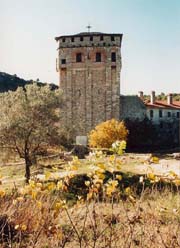
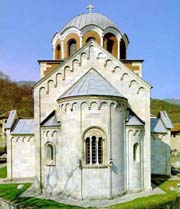
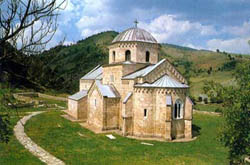
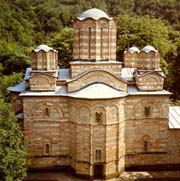
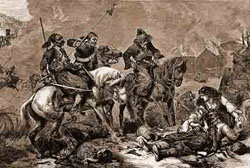
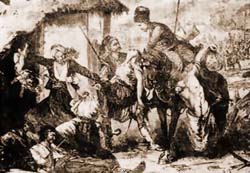
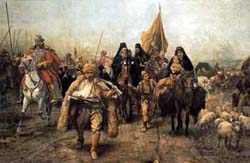
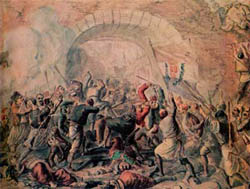
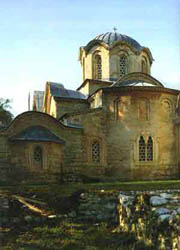
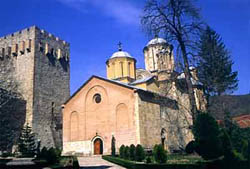
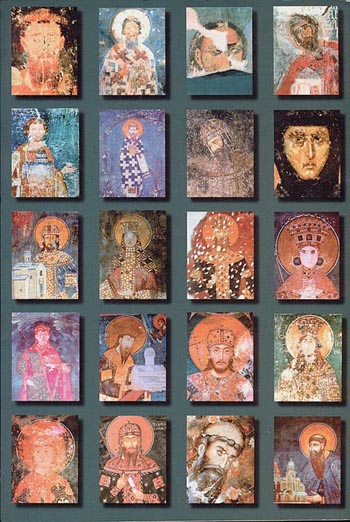
* A spiritual title given to some saints in the Orthodox Church (translator's note).
** A nobleman's title among Slavs (translator's note).
* A nobleman's title among medieval Slavs (translator's note).
** Another nobleman's title among medieval Slavs (translator's note).
* djed = grandfather, gost = guest, starac = elder (translator's note).