Fruškogorski Manastiri
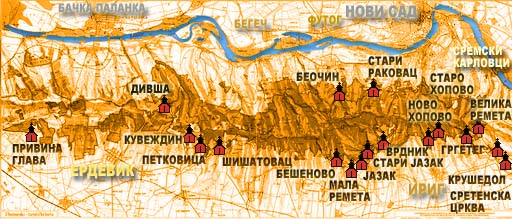
In a low mountain range above Panonia known by a variety of names throughout history (Mons Pinguis, Mons Almus, Alma Mons and Fruska Gora), set between the rivers Sava and Danube, 35 monasteries were built in a marvelous natural setting. Fifteen have been preserved till today. Serbian orthodox church communities exist there at the monasteries of: Krusedol, Petkovica, Rakovac, Velika Remeta Divsa, Novo Hopovo, Staro Hopovo, Jazak, Mala Remeta, Grgeteg, Beocin, Privina Glava, Sisatovac, Kuvezedin, and Vrdnik- Ravanica. According to historical data, these monastery communities have existed since the first decades of the sixteenth century, but the legends relate their founding to the period between the 12th and fifteenth centuries. The monasteries are concentrated in an area 50 kilometers long, and 10 kilometers wide. In the course of five centuries of existance, these monasteries sustained the spiritual and political life of the Serbian nation.
The monasteries were founded in a period of great wars and migrations, and they became centers where the cult of the Brankovic Family (the last of the Serbian despotic families) was carefully nurtured, using the Nemanjic family dynasty as a model. Of equal importance in understanding the spiritual life of the Fruska Gora monasteries are the cults of individual saints, whose relics attracted both pilgrims and patrons to the monasteries. The donations of pilgrims and the highly developed sense of patronage among the Serbs served to heighten religious feelings, stimulating the further construction, decoration and replenishment of the monasteries. Monasteries of Fruska Gora are a unique part of the religious, educational, and cultural being of the Serbian nation, and cultural heritage of Serbia.