Various Other Feasts
In addition to the Holy Pascha of the Lord, and the Twelve Great Feasts, there
are several other Feasts ranking in importance just after them. These are: The
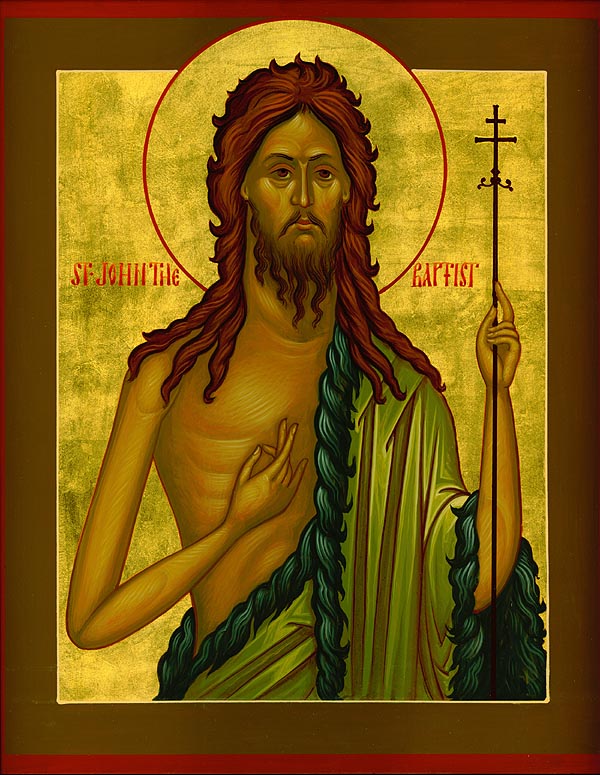
Circumcision of the Lord, The Nativity of St. John the Baptist, The Holy
Apostles Peter and Paul, The Beheading of St. John the Baptist, The Protection
of the Most-Holy Theotokos (Russian Church only), and The Synaxis of the
Archangel Michael and the Other Bodiless Powers.
The Protection of the Most-Holy Theotokos (Oct. 1).
This Feast commemorates an event that happened at Constantinople in the 10th
Century. In the year 911, during the reign of Emperor Leo the Wise, a large army
of Saracens was preparing to attack the city and conquer it. The pious people of
Constantinople reacted to the threat by turning to prayer. They thronged to the
Church of Blachernae (where was preserved the Robe and Veil of the Mother of
God) and there raised their voices to Christ the Lord, and to His Mother, the
All-Holy Theotokos, pleading for mercy and help against the foe.
As the soldiers raised their arms in battle, the church was filled with hymns
and prayers. Among the believers was St. Andrew, a Fool-for-Christ, and his
disciple, St. Epiphanius. Suddenly they saw a vision of the Virgin Mary
surrounded by a choir of angels, prophets and apostles. Do you see, brother, the
Queen of all praying for the peace of the world asked Andrew? Indeed I see,
father, answered the disciple. I see and I fear.
The inhabitants of the city heard of this vision of the two men, and were filled
with joy and hope that this was a sign of deliverance. They thanked God and sang
hymns to the One who interceded for them. All night they prayed in the church,
while outside, the Christian army fought against the invaders. The tide of
battle turned against the enemy and the defenders of Constantinople emerged with
a decisive victory. Saints Andrew and Epiphanius told everyone of their vision
in the church, seeing the Holy Virgin with outstretched arms, holding a veil
over the city as a sign of protection, and imploring God's mercy upon the people.
Since that time the Feast of the Protection has come to be celebrated by the
Church. In the Feast of the Protection of the Most-Holy Theotokos, we entreat of
the Queen of Heaven to protect and help: Remember us in your prayers, O Lady,
Virgin Theotokos, that we not perish for the increase of our sins; protect us
from all evil and cruel misfortune. For we put our hope on you, and honoring the
Feast of your Protection, we magnify you!
Synaxis of the Holy Angels (Nov. 8).
The Feast of the Synaxis of the Archangel Michael and the Other Bodiless Hosts
was established at the beginning of the 4th Century at the Local Council of
Laodicea, a few years before the First Ecumenical Council. This Council, among
other things, condemned and rejected the heretical worship of angels as creators
and rulers of the world and confirmed the Orthodox in their particular
veneration.
The Feast is celebrated in November the 9th Month (counting March, which, in antiquity, \vas the beginning of the year) conforming to the
traditional Nine Ranks of Angels Seraphim and Cherubim, Thrones, Dominions,
Powers, Authorities, Principalities, Archangels and Angels. [All of these titles
are mentioned in Holy Scripture, and a detailed exposition of them, their
characteristics and function may be found in The Celestial Hierarchies by
Pseudo-Dionysius, who wrote in the 6th Century.] The fact that the Feast is
celebrated on the 8th Day of the month indicated the future assembly of the
Heavenly Powers on the day of the awesome judgment of God which the Holy Fathers
called the 8th Day, since after this present age, characterized by 7-day weeks,
will come the 8th Day, when the Son of man comes in His glory, and all the
angels with Him (Matt. 25:31).
In the theology of the Church, the angels are seen as pure spirits, but
nonetheless created spirits, destined to worship and reflect the infinite divine
beauty as well as being sent forth to do the divine bidding. As St. Paul tells us, Are they not all ministering spirits sent forth to serve, for the sake
of those who are to obtain salvation (Heb. 1:14)? Angels appear at times in the
Old Testament to the Patriarchs and Prophets and often were seen to be the
bearers of God's image and power by the ancient Jews. Especially noted is the
manifestation of the Holy Trinity to Abraham (Gen. 18) in the form of three
angels (the subject of Andrei Rublev's famous icon of the Holy Trinity).
In the New Testament the Archangel Gabriel announced the birth of Jesus; angels
ministered to Him in the wilderness and also during His agony in Gethsemane
before His crucifixion; and the Resurrection is announced to the Myrrhbearers by
angels. They are closely involved in the life of the apostles and also in the
beginnings of the Church.
In addition, the Church teaches that everyone is given a Guardian Angel at birth
to act as a guide and protector to every individual. The Lord Himself bears
witness to this, when speaking of little children, He cautioned His disciples: See that you do not despise one of these little ones; for
I tell you that in heaven their angels always behold the face of My Father Who
is in heaven (Matt. 18:10).
The leader of the Heavenly hosts is Michael the Archangel, whose name means Like
unto God. He is mentioned by name in the Old Testament book of Daniel, as well
as in the New Testament Epistle of St. Jude, and especially figures in the
Revelation of St. John. In ancient Jewish tradition, he was seen as the heavenly
protector of Israel.
According to the Revelation of St. John, seven angels serve before the throne of
God (Rev. 8-10) and take part in the final woes of the world. In the tradition
of the Church, the names of these angels, commemorated by name in the Church
Calendar on November 8 are: Michael, Gabriel, Raphael, Uriel, Selaphiel,
Jegudiel and Barachiel.
The Circumcision of Our Lord Jesus Christ (Jan. 1).
January 1 is dedicated to the memory of the Circumcision of Christ. According to
the covenant which God made with Abraham, God said to Abraham, As for you, you shall keep My covenant,
you and your descendants after you throughout their generations.... Every male
among you shall be circumcised. You shall be circumcised in the flesh of your
foreskins, and it shall be a sign of the covenant between Me and you. He that is
eight days old among you shall be circumcised (Gen. 17:9-12).
In submitting to the Law of Circumcision, Our Lord signifies that He is the
fullness and the completion of the Old Covenant: And at the end of eight days,
when He was circumcised, He was called Jesus, the name given by the angel before
He was conceived in the womb (Luke 2:21). At the same time He showed the way to
humility by submitting to humiliation of the flesh, prefiguring the bloody
consecration His All-Pure Body was to receive on the Cross.
So, too, in the spiritual sense, every Christian must submit his body and
desires to the will of God. As St. Paul says, in the Epistle Lesson read on the
Feast: For in [Jesus] the whole fullness of deity dwells bodily, and you have come to fullness of life in Him,
Who is the head of all rule and authority. In Him also you were circumcised with a circumcision made without hands, by putting off the body of flesh in the
circumcision of Christ (Col. 2:9-11).
The Nativity of St. John the Baptist (June 24).
The birth of St. John the Baptist, the last and greatest of the Old Testament
Prophets, was the result of a miracle. As Holy Scripture tells us: In the days
of Herod, King of Judea, there was a priest named Zechariah, of the division of
Abijah; and he had a wife of the daughters of Aaron, and her name was Elizabeth.
And they were both righteous before God, walking in all the commandments and
ordinances of the Lord blameless. But they had no child, because Elizabeth was
barren, and both were advanced in years(Luke 1:5-7).
Childlessness was a terrible thing to an Old Testament Jew; not having a firm
belief in life after death, barrenness meant that one's name would not be
carried on in life. In addition, Zechariah and Elizabeth were both getting on in years, and
the likelihood of bearing children diminished with each passing day.
But then the miraculous hand of God intervened. One day, while Zechariah was
serving in the Temple, the Archangel Gabriel appeared to him and told him that
his barren wife Elizabeth would bear a son, whose name would be John. Zechariah
was incredulous. He doubted the angel since both he and his wife were old. As a
result, by divine command, he was struck dumb until the time when the child
would be born (Luke 1:8-23). After this, Elizabeth conceived, and for five
months she hid herself, saying, Thus the Lord has done to me in the days when He
looked on me, to take away my reproach among men (Luke 1:24-25).
We find parallels to this account in the Old Testament stories of the births of
the Prophet Samuel and of Samson, both of whom were born of barren mothers at
the intervention of God. But we find an even greater parallel in the birth of
the Most-Holy Theotokos, who was born of barren parents, Joachim and Anna, also by means of Divine
Intervention.
Finally the time came for the consummation of the miracle. For the time came for
Elizabeth to be delivered, and she gave birth to a son. And her neighbors and
kinfolk heard that the Lord had shown great mercy to her, and they rejoiced with
her. And on the eighth day they came to circumcise the child; and they would
have named him Zechariah after his father, but his mother said, Not so; he shall
be called John (Luke 1:57-60). This was confirmed by Zechariah in writing; and
when he wrote the name John, his mouth was opened, and he spoke openly.
And his father Zechariah was filled with the Holy Spirit, and prophesied,
saying, you, child, will be called the prophet of the Most High; for you will go
be fore the Lord to prepare His ways, to give knowledge of salvation to His
people in the forgiveness of their sins (Luke 1:67, 76-77). We know that John
later became a great Prophet and was privileged to baptize the Lord Himself in the waters of the Jordan. As the Evangelist tells us, he acknowledged
Christ's divinity when, after he had baptized Him and witnessed the events of
that glorious day, he said, / have seen and have borne witness that this is the
Son of God (John 1:34).
The Holy Apostles Peter and Paul (June 29).
From the 4th Century on, the Church of Rome has celebrated the Feast of the Holy
Apostles on June 29. This became the usage of the Universal Church. Spiritually
the Feast is linked with Holy Pentecost, as the witness of the Apostles is the
immediate fruit of the descent of the Holy Spirit which came upon them. The
?Feast is preceded by the Fast of the Holy Apostles which begins on the Monday
following All-Saints' Sunday (1st after Pentecost). The two most important
Apostles of the early Church were Peter and Paul and, according to Church
Tradition, they were both martyred in Rome, Paul by beheading and Peter by
crucifixion. Thus this Feast became especially prominent in Rome.
Although St. Peter had a special zeal concerning Christ and is considered the chief of the Apostles, he
did not have any special authority over the other Apostles, but was only first
in honor. When there were important questions in the Church, it was a Church
council that decided them, and St. Peter himself was sent by a council to preach
the Word of God.
According to St. John Chrysostom, St. Paul sought dishonor more than we seek
honor, death more than we seek life, poverty more than we seek wealth, sorrows
more than we seek joy, and that he prayed for his enemies more than others pray
against their enemies. For him there was only one thing to be feared: that he
might offend God! He desired nothing more in life than to please God and the
whole meaning of his life was his love for Christ.
The Beheading of St. John the Baptist (Aug. 29).
During His earthly ministry, the Lord bore witness to the stature of His
Baptizer. Jesus began to speak to the crowds concerning John: What did you go
out into the wilderness to behold? A reed shaken by the wind? Why then did you go out? To see a man clothed in soft
raiment? Behold, those who wear soft raiment are in kings' houses. Why then did
you go out? To see a prophet? Yes, I tell you, and more than a prophet. This is
he of whom it is written, 'Behold, I send My messenger before Thy face, who
shall prepare Thy way before Thee.' Truly, I say to you, among those born of
women there has risen no one greater than John the Baptist; yet he who is least
in the Kingdom of Heaven is greater than he (Matt. 11:7-11).
John was the greatest of the prophets; however, as the Resurrection had not yet
occurred, no man had ascended to the glory of the Kingdom of God. Even so great
a prophet as John had not been redeemed. Like all men, John had to die a bodily
death and it is entirely appropriate that this occurred as the result of his
high moral integrity and courageous words such as would come from a great
prophet.
The Holy Evangelist Mark tells the story: Herod had sent and seized John, and
bound hint in prison for the sake of Herodias, his brother Philip's wife; because he had
married her. For John said to Herod, It is not lawful for you to have your
brother's wife. And Herodias had a grudge against him, and wanted to kill him.
But she could not, for Herod feared John, knowing that he was a righteous and
holy man, and kept him safe. When he heard him he was much perplexed; and yet he
heard him gladly.
But an opportunity came when Herod on his birthday gave a banquet for his
courtiers and officers and the leading men of Galilee. For when Herodias'
daughter came in and danced, she pleased Herod and his guests; and the king said
to the girl, Ask me for whatever you wish, and I will grant it. And he vowed to
her, Whatever you ask me, I will give you, even half of my kingdom. And she went
out, and said to her mother, What shall I ask? And she said, The head of John
the baptizer. And she came in immediately with haste to the king, and asked,
saying, I want you to give me at once the head of John the Baptist on a platter.
And the king was exceedingly sorry; but because of his oaths and his guests he
did not want to break his word to her. And immediately the king sent a soldier
of the guard and gave orders to bring his head. He went and beheaded him in the
prison, and brought his head on a platter, and gave it to the girl; and the girl
gave it to her mother. When his disciples heard of it, they came and took his
body, and laid it in a tomb (Mark 6:17-29). Thus the Baptizer of Christ met a
tragic end. In commemoration of this event, on the Day of his Beheading, the
Holy Church has decreed a day of strict fasting.
In addition to the above Feasts, other days are dedicated to the Saints and Holy
Events. Among these are:
St. Anthony the Great, Father of Monasticism (Jan. 17)
The Three Holy Hierarchs: Basil the Great, Gregory the Theologian and John
Chrysostom (Jan. 30)
The Repose of St. Innocent, Metropolitan of Moscow, Enlightener of the Aleuts
and Apostle to the Americas (Mar. 31)
The Holy Greatmartyr and Victorybearer George (Apr. 23).
The Holy Apostle and Evangelist John the Theologian (May 8)
The Holy Equal-to-the-Apostles Cyril and Methodius, Evangelizers of the Slavs
(May 11)
The Holy Equal-to-the-Apostles Emperor Constantine and his mother, St. Helena
(May 21)
Our Venerable Father Sergius, Wonderworker of Radonezh (July 5).
The Holy Equal-to-the-Apostles Great Prince Vladimir (July 15).
Our Venerable Father Seraphim, Wonderworker of Sarov (July 19).
The Holy Glorious Prophet Elijah (July 20)
The Procession of the Honorable Wood of the Life-Giving Cross of the Lord (Aug.
1)
The Glorification of Our Venerable Father Herman, Wonderworker of Alaska and All
America (Aug. 9)
The Repose of St. Tikhon, Bishop of Voronezh, Wonderworker of Zadonsk and All
Russia (Aug. 13)
The Holy New-Martyrs of Alaska: Peter the Aleut and Priest-monk Juvenaly (Sept.
24)
The Glorification of St. Innocent, Metropolitan of Moscow, Enlightener of the
Aleuts and Apostle to the Americas (Oct. 6)
St. Nicholas the Wonderworker, Archbishop of Myra in Lycia (Dec. 6)
The Repose of Our Venerable Father Herman, Wonderworker of Alaska and All
America (Dec. 13).