
On Saturday, the day after the crucifixion of the Lord, His disciples and followers were filled with gloom, for they had seen their Lord and Master die, crucified on a cross. As Holy Scripture tells us, there was a man named Joseph from the Jewish town of Arimathea. He was a member of the council, a good and righteous man, who had not consented to their purpose and deed, and he was looking for the kingdom of God. This man went to Pilate and asked for the body of Jesus (Luke 23:50-52). Pilate gave him leave. So he came and took away His body. [He and] Nicodemus also, who had at first come to Him by night...took the body of Jesus, and bound it in linen clothes...as is the burial custom of the Jews. Now in the place where He was crucified there was a garden, and in the garden a new tomb where no one had ever been laid. So because of the Jewish day of Preparation, as the tomb was close at hand, they laid Jesus there (John 19:38-42). The women who had come with Him from Galilee fallowed, and saw the tomb, and how His body was laid; then they returned and prepared spices and ointments. On the sabbath they rested according to the commandment (Luke 23 :55-56).
Next day, that M, after the day of Preparation, the chief priests and the Pharisees gathered before Pilate and said, "Sir, we remember how that impostor said, while He was still alive, 'After three days I will rise again.' Therefore order the sepulchre to be made secure until the third day, lest His disciples go and steal Him away, and tell the people, 'He has risen from the dead," and the last fraud will be worse than the first," Pilate said to them, "You have a guard of soldiers; go, make it as secure as you can." So they went and made the sepulchre secure by sealing the stone and setting a guard (Matt. 27:62-66).
But on the first day of the week, at early dawn, [the women] went to the tomb, taking the spices which they had prepared (Luke 24:1). And behold, there was a great earthquake; for an angel of the Lord descended from heaven and came and rolled back the stone, and sat upon it. His appearance was like lightning, and his raiment white as snow. And for fear of him the guards trembled and became like dead men. But the angel said to the women, "Do not be afraid; for I know that you seek Jesus Who was crucified. He is not here; for He has risen, as He said. Come, see the place where He lay. Then go quickly and tell His disciples that He has risen from the dead (Matt. 28-2-7).
Mary Magdalene came to the tomb early, while it was still dark, and saw that the stone had been taken away from the tomb. So she ran, and went to Simon Peter and the other disciples, the one whom Jesus loved, and said to them, "They have taken the Lord out of the tomb, and we do not know where they have laid Him." Peter then came out with the other disciples, and they went toward the tomb. They both ran, but the other disciples outran Peter and reached the tomb first; and stooping to look in, he saw the linen cloths lying there, but he did not go in. Then Simon Peter came, following him; and went into the tomb, he saw the linen cloths lying, and the napkin, which had been on His head, not lying with the linen cloths but rolled up in a place by itself. Then the other disciple, who reached the tomb first, also went in, and he saw and believed.... Then the disciples went back to their homes.
But Mary stood weeping outside the tomb, and as she wept she stooped to look into the tomb; and she saw two angels in white, sitting where the body of Jesus had lain, one at the head and one at the feet. They said to her, "Woman, why are you weeping?" She said to them, "Because they have taken away my Lord, and I do not know where they have laid Him." Saying this, she turned around and saw Jesus standing, but she did not know that it was Jenuft. JKSUM said to her, "Woman., why are you weeping? Whom do you seek?" Supposing Him to be the gardener, she said to Him, "Sir, if You have carried Him away, tell me where You have laid Him, and I will take Him away.** Jesus said to her, "Mary." She turned and said to Him in Hebrew, "Rabboni!" (which means Teacher). Jvsus said to her, "Do nut hold Me, fur I have nut yet ascended to the Father; but go to My brethren and say to them? I am ascending to My Father and your Father, to My God and your Cod." Mary Magdalene went and said to the disciples, "I have seen the Lord; and she told them that He had said these things to her (John 20:1-8, 10-18).
Later the Risen Christ revealed Himself to the apostles in the Divine Glory of the Resurrection. And when they witnessed that glory, a new awareness of life was born within them along with the power of faith which moved them to new deeds in their apostolic service. It led them into a hostile world in which they were to endure suffering and which met their preaching of the Crucifixion and Resurrection of Christ with enmity and scorn. But we know that Christ's apostles carried His holy message throughout the Greek and Roman world and into other lands, preaching Christ, how He had come into the world to save men and how, though Himself Cod, He had taken human flesh and lived as a man among men, and how, as a man. He had achieved incomprehensible perfection.
So too, all true believers rejoice on this day of redemption by the great revelation of Cod's truth and life eternal in Jesus Christ, our Redeemer. His glorious Resurrection is the foundation of our Christian Faith and Hope. It is the indestructible foundation on which the miraculous structure of Christ's Church is built.
The Resurrection of Christ the Redeemer is the completion of the Great Work for the redemption of mankind from enslavement to Satan and corruption; the power of sin is destroyed and Death itself is abolished. The Resurrection of Christ grants every one the right to call himself a child of God; it is the return of Paradise lost, the threshold of the Holy of Holies of immortal life and communion with God. St. Paul tells us that if there had been no Resurrection then our Christian faith would have been deprived of any foundation or value: If Christ has not been raised, then our preaching is in vain and your faith is in vain.... If Christ has not been raised, your faith is futile and you are still in your sins (1 Cor. 15:14, 17).
But Christ is risen; He rose the First among the sons of earth, and thus manifested His Might and His Divine Power. Through our forefathers disobedience to God, sin took possession of human nature, and brought decay and death in its wake. But Christ abolished original sin and cleansed the fallen Adam (Eph, 1:7). With His divine blood He raises man into a new creation (1 Cur. 15.13-26).
The Holy Orthodox Church triumphs, exults and rejoices, magnifying and extolling Christ's glorious Resurrection, the great and wonderful manifestation of Divine Love and Forgiveness and the beginning of everlasting life. On this Feast of Feasts, this Triumph of Triumphs, the Holy Church exults in her love for her beloved Bridegroom, Who rose from the tomb for our salvation, and summons us, Her faithful children, to this eternal Feast of angels and men. This greatest feast, illuminated by the light from on high, is a divine prefiguration of the general resurrection of all those who have died from the beginning of time. And this is so because, as the Paschal Hymn so triumphantly proclaims: "Christ is risen from the dead, trampling down death by death, and upon those in the tombs bestowing life!"
Troparion of the Feast (Special Melody)
Kontakion of the Feast (Tone 8)
Hymn of the Resurrection
Come, all you faithful, let us venerate. Christ's holy Resurrection. For, behold through the Cross joy has come into all the world. Let us ever bless the Lord, praising His Resurrection, for by enduring the Cross for us, He has destroyed death by death!
 The first Great Feast to fall in the Church Year
is the Nativity of the Most-Holy Theotokos. It is entirely
fitting that at the beginning of the new religious year
all Orthodox Christians should come before the highest
example of human holiness that the Orthodox Church holds
precious and venerates - that of Mary, the Theotokos and
Mother of God. This day is seen as one of universal joy;
for on this day - the boundary of the Old and New Covenants
- was born the Most-Blessed Virgin, pre-arranged from the
ages by Divine Providence to serve the mystical Incarnation
of God the Word.
The first Great Feast to fall in the Church Year
is the Nativity of the Most-Holy Theotokos. It is entirely
fitting that at the beginning of the new religious year
all Orthodox Christians should come before the highest
example of human holiness that the Orthodox Church holds
precious and venerates - that of Mary, the Theotokos and
Mother of God. This day is seen as one of universal joy;
for on this day - the boundary of the Old and New Covenants
- was born the Most-Blessed Virgin, pre-arranged from the
ages by Divine Providence to serve the mystical Incarnation
of God the Word.The first Old Testament Reading of Vespers (Gen. 28:10-17) speaks of the dream of Jacob, one of the Old Testament Patriarchs, when he fled the wrath of his brother Esau. He saw a ladder extending from earth to heaven, with angels ascending and descending. When he awoke, Jacob blessed with oil the stone on which he had slept and called it Bethel, meaning house of God. The Most-Pure Mother of God is seen here as that ladder between heaven and earth, uniting earth with heaven in her womb. She who carried God in her womb is truly Bethel, none other than the house of God...and the gate of heaven (Gen. 28:17).
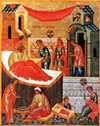
The birth of the Most-Holy Theotokos took place in the following manner: Her father, the Righteous Joachim, was a descendant of King David, to whom God had promised that from the seed of his descendants would be born the Savior of the world. Her mother, the Righteous Anna, was the daughter of Matthan, and through her father was of the tribe of Aaron and through her mother was of the tribe of Judah. The spouses lived in Nazareth of Galilee.
Joachim and Anna had no children, and all their life they grieved about this, especially since they were now in old age. Scorn and mockery was their lot, for at that time childlessness was reckoned as a shame. But they never murmured and only the more fervently beseeched God, humbly trusting in His Will.
Once, during the time of a great Feast, the offering which Joachim took to Jerusalem to offer to God in the Temple, was not received by the priest, who reckoned that a childless man was not worthy to bring a sacrifice to God. This greatly grieved the old man and he, counting himself only a sinner among men, decided not to return home, but to flee to a place of solitude in a deserted place.
Anna, having heard how her husband had been humiliated by the priest, began to fast, and in prayer sadly beseeched God to grant her a child. In the wilderness, secluded and fasting, Joachim also prayed to God about this.
The prayers of the Holy Spouses were heard. The angel Gabriel came to them and announced that a daughter would be born to them, whom the whole human race would call blessed. At the command of the Heavenly Messenger, Joachim and Anna returned to Jerusalem where, according to the promise of God, a daughter was born to them, whom they named Mary.
This child, the Most-Holy Virgin Mary, pure and virtuous, surpassed not only all men, but even the angels, being manifested as the Living Temple, "the Heavenly Gate, ushering in Christ to the Universe as the Salvation of our souls." The Nativity of the Mother of God pre-announced the approaching time when the great and comforting promise of God concerning the salvation of the human race from the slavery of the devil was to be accomplished. The Mother of the First-Born of all Creation was revealed to all of us as a merciful Intercessor to whom we perpetually run for help in all things.
Troparion of the Feast (Tone 4)
Kontakion of the Feast (Tone 4)
By your Nativity, O Most-Pure Virgin, Joachim and Anna are freed from barrenness; Adam and Eve, from the corruption of death. And we, your people, freed from the guilt of sin, celebrate and sing to you: The barren woman gives birth to the Theotokos, the Nourisher of our Life.
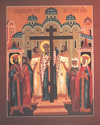
Truly, the Nativity of the Theotokos was seen as the beginning of our salvation, and the Cross is seen as the culmination of our salvation. By Christ's death on It, our salvation was accomplished. Mary is also closely associated with the Cross, for she was the "mystical paradise" in whom the Tree of Life sprouted; this Tree of Life, Christ our Savior, then "planted on earth the life-creating Tree of the Cross" (from the Feast). And as He suffered and died on the Life-giving Tree of the Cross, so too we are called upon to take up our own crosses on our shoulders and to die daily for the sake of Him Who died for us.
The Feast itself came about because of certain historical events. After the voluntary suffering and death on the Cross of the Lord, the sacred place of His suffering was scorned by the pagans. When the Roman Emperor Titus, in 70 A.D. conquered Jerusalem, he destroyed the city and leveled the Temple on Mt. Moriah, not leaving even a stone upon a stone, as had been foretold by the Savior in a dialogue with His disciples (Mark 13:1-2).
The Emperor Hadrian (117-138), a backward, zealous pagan, constructed in place of the Jerusalem destroyed by Titus a new city, which he named Helio-Hadrianopolis. Further, it was forbidden for this city to be called by its previous name of Jerusalem. He commanded that the Holy Grave of the Lord be covered with earth and stones, raising on it an idol. On Golgotha, where the Savior was crucified, in 119 he erected a temple dedicated to the goddess Venus. Sacrifices were offered before the statue and pagan rites were celebrated, accompanied by prostitution. In Bethlehem, in the place where the Savior had been born of the Most-Pure Virgin, the impious monarch erected an idol to Adonis. All of this he did intending that the people completely forget about Christ the Savior and nevermore recollect the place where He lived, taught, suffered and arose with glory.
When Constantine the Great, Equal-to-the-Apostles (306-337) ascended the throne (being the first of the Roman Emperors to recognize Christianity) , he, together with his pious mother. Queen Helena, decided to restore the city of Jerusalem, and in the place of the suffering and resurrection of the Lord Jesus Christ to erect a new church, to cleanse all of the places connected with the memory of Jesus from the pagan cult, and again to consecrate all of them. The Orthodox Queen Helena left for Jerusalem with a great quantity of gold, and the Emperor sent a letter to Patriarch Macarius I (313-323) in which he asked every kind of aid in the holy task of restoring the Christian holy places.
Having arrived in Jerusalem, the pious Queen destroyed all the idols and cleansed the city of pagan cult objects, consecrating the defiled places. She burned with the desire to raise up the Cross of Our Lord Jesus Christ; and so she commanded that digging proceed at the place where the Temple of Venus had stood. There the covered Grave of the Lord was discovered, as well as the place of execution, not far from which were found three crosses and four nails, as well as the sign board which had been nailed over His head.
In order to determine which of the three crosses belonged to the Savior, Patriarch Macarius ordered that the crosses, in turn, be placed on a dead person who was being brought to a place of burial. When the Cross of Christ touched the dead one, he immediately came to life. With great joy, the Orthodox Queen and the Patriarch together lifted up the Life-Creating Cross and showed it to all the people standing by. Later the Church of the Holy Sepulchre was constructed on the site, enclosing within its walls the place of the crucifixion of the Savior, as well as His tomb, and a Feast was instituted for September 14, commemorating the glorious Exaltation of the Cross.
Troparion of the Feast (Tone 1)
Kontakion of the Feast (Tone 4)
The Entrance in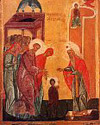 to the Temple
According to the Inner Tradition of the Church, the Entrance into the Temple took place in the following manner: The parents of the Virgin, Joachim and Anna, when praying for the resolution of their barrenness, gave a vow that if a child was born, it would be dedicated to the service of God. Thus, when the Most-Holy Virgin was three years old, her holy parents resolved to fulfill their vow.
Having gathered relatives and acquaintances, clothing the Most-Pure Mary in bright garments, singing sacred hymns and carrying lit candles in their hands, they led her to the Jerusalem Temple. There the young Maiden was met by the High Priest with a multitude of priests. Leading up into the Temple were fifteen high steps, and the child Mary, it seems, was not able on her own to ascend these steps. But, as soon as she was put on the first step, being strengthened by the power of God, she quickly climbed the remaining steps to the top. Later, at an inspiration from Above, the High Priest led the Most-Holy Virgin into the Holy of Holies into which the High Priest entered only once a year on behalf of the people, after first making sacrifices for them and for himself. All who were present were astonished at this extraordinary event.
The righteous Joachim and Anna, having delivered the child voluntarily to the Heavenly Father, returned home; the Most-Blessed Mary remained in the rooms for virgins which were found at the Temple. Around the Temple, according to the witness of Holy Scripture (e.g., Luke 2:37), as well as that of the historian Josephus Flavius, there were many rooms in which remained those dedicated to the service of God.
A deep mystery covers the earthly life of the Most-Holy Theotokos from her childhood to her repose. Her life in the Jerusalem Temple was concealed. "If you were to ask me," said the Blessed Jerome, "how the Most-Holy Virgin passed the time of her youth, I would answer that this is known only to God Himself and the Archangel Gabriel detailed to protect her." In Church Tradition, however, is preserved information that during her sojourn in the Jerusalem Temple, the Most-Pure Virgin was educated in the community of pious virgins, diligently reading Holy Scriptures, occupied with handiworks, perpetually in prayer and growing up with love towards God.
In remembrance of the Entry into the Temple of the Most-Holy Theotokos, the Church, from ancient times, instituted a solemn Feast. Information concerning the celebration of the Feast in the first centuries of Christianity is found in the tradition of Palestinian Christians, which says that when the Holy Queen Helena came to Palestine, she erected a church in honor of the Entrance into the Temple of the Most-Holy Theotokos. Thus the Feast of the Entrance into the Temple of the Most-Holy Theotokos, pre-announcing the Incarnation of God on earth, proclaims salvation to all Christians.
Troparion of the Feast (Tone 4)
Today is the prelude of the good will of God, of the preaching of the salvation of mankind. The Virgin appears in the Temple of God, in anticipation proclaiming Christ to all. Let us rejoice and sing to her: Rejoice, O divine Fulfillment of the Creator's dispensation!Kontakion of the Feast (Tone 4)
The Nativity of Jesus Christ
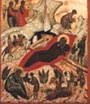
December 25 was ultimately chosen by the Church as the date of the Nativity in order to christianize the pagan Feast of Natalis Invicti or Invincible Sun, which was celebrated on that day. St. Cyprian of Carthage noted that this "anniversary of the invincible" was made actual only in the birth of Jesus-the only invincible One.
As the hymns of Christmas proclaim, "Our Savior, the Dayspring from the East, has visited us from on high: And we who were in darkness and shadow have found the Truth. For the Lord is born of the Virgin" (Exapostilarion). And as the Prophet Isaiah foretold many centuries before, and as the Church proclaims at the Great Compline during the All-Night Vigil for the Nativity of Christ, "Understand all ye nations, and submit yourselves, for God is with us!"
The Christmas story is well-known from the witness of Holy Scripture:
In those days a decree went out from Caesar Augustus that all the world should be enrolled. This was the first enrollment, when Quirinius was governor of Syria. And all went to be enrolled, each to his own city. And Joseph also went up from Galilee, from the city of Nazareth, to Judea, to the city of David, which is called Bethlehem, because he was of the house and lineage of David, to be enrolled with Mary his betrothed, who was with child. And while they were there, the time came for her to be delivered. And she gave birth to her first-born Son and wrapped Him in a manger, because there was no place for them in the inn [Luke 2:1-7].
Now when Jesus was born in Bethlehem of Judea in the days of Herod the king, behold, wise men from the East came to Jerusalem, saying, "Where is He Who has been born king of the Jews? For we have seen His star in the East, and have come to worship Him." When Herod the king heard this, he was troubled, and all Jerusalem with him; and assembling all the chief priests and scribes of the people, he inquired of them where the Christ was to be born. They told him, "In Bethlehem of Judea; for so it is written by the prophet: 'And you, 0 Bethlehem, in the land of Judah, are by no means least among the rulers of Judah; for from you shall come a ruler who will govern My people Israel." Then Herod summoned the wise men secretly and ascertained from them what time the star appeared; and he sent them to Bethlehem, saying, "Co and search diligently for the Child, and when you have found Him bring me word, that I too may come and worship Him." When they had heard the king they went their way; and lo, the Mar which they had seen in the East went before them, till it came to rest over the place where the Child was. When they saw the star, they rejoiced exceedingly with great joy; and going into the house they saw the Child with Mary His mother, and they fell down and worshipped Him. Then, opening their treasures, they offered Him gifts, gold and frankincense and myrrh. And being warned in a dream not to return to Herod, they departed to their own country by another way [Matt. 2:1-12].
And in that region there were shepherds out in the fields, keeping watch over their flock by night. And an angel of the Lord appeared to them, and the glory of the Lord shone around them, and they were filled with fear. And the angel said to them, "Be not afraid; for behold, I bring you good news of a great joy which will come to all the people; for to you is born this day in the city of David a Savior, Who is Christ the Lord. And this will be a sign for you: you will find a babe wrapped in swaddling cloths and lying in a manger." And suddenly there was with the angel a multitude of the heavenly host praising God and saying, "Glory to God in the highest, and on earth peace, good will among men" [Luke 2:8-14].
When the angels went away from them into heaven, the shepherds said to one another, "Let us go over to Bethlehem and see this thing that has happened, which the Lord has made known to us." And they went with haste, and found Mary and Joseph, and the Babe lying in a manger. And when they saw it they made known the saying which had been told them concerning this Child; and all who heard it wondered at what the shepherds told them. But Mary kept all these things, pondering them in her heart. And the shepherds returned, glorifying and praising God for all they had heard and seen, as it had been told them [Luke 2:15-20].
Now when [the wise men and shepherds] had departed, behold, an angel of the Lord appeared to Joseph in a dream and said, "Rife, take the Child and His mother, and flee to Egypt, and remain there till I tell you; for Herod is about to search for the child, to destroy Him." And he rose and took the Child and His mother by night, and departed to Egypt, and remained there until the death of Herod. This was to fulfill what the Lord had spoken by the prophet, "Out of Egypt have I called My son." Then Herod, when he saw that he had been tricked by the wise men, was in a furious rage, and he sent and killed all the male children in Bethlehem and in all that region who were two years old or under, according to the time which he had ascertained from the wise men. Then was fulfilled what was spoken by the prophet Jeremiah: "A voice was heard in Ramah, wailing and loud lamentation, Rachel weeping for her children; she refused to be consoled, because they were no more" [Matt. 2:13-18].
Troparion of the Feast (Tone 4)
Thy Nativity, O Christ our God, has shone to the world the light of wisdom! For by it, those who worshipped the stars, were taught by a star to adore Thee, the Sun of Righteousness, and to know Thee, the Orient from on high. O Lord, Glory to Thee!Kontakion of the Feast (Tone 3)
Today the Virgin gives birth to the Transcendent One, and the earth offers a cave to the Unapproachable One! Angels, with shepherds, glorify Him! The wise men journey with the star! Since for our sake the eternal God was born as a little child!
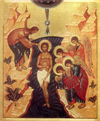
As Holy Scripture tells us: In those days came John the Baptist, preaching in the wilderness of Judea, "Repent, for the kingdom of heaven is at hand." For this is he who was spoken of by the prophet Isaiah when he said, "The voice of one crying in the wilderness: Prepare the way of the Lord, make His paths straight." Now John wore a garment of comet's hair, and a leather girdle around his waist; and his food was locusts and wild honey. Then went out to him Jerusalem and all Judea and all the region about the Jordan, and they were baptized by him in the river Jordan, confessing their sins.... [And John said,] "I baptise you with water for repentance, but He Who is coming after me is mightier than I, Whose sandals I am not worthy to carry; He will baptize you with the Holy Spirit and with fire" [Matt. 3:1-6, 11).
The next day he saw Jesus coming toward him, and said, "Behold, the Lamb of God, Who takes away the sin of the world! This is He of Whom I said, 'After me comes a man Who ranks before me, for He was before me'" [John 1:28-30]. Then Jesus came... to John, to be baptized by him. John would have prevented Him, saying, "I need to be baptized by You, and do You come to me?" But Jesus answered him, "Let it be so now; for thus it is fitting for us to fulfill all righteousness." Then he consented. And when Jesus was baptized. He went up immediately from the water, and behold, the heavens were opened and He was the Spirit of Cod descending like a dove, and alighting on Him; and lo, a voice from heaven, saying, "This is My beloved Son, with Whom I am well pleased" [Matt. 3:13-17].
And John bore witness, "I saw the Spirit descend as a dove from heaven, and it remained on Him. I myself did not know Him; but He Who sent me to baptize with water said to me, 'He on Whom you see the Spirit descend and remain, this is He Who baptizes with the Holy Spirit. 'And I have seen and have borne witness that this is the Son of God" [John 1:32-34].
In commemoration of this event, the Church, on January 5, the Eve of Theophany, performs the Blessing of Waters in the church itself, and on January 6, the day of the Feast itself, the Blessing of Waters is performed at a site prepared outside the church (preferably a river or lake).
The Feast of the Epiphany reminds us of our own Baptism in the hymn sung just before the reading of the Epistle at the Divine Liturgy: "As many as have been baptized into Christ have put on Christ. Alleluia!" For in the waters of Baptism, we put off the Old Man and put on the New, that is Jesus Christ, and strive to acquire the humility shown by the Lord Himself when He, the Creator, bowed His head under the hand of John, the creature, in the waters of the Jordan River.
Troparion of the Feast (Tone 1)
Kontakion of the Feast (Tone 4)
Today
Thou hast appeared to the universe, and Thy light, 0 Lord,
has shone on us, who with understanding praise Thee:
Thou hast come and revealed Thyself, O Light Unapproachable!
The Meeting of Jesus Christ in the Temple
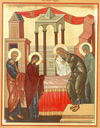
And so Mary and Joseph came after forty days of purification to the Temple to offer a sacrifice according to what is said in the law of the Lord, "a pair of turtledoves, or two young pigeons" (Luke 2:24). The original Old Testament prescription that the firstborn must be consecrated to the service of the Lord was now done by substitution: ...the firstborn of man you shall redeem, and the firstling of unclean beasts you shall redeem. And their redemption price (at a month old you shall redeem them) you shall fix at five shekels in silver, according to the shekel of the sanctuary... (Num. 18:15-16). These five shekels evidently symbolized the coming redemption of us by the Savior - His five wounds on the Cross.
The harsh way of the Cross, portent with profound significance, brought Son and Mother, the God-Man and she who is "more honorable than the Cherubim and more glorious, beyond compare, than the Seraphim," meekly to the Temple at Jerusalem, and the Liberator and Redeemer of the world was Himself redeemed for so trifling a sum.
Now there was a man in Jerusalem, whose name was Simeon, and this man was righteous and devout, looking for the consolation of Israel, and the Holy Spirit was upon him And it had been revealed to him by the Holy Spirit that he should not see death before he had seen the Lord's Christ. And inspired by the Spirit he came into the temple; and when the parents brought in the child Jesus, to do for Him according to the custom of the Law, he took Him up in his arms and blessed God and said, "Lord, now lettest Thou Thy servant depart in peace, according to Thy word" (Luke 2:25-29).
This was the crossroads between the Old Testament and the New. St. Simeon symbolizes the departing Old Testament, exemplified by men of righteousness and prophets who in spite of all their doubts and searchings entertained the firmest faith in what had been foretold of the promised salvation. The righteous Simeon took Him up in his arms, and the Old and New Testaments stood together: the Old, departing, held in its arms and blessed the New. This was unity and continuity, a direct link and a development; the Law and the promised manifestation of the Grace of God as His Only-Begotten Son, the Redeemer.
To Simeon the God-Receiver was granted more than had been granted to any other man before him: he held the Almighty in his arms, and to him were revealed both the Glory and the Way of the Cross of his God: "for mine eyes have seen Thy salvation which Thou hast prepared before the face of all people, a light to enlighten the Gentiles and to be the glory of Thy people Israel/' And His father and His mother marveled at what was said about Him; and Simeon blessed them and said to Mary His mother, "Behold, this Child is set for the fall and rising of many in Israel, and for a sign that is spoken against (and a sword will pierce through your own soul also), that thoughts out of many hearts may be revealed" (Luke 2:30-35). Thus, for the first time, the Most-Holy Mary was forewarned that there would be no end to the thorns and trials of her life, that her Son, while bringing light and spiritual renewal to all peoples, would Himself be so persecuted that a sword will pierce through your own soul also.
The Lord wished for moral harmony in spreading abroad this holy news, and so He wished a woman, too, to repeat what had been said by Simeon;
And there was a prophetess, Anna, the daughter of Phanuel, of the tribe of Asher; she was of a great age, having lived with her husband seven years from her virginity, and as a widow till she was eighty-four. She did not depart from the Temple, worshipping with fasting and prayer night and day. And coming up at that very hour she gave thanks to Cod, and spoke of Him to all who were looking for redemption in Jerusalem (Luke 2:36-38).
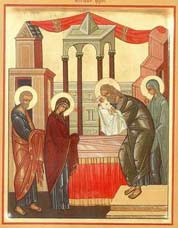 Just as in Palestine in ancient times, we bring our children
on the fortieth day to be presented to the Lord; but in contrast to
the Israelites, we bring children of either sex. In the Presentation,
Christ, the Firstborn of all the human race. Creator of the New Church
and of the New Testament, filled the old rites with a new content.
By bringing our children to church like the Most-Pure Virgin Mary,
we bind them over to God. Baptized and sanctified by grace, our children,
by being made members of the Church, take their first steps upon the
way of grace and the way of the Cross that lies before those who would
follow Christ.
Just as in Palestine in ancient times, we bring our children
on the fortieth day to be presented to the Lord; but in contrast to
the Israelites, we bring children of either sex. In the Presentation,
Christ, the Firstborn of all the human race. Creator of the New Church
and of the New Testament, filled the old rites with a new content.
By bringing our children to church like the Most-Pure Virgin Mary,
we bind them over to God. Baptized and sanctified by grace, our children,
by being made members of the Church, take their first steps upon the
way of grace and the way of the Cross that lies before those who would
follow Christ.So we must go out to meet Christ and receive Him, taking Him into the arms of our souls, begging leave for sin to depart from us that we may live our lives in peace and tranquility, free of the agitations of evil. St. Simeon gave us an example of how firmly to follow the path of a righteous life, filled with the expectation of a meeting with the Lord.
Troparion of the Feast (Tone 1)
Rejoice, O Virgin Theotokos, Full of Grace! From you shone the Sun of Righteousness, Christ our God, enlightening those who sat in darkness! Rejoice and be glad, O righteous Elder; you accepted in your arms the Redeemer of our souls, Who grants us the Resurrection.
Kontakion of the Feast (Tone 1)
By Thy Nativity, Thou didst sanctify the Virgin's womb and didst bless Simeon's hands, O Christ God. Now Thou hast come and saved us through love. Grant peace to all Orthodox Christians, O only Lover of Man!
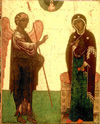
As Holy Scripture tells us: In. the sixth month the angel Gabriel was sent from God to a city of Galilee named Nazareth, to a virgin betrothed to a man whose name was Joseph, of the house of David; and the virgin's name was Mary. And he came to her and said, "Hail, O favored one, the Lord is with you! Blessed are you among women!" But she was greatly troubled at the saying, and considered in her mind what sort of greeting this might be. And the angel said to her, "Do not be afraid, Mary, for you have found favor with God. And behold, you will conceive in your womb and bear a son, and you shall call His name Jesus, He will be great, and will be called the Son of the Most High; and the Lord Cod will give to Him the throne of His father David, and He will reign over the house of Jacob forever; and of His kingdom there will be no end." And Mary said to the angel, "How shall this be, since I have no husband?" [Luke 1:26-34].
Mary's question, How shall this be...? is not an _expression of doubt. In this differs quite radically from the attitude of Zechariah, the father of St. John the Baptist, when the angel announced to him news of the birth of his own son. She simply poses a respectful question. And the angel said to her, "The Holy Spirit will come upon you and the power of the Most High will overshadow you; therefore the child to be born of you will be called holy, the Son of God. And behold, your kinswoman Elisabeth [the mother of St. John the Baptist] in her old age has also conceived a son, and this is the sixth month with her who was called barren. For with Cod nothing will be impossible" [Luke 1:35-37].
With perfect obedience and humility, Mary gives her reply to the angel and with it overturns the curse of the First Parents: And Mary said, "Behold, I am the handmaid of the Lord; let it be to me according to your word." And the angel departed from her [Luke 1:38]. Thus, with the Archangel Gabriel we can all cry out to her from the depths of our hearts: Rejoice, you through whom joy will shine forth: Rejoice, you through whom the curse will cease! Rejoice, restoration of fallen Adam: Rejoice, redemption of the tears of Eve! Rejoice, Height hard to climb for the thoughts of man: Rejoice, Depth hard to perceive even for the eyes of angels! Rejoice, you who are the throne of the King: Rejoice, you who hold Him Who holdeth all! Rejoice, Star who makes the Sun appear: Rejoice, Womb of the Divine Incarnation! Rejoice, you through whom the Creation is made new: Rejoice, you through whom the Creator becomes a newborn child! Rejoice, Unwedded Bride! [From the Ikos of the Matins of the Feast].
Troparion of the Feast (Tone 4)
Today is the beginning of our salvation, the revelation of the eternal mystery! The Son of God becomes the Son of the Virgin as Gabriel announces the coming of Grace. Together with him let us cry to the Theotokos: Rejoice, O Full of Grace, the Lord is with you!
Kontakion of the Feast (Tone 8)
O victorious Leader of triumphant hosts! We, your servants, delivered from evil, sing our grateful thanks to you, O Theotokos! As you possess invincible might set us free from every calamity so that we may sing: Rejoice, O Unwedded Bride!
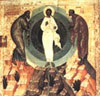
In the Old Testament, the presence of light and cloud often signified the Divine Presence: Then Moses went up on the mountain, and the cloud covered the mountain. The glory of the Lord settled on Mount Sinai, and the cloud covered it six days; and on the seventh day He called to Moses out of the midst of the cloud. Now the appearance of the glory of the Lord was like a devouring fire on the top of the mountain in the sight of the people of Israel (Ex. 24:15-17). Likewise, on Mt. Tabor the cloud signified the Divine Presence - the God-Man Jesus Christ, and the Theophany here was accompanied by a bright radiance.
Both Moses and Elijah had beheld the presence of God, as the Readings at the Vespers of the Feast point out, and thus were appropriate witnesses on Mt. Tabor to Christ's divinity. In addition, as Jesus is the fulfillment of the Law and the Prophets, how appropriate it was for those who par excellence represented the Law (Moses) and the Prophets (Elijah) to be present.
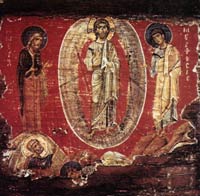 The Lord took His three closest disciples
(Peter, James and John) with .Him on the mountain for, although
God sometimes reveals Himself to sinners in quite unexpected
ways, it is usually those who have followed Him long and faithfully
who are privileged to enter into the joy of the Transfiguration
of the Master.
The Lord took His three closest disciples
(Peter, James and John) with .Him on the mountain for, although
God sometimes reveals Himself to sinners in quite unexpected
ways, it is usually those who have followed Him long and faithfully
who are privileged to enter into the joy of the Transfiguration
of the Master.The bright radiance and shining of the face is also a characteristic of those closest to God. Such was the case of Moses, who spoke to God/ace to face: When Moses came down from Mount Sinai, with the two tables of the testimony in his hand as he came down from the mountain, Moses did not know that the skin of his face shone because he had been talking with God. And when Aaron and all the people of Israel saw Moses, behold, the skin of his face shone, and they were afraid to come near him. But Moses called to them; and Aaron and all the leaders of the congregation returned to him, and Moses talked with them.... And when Moses had finished speaking with them, he put a veil on his face; but whenever Moses went in before the Lord to speak with Him, he took the veil off, until he came out; and when he came out, and told the people of Israel what he was commanded, the people of Israel saw the face of Moses, that the skin of Moses' face shone; and Moses would put the veil upon his face again, until he went in to speak with Him (Ex. 34:29-35). In more recent times this phenomenon was especially noted in the case of St. Seraphim of Sarov whose face shone like the brightest sun according to contemporary reports [Conversation with Motovilov].
In like manner, we all have the opportunity to be transfigured in our lives and to acquire a close relationship with God. So, too, we all have the opportunity to manifest the visible signs of those closest to God. In any case, as St. Paul tells us, when we die our bodies will be transformed (transfigured, as it were) and we will take on spiritual, radiant bodies. This aspect is clearly seen in the Transfiguration of Our Lord.
Troparion of the Feast (Tone 7)
Kontakion of the Feast (Tone 7)
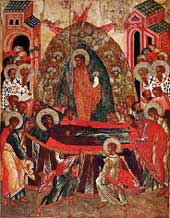 Liturgically, the most important Feast
of the Theotokos is that of her Dormition or Falling-Asleep.
Prior to this Feast there is a strict two-week fast,
beginning on August 1, which is broken only by the Feast
of the Transfiguration on August 6. This Feast possesses
two distinct aspects inseparably linked in the mind of
the believer. On the one hand, there is death and burial
and, on the other, resurrection and the assumption of
the Mother of God. As part of the Inner Tradition of
the Church, this event was mystery that was not designed
for the ears of the outside world, but which was revealed
to the faithful within the Church.
Liturgically, the most important Feast
of the Theotokos is that of her Dormition or Falling-Asleep.
Prior to this Feast there is a strict two-week fast,
beginning on August 1, which is broken only by the Feast
of the Transfiguration on August 6. This Feast possesses
two distinct aspects inseparably linked in the mind of
the believer. On the one hand, there is death and burial
and, on the other, resurrection and the assumption of
the Mother of God. As part of the Inner Tradition of
the Church, this event was mystery that was not designed
for the ears of the outside world, but which was revealed
to the faithful within the Church.True believers know that insofar as the son of God assumed human nature in the womb of the Virgin, She who was the means of His Incarnation was resurrected and taken up into Heaven in the Divine Glory of Her Son. Arise, 0 Lord, and go to Thy resting place. Thou and the ark of Thy might (Ps. 132;8). The Son transported His Mother to the eternity of the life to come, "for being the Mother of Life, she was translated to life by the One Who dwelt in her virginal womb" (from the Kontakion of the Feast).
Thus, if every year we commemorate the anniversaries of the deaths of the Saints - the Martyrs, Apostles, Venerable Mothers and Fathers, Sainted Hierarchs, etc. - so much the more we commemorate the death of the Most-Holy Theotokos who did not see the corruption of the grave common to all humanity. And not only did her soul ascend to heaven, but her body also. As she was a perfect example of that obedience which all Christians are called upon to exercise, and as she alone was the Mother of God, her body did not see the natural corruption which follows death, but was raised from the dead and carried to the glory of the King of All in the heavenly mansions.
According to the Inner Tradition of the Church, the Dormition of the Most-Holy Theotokos took place in the following manner: Having reached an advanced age, the Most-Pure One wished to leave the body and go to God as soon as possible, since the one unceasing desire of her soul had always been to see the sweet face of her son sitting at the right hand of the Father in Heaven. Many tears she shed as she prayed to the Lord to take her from this present vale of sorrows.
The All-Chaste One lived in the house of St. John the Divine on Zion and often she went to the Mount of Olives, which was nearby, offering there in solitude her fervent prayer to her Son. Once, as she was praying alone on the Mount, the Archangel Gabriel appeared to her and announced that soon (after three days) she would depart and be with Christ. The Archangel told her that she should not be troubled, but should receive his words with joy as she was being called to immortal life and to the eternal
King of Glory. As a sign of the triumph of the Mother of God over death - that bodily death would not have power over her, just as spiritual death had not had dominion over her, and that she would merely fall asleep for a short time and then, as if waking from sleep, she would rise and shake off death like sleep from the eyes and would see in the light of the Lord's face the immortal life and glory to which she would go with shouts of joy and spiritual happiness - the Archangel handed the Most-Holy Virgin a branch from Paradise. The Most-Blessed Mother of God was filled with unspeakable joy and, falling down on her knees, she fervently thanked her Creator.
Before her departure from this life, the Most-Pure Lady wanted to see the Holy Apostles who were already scattered all over the world for the preaching of the Gospel. On her knees she prayed that this might be possible and that at the hour of her death she might not see the Prince of Darkness and his terrible servants, but that her son and God Himself would fulfill His promise and come and receive her soul into His holy hands. As she knelt, the olive trees growing on the Mountain bent, as if they were animate, and when the Pure Theotokos rose, they straightened themselves out again, honoring her as the Mother of God.
Returning home, the Most-Blessed Lady showed the branch from Paradise to St. John and told him to carry it before her bed. Then she began to make preparations for her burial. St. John sent word to St. James, first Bishop of Jerusalem and the brother of the Lord, and also to all other relatives and neighbors, informing them of the imminent decease of the Mother of God. In turn St. James informed all the Christians living in Jerusalem and the surrounding towns. With weeping they came to the home of the Pure Virgin to await her death.
As the multitude was gathered at the home of the Theotokos, suddenly there was heard a loud noise, like thunder, and a cloud encircled the house of St. John the Divine. At the command of God, angels seized the Apostles who were scattered to the ends of the earth and, bringing them on clouds to Jerusalem, placed them on Zion before the door of the house. St. John greeted them and told them of the speedy departure of the Most-Holy Mother of God. Later the Apostle Paul, accompanied by his close disciples, Dionysius the Areopagite, Hierotheus and Timothy, as well as the Seventy Apostles arrived at the home.
On the fifteenth day of the month of August, as all were awaiting the final hour, there suddenly shone in the room an ineffable light of Divine Glory which dimmed the lamps that had been lit in the house. The inhabitants saw the roof of the room opened and the glory of the Lord descending from Heaven-Christ the King of Glory Himself with the hosts of angels and archangels, with all the heavenly powers, with the holy Fathers and Prophets who of old had prophesied about the Holy Virgin, and all the righteous souls, approached His Immaculate Mother.
After greeting Her Son, the Virgin surrendered her pure soul into His hands. She felt no pain whatever, for the end was as if she had fallen into a sweet sleep. At once there began angelic singing and with triumphant songs the heavenly hosts accompanied the soul of the Mother of God as she went in the arms of the Lord to the dwellings on High.
After her demise, the Holy Apostles bore the Most-Pure Body of the Mother of God to the Garden of Gethsemane, where she was placed in a tomb. The Holy Apostles stayed by the tomb of the Most-Pure One without leaving the Garden for three full days, singing psalms day and night. In addition, for all this time there was heard in the air the wonderful singing of the heavenly hosts praising God and blessing His Immaculate Mother.
By God's special arrangement, one of the Apostles, St. Thomas, was not present at the glorious burial of the body of the Immaculate Mother and he only arrived at Gethsemane on the third day. Grieving that he had not been granted the last greeting and blessing of the Most-Pure One, Thomas wept bitterly. Taking pity on him, the Apostles decided to open the tomb so that he might at least see the dead body of the Blessed Mother. But when the tomb was opened, the body of the Mother of God was not there, but only the burial clothes, giving off a wonderful fragrance!
With weeping and reverance the Holy Apostles kissed the burial clothes, praying that the Lord would reveal to them where the body of the All-Pure One had disappeared to. Later, after having eaten a meal in the Garden, the Apostles suddenly heard angelic singing. Looking up, they saw standing in the air the Immaculate Mother of God surrounded by a multitude of angels. She was enveloped in an ineffable light and she said to them: "Rejoice, for I am with you always!" Filled with joy, instead of the usual "Lord Jesus Christ, help us!" the Apostles cried: "Most Holy Mother of God, help us!" From that time they taught the Holy Church to believe that the Immaculate Mother of God on the third day after her burial was raised by her Son and taken with her body to Heaven.
Thus, the Lord, by His special Providence, delayed the arrival of St. Thomas until the day of the Falling-asleep of the Mother of God so that the tomb might be opened for him, so that the Church, in this way, might believe in the resurrection of the Mother of God, just as previously through the same Apostle's unbelief the Church had come to believe in the resurrection of Christ. Thus were accomplished the Falling-asleep of our Most-Blessed Lady the Mother of God, the burial of her undefiled body, her glorious resurrection and the triumphant assurance regarding her ascension to heaven in the flesh.
Troparion of the Feast (Tone 1)
In giving birth, you preserved your virginity! In falling asleep you did not forsake the world, O Theotokos! You were translated to life, O Mother of Life, and by your prayers you deliver our souls from death!
Kontakion of the Feast (Tone 2)
The Entrance into Jerusalem
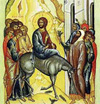
The number of people believing in Christ the Savior was growing from day to day, and even some of the Jews who had up until then been hostile towards Him, seeing the miracle He had wrought, believed in Him. This made the scribes and Pharisees even more angry, and they resolved to kill not only Our Lord Jesus Christ, but the righteous Lazarus as well.
Jesus Christ did not want to increase the spite of His foes, the scribes and Pharisees, and for this reason He often avoided direct and open confrontation with them. But the time had come to take all the wrath and spite of these people upon Himself. So that His enemies would have no justification for their unbelief and would not be able to say afterwards that He had hidden His glory and His predestined Messianic mission from them. Our Lord made a ceremonial entry into Jerusalem, fulfilling all that the Prophets had foretold of Him. After spending a day in Bethany, Jesus Christ set out for the Holy City.
Calling to Himself two of His disciples - in all likelihood Peter and John - Our Lord asked them to bring from a nearby village a she-ass and her colt. The disciples went and fulfilled everything: finding at the gates of the town a she-ass and her colt, they brought them to the Savior. The young colt had not been ridden or borne a yoke before (1 Sam. 6:7). The disciples then spread their clothes upon it.
Thus Jesus entered Jerusalem, not in a royal chariot drawn by horses, but on a young ass, covered, not with rich cloths, but with the well-worn robes of the disciples. In this way, as the Evangelists John and Matthew tell us, the sayings of the Prophets were fulfilled: Tell the daughter of Zion, Behold, your king is coming to you, humble, and mounted on an ass, and on a colt, the foal of an ass (Matt. 21:5).
The meek and humble entry of Our Lord Jesus Christ in to Jerusalem was a symbol of peace and humility, for it represented a complete contrast to the triumphal processions of kings at that time. The way in which Christ entered Jerusalem showed that His Kingdom was not of this world, but that He was sent by His Father in Heaven. Jesus was accompanied by throngs of people who had followed Him from Bethany or had met Him on the way.
Having ascended the Mount of Olives, He stopped. From this hill a beautiful view opened out over Jerusalem. The tumultuous joy of the people following the Great Miracle-Worker who had raised Lazarus from the dead, grew even greater at the sight of this beautiful and sacred city.
Not only the disciples, but all who believed in Him rejoiced with a great joy, for they believed that Jesus was the promised Messiah, Who, according to the erroneous beliefs and expectations of the Jews, would sit on the throne of David, the king of glory, and be their ruler and rescue them from the Roman yoke.
At the gates of Jerusalem Jesus was met by a great multitude of people, rejoicing and waving palm branches, who, as St. Matthew tells us, bestrewed the way with them and their garments (Matt. 21:7-8). All this was an _expression of particular reverence for the Messiah Whom they had come out to welcome. [We note here that in the Russian Orthodox Church, branches from the pussy willow are used instead of palm branches, obviously on account of the harsh climate.]
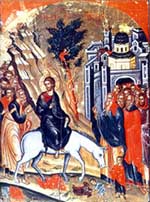 During the Lord's triumphant entry into
Jerusalem, the whole people, who had come in their multitudes
to celebrate the Passover and those who had witnessed Lazarus'
resurrection and had been astounded by this great miracle, cried
in joyous rapture: Hosanna to the Son of David! Blessed is He
Who comes in the name of the Lord! Hosanna in the highest! (Matt.
21:9). The humble and meek procession of the Savior through the
streets of Jerusalem surpassed and eclipsed all the triumphant
processions that humanity had ever known.
During the Lord's triumphant entry into
Jerusalem, the whole people, who had come in their multitudes
to celebrate the Passover and those who had witnessed Lazarus'
resurrection and had been astounded by this great miracle, cried
in joyous rapture: Hosanna to the Son of David! Blessed is He
Who comes in the name of the Lord! Hosanna in the highest! (Matt.
21:9). The humble and meek procession of the Savior through the
streets of Jerusalem surpassed and eclipsed all the triumphant
processions that humanity had ever known.Seeing the joy of the multitudes around Him, however, the Savior grew sad, and since He loved His people and His city. His heart was filled with sorrow. He knew that the same people, who rejoiced now and cried Hosanna! and saw in Him their salvation, would in a few days cry out in rage: Crucify Him! Crucify Him! (John 19:6). The Savior also knew that the fair and holy city of Jerusalem which He was entering, would soon be desolated and not a stone be left one upon another. As He drew night to the city, Jesus wept over it, saying, "Would that even today you knew the things that make for peace! But now they are hid from your eyes (Luke 19:41-42).
But it was not for Himself that our Lord wept. He wept and grieved because He knew that God's chosen Jewish people were perishing in ignorance and error. The Lord grieved not only for Jerusalem and the Chosen People, but for the whole universe; His gaze reached across the centuries, and saw the sins of future generations, and it was for them that He grieved in His soul; for them He wept and prayed.
Thus, the triumphant entrance of the Savior into Jerusalem which we celebrate on Palm Sunday was accomplished. In the Lord's Entrance, we see His way to voluntary suffering and death for our salvation. And we also see the image of Christ's spiritual Kingdom - the Kingdom of Truth, Peace and Humility.
Troparion of the Feast (Tone 1)
Another Troparion (Tone 4)
Kontakion of the Feast (Tone 6)
Sitting on Thy throne in heaven, carried on a foal on earth, O Christ God! Accept the praise of angels and the songs of children, who sing: Blessed is He that comes to recall Adam!
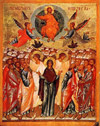
The Lord ascended to Heaven not to sadden us with His departure, but in order to do what was best for us. It is to your advantage that I go away. He had told His disciples. [For] if I do not go away, the Comforter will not come to you (John 16:7). I will pray the Father, and He will give you another Comforter, to be with you for ever, even the Spirit of truth.... The Comforter, the Holy Spirit, Whom the Father will send in My name. He will teach you all things (John 14:16, 26). The Savior saw that His mission on earth was accomplished. The goal of His Incarnation was to proclaim the Divine Truth to the world, to direct men onto the path of repentance and salvation, and deliver us from Eternal Death. The Lord accomplished our salvation and man acquires it through the action of the Holy Spirit.
The Lord knew the trials and tribulations that would be endured by His disciples - mockings, scourgings, imprisonment and even death. And thus the Lord ascended to His Heavenly Father that the Spirit might descend from the Father as the Comforter, and fortify His Friends.
The Lord ascended to Heaven in order to prepare for us, too, the path to the Heavenly Mansions, to open the Gates of Paradise, and Himself to be our Guide. Heaven that had been closed to men before the Resurrection now at the Ascension was opened by Christ the Savior.
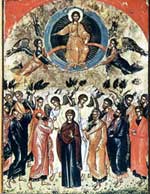 None of the righteous men of the Old Testament
- the Patriarchs, the Prophets, and men pleasing to God could
enter Heaven. No one has ascended into heaven but He Who descended
from heaven, the Son of man (John 3:13), the Lord had said. Our
first parent, Adam, closed the Gates of Paradise, and an angel
with a flaming sword was placed at the gates. But the New Adam,
Our Lord Jesus Christ, through His Ascension, opened the way
to Life and Heaven itself. He was followed by the souls of the
holy Forefathers, Prophets and hosts of righteous people of the
New Testament. All worthy Christians who follow in the footsteps
of their Savior, enter Heaven in this way today and so they will
in the future.
None of the righteous men of the Old Testament
- the Patriarchs, the Prophets, and men pleasing to God could
enter Heaven. No one has ascended into heaven but He Who descended
from heaven, the Son of man (John 3:13), the Lord had said. Our
first parent, Adam, closed the Gates of Paradise, and an angel
with a flaming sword was placed at the gates. But the New Adam,
Our Lord Jesus Christ, through His Ascension, opened the way
to Life and Heaven itself. He was followed by the souls of the
holy Forefathers, Prophets and hosts of righteous people of the
New Testament. All worthy Christians who follow in the footsteps
of their Savior, enter Heaven in this way today and so they will
in the future.The Lord ascended to intercede for us with His Heavenly Father. Towards the end of His earthly mission He had said: I go to prepare a place for you. And when I go and prepare a place for you, I will come again and will take you to Myself, that where I am you may be also (John 14:2-3). This same thought was also expressed by the great Preacher of Christ's teaching, St. Paul, in the Epistle to the Hebrews: Christ has entered, not into a sanctuary made with hands, a copy of the true one, but into heaven itself, now to appear in the presence of Cod on our behalf (Heb. 9:24). These words fill us with hope, for we now have in Heaven a great Mediator and Advocate for the world with God - Christ Our Lord.
Our Lord ascended in a cloud on high, symbolizing the rising smoke of an acceptable sacrifice. Thus the sacrifice was accepted by God and Christ the Lamb that was slain is ushered into the preserve of God where He will be eternally offered in the Holy Eucharist. Therefore we must be worthy of the great mercies of God, capable and ready to receive them. All the power, all the fruit of His divine Ascension, therefore, belong to us, for when He ascended on High, He led captivity captive, and gave gifts to men (Eph. 4:8). This is why the Church repeatedly proclaims: "Clap your hands, all you nations, for Christ is ascended up to the place where He was before" [from the Vespers of the Feast].
Troparion of the Feast (Tone 4)
Kontakion of the Feast (Tone 6)
When Thou didst fulfill the dispensation for our sake, and unite earth to heaven: Thou didst ascend in glory, O Christ our God, not being parted from those who love Thee, but remaining with them and crying: I am with you and no one will be against you!
The Holy Pentecost
.jpg)
In His farewell discourses to His disciples, the Lord told them, I will pray the Father, and He will give you another Comforter, to be with you for ever, even the Spirit of Truth, Whom the world cannot receive, because it neither sees Him nor knows Him; you know Him, for He dwells with You, and will be in you.... [The] Comforter, the Holy Spirit, Whom the Father will send in My name. He will teach you all things... (John 14:16-17, 26). These words of the Lord were accomplished on the 50th Day after the Passover (Pascha), for the Seal of the Holy Spirit was seen on the Apostles in the form of fiery tongues, just as, in Holy Chrismation, we receive the Seal of the Holy Spirit in the form of the Holy Chrism.
The people who were present were greatly amazed at the sight, and especially that each one of them, no matter what nationality, heard the Apostles speaking to them in their own'language. But others mocking said, "They are filled with new wine" (Acts 2:13).
Then Peter got up and spoke to them: Men of Judea and all who dwell in Jerusalem, let this be known to you, and give ear to my words. For these men are not drunk, as you suppose, since it is only the third hour of the day; but this is what was spoken by the prophet Joel: "And in the last days it shall be. Cod declares, that I will pour out My Spirit upon all flesh, and your sons and your daughters shall prophesy, and your young men shall see visions, and your old men shall dream dreams; yea, and on My menservants and My maidservants in those days I will pour out My Spirit; and they shall prophesy. And I will show wonders in the heaven above and signs on the earth beneath, blood, and fire, and vapor of smoke; the sun shall be turned into darkness and the moon into blood, before the day of the Lord comes, the great and manifest day. And it shall be that whoever calls on the name of the Lord shall be saved" (Acts 2:14-21).
Peter went on to speak of the Risen Christ and His redemptive acts, reminding them that this Jesus Cod raised up, and of that...all [of the Apostles were] witnesses (Acts 2:32). He continued: Being therefore exalted at the right hand of God, and having received from the Father the promise of the Holy spirit. He has poured out this which you see and hear (Acts 2:33).
Many of those hearing were cut to the heart, and said to Peter and the rest of the apostles, "Brethren, what shall we do?" And Peter said to them, "Repent, and be baptized every one of you in the name of Jesus Christ for the forgiveness of your sins; and you shall receive the gift of the Holy Spirit...." So those who received his word were baptized, and there were added that day about three thousand souls (Acts 2:37-38, 41).
A special characteristic of this day is the singing of the Troparion to the Holy Spirit: "0 Heavenly King, the Comforter, the Spirit of Truth, Who art everywhere present and fillest all things, Treasury of Blessings and Giver of Life: Come and abide in us and cleanse us from every impurity, and save our souls, 0 Good One!" In addition, seven Kneeling Prayers are read by the Priest during the Vespers which immediately follows the Divine Liturgy of that day, while everyone are on bended knees, this being the first time kneeling is permitted since Holy Pascha.