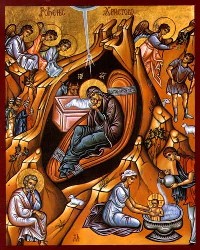
Holy Icons
One of the first things that strikes a non-Orthodox visitor to an Orthodox
church is the prominent place assigned to the Holy Icons. The Iconostasis
(Icon-screen) dividing the Altar from the rest of the church is covered with
them, while others are placed in prominent places throughout the church
building. Sometimes even the walls and ceiling are covered with them in fresco
or mosaic form. The Orthodox faithful prostrate themselves before them, kiss
them, and burn candles before them. They are censed by the Priest and carried in
processions. Considering the obvious importance of the Holy Icons, then,
questions may certainly be raised concerning them: What do these gestures and
actions mean? What is the significance of these Icons? Are they not idols or the
like, prohibited by the Old Testament?
Some of the answers to these questions can be found in the writings of St. John
of Damascus (f776), who wrote in the Mid-Eighth Century at the height of the
iconoclast (anti-icon) controversies in the Church, controversies which were resolved only by the 7th Ecumenical Council
(787), which borrowed heavily from these writings.
As St. John points out, in ancient times God, being incorporeal and
uncircumscribed, was never depicted, since it is impossible to represent that
which is immaterial, has no shape, is indescribable and is unencompassable. Holy
Scripture states categorically: No one has ever seen God (John 1:18) and You
cannot see My [God's] face, for man shall not see Me and live (Ex. 33:20). The
Lord forbade the Hebrews to fashion any likeness of the Godhead, saying: I7ou
shall not make for yourself a graven image, or any likeness of anything that is
in heaven above, or that is in the earth beneath, or that is in the water under
the earth (Ex. 20:4). Consequently, the Holy Apostle Paul also asserts: Being
then God's offspring, we ought not to think that the Deity is like gold, or
silver, or stone, a representation by the art and imagination of man (Acts
17:29).
Nonetheless, we know that Icons have been used for prayer from the first centuries of Christianity. Church
Tradition tells us, for example, of the existence of an Icon of the Savior
during His lifetime (the Icon-Made-Without-Hands) and of Icons of the Most-Holy
Theotokos immediately after Him. Tradition witnesses that the Orthodox Church
had a clear understanding of the importance of Icons right from the beginning;
and this understanding never changed, for it is derived from the teachings
concerning the Incarnation of the Second Person of the Holy Trinity Our Lord and
Savior Jesus Christ. The use of Icons is grounded in the very essence of
Christianity, since Christianity is the revelation by the God-Man not only of
the Word of God, but also of the Image of God; for, as St. John the Evangelist
tells us, the Word became flesh and dwelt among us (John 1:14).
No one has ever seen God; the only Son, Who is in the bosom of the Father, He
has made Him known (John 1:18), the Evangelist proclaims. That is, He has
revealed the Image or Icon of God. For being the brightness of [God's] glory, and the express image of [God's]
person (Heb. 1:3), the Word of God in the Incarnation revealed to the world, in
His own Divinity, the Image of the Father. When St. Philip asks Jesus, Lord,
show us the Father, He answered him: Have I been with you so long, and yet you
do not know Me, Philip? He who has seen Me has seen the Father (John 14:8, 9).
Thus as the Son is in the bosom of the Father, likewise after the Incarnation He
is consubstantial with the Father, according to His divinity being the Father's
Image, equal in honor to Him.
The truth expressed above, which is revealed in Christianity, thus forms the
foundations of Christian pictorial art. The Image (or Icon) not only does not
contradict the essence of Christianity, but is unfailingly connected with it;
and this is the foundation of the tradition that from the very beginning the
Good News was brought to the world by the Church both in word and in image. This
truth was so self-evident, that Icons found their natural place in the Church, despite the Old Testament prohibition against
them and a certain amount of contemporary opposition.
St. John Damascene further tells us that because the Word became flesh (John
1:14), we are no longer in our infancy; we have grown up, we have been given by
God the power of discrimination and we know what can be depicted and what is
indescribable. Since He Who was incorporeal, without form, quantity and
magnitude, Who was incomparable owing to the superiority of His nature, Who
existed in the image of God assumed the form of a servant and appeared to us in
the flesh, we can portray Him and reproduce for contemplation Him Who has
condescended to be seen.
We can portray His ineffable descent, His Nativity from the Blessed Virgin, His
Baptism in the Jordan, His Transfiguration on Mt. Tabor, His sufferings, death
and miracles. We can depict the Cross of Salvation, the Sepulcher, the
Resurrection and the Ascension, both in words and in colors. We can confidently
represent God the Invisible not as an invisible being, but as one Who has made Himself visible
for our sake by sharing in our flesh and blood.
As the Holy Apostle Paul says: Ever since the creation of the world [God's]
invisible nature, namely, His eternal power and deity, has been clearly
perceived in the things that have been made (Rom. 1:20). Thus, in all creatures
we see images that give us a dim insight into Divine Revelation when, for
instance, we say that the Holy Trinity Without Beginning can be represented by
the sun, light and the ray, or by the mind, the word and the spirit that is
within us, or by the plant, the flower and the scent of the rose.
Thus, what had only been a shadow in the Old Testament is now clearly seen. The
Council in Trullo (691-2), in its 82nd Rule, stated:
Certain holy icons have the image of a lamb, at which is pointing the finger of
the Forerunner. This lamb is taken as the image of grace, representing the True
Lamb, Christ our God, Whom the law foreshadowed. Thus accepting with love the ancient images and shadows as prefigurations and symbols of truth
transmitted to the Church, we prefer grace and truth, receiving it as the
fulfillment of the law. Thus, in order to make plain this fulfillment for all
eyes to see, if only by means of pictures, we ordain that from henceforth icons
should represent, instead of the lamb of old, the human image of the Lamb, Who
has taken upon Himself the sins of the world, Christ our God, so that through
this we may perceive the height of the abasement of God the Word and be led to
remember His life in the flesh, His Passion and death for our salvation and the
ensuing redemption of the world.
The Orthodox Church, then, created a new art, new in form and content, which
uses images and forms drawn from the material world to transmit the revelation
of the divine world, making the divine accessible to human understanding and
contemplation. This art developed side by side with the Divine Services and,
like the Services, expresses the teaching of the Church in conformity with the word of Holy Scripture. Following the teachings of the
7th Ecumenical Council, the Icon is seen not as simple art, but that there is a
complete correspondence of the Icon to Holy Scripture, for if the [Icon] is
shown by [Holy Scripture], [Holy Scripture] is made incontestably clear by the
[Icon] [Acts of the 7th Ecumenical Council, 6].
As the word of Holy Scripture is an image, so the image is also a word, for,
according to St. Basil the Great (f379), what the word transmits through the
ear, that painting silently shows through the image [Discourse 19, On the 40
Martyrs]. In other words, the Icon contains and professes the same truth as the
Gospels and therefore, like the Gospels, is based on exact data, and is not a
human invention, for if it were otherwise, Icons could not explain the Gospels
nor correspond to them.
By depicting the divine, we are not making ourselves similar to idolaters; for
it is not the material symbol that we are worshipping, but the Creator, Who
became corporeal for our sake and assumed our body in order that through it He might save
mankind. We also venerate the material objects through which our salvation is
effected the blessed wood of the Cross, the Holy Gospel, and, above all, the
Most-Pure Body and Precious Blood of Christ, which have grace-bestowing
properties and Divine Power.
As St. John Damascene asserts: I do not worship matter but I worship the Creator
of matter, Who for my sake became material and deigned to dwell in matter, Who
through matter effected my salvation. I will not cease from worshipping the
matter through which my salvation has been effected [On Icons, 1,16]. Following
his teachings, we, as Orthodox Christians, do not venerate an Icon of Christ
because of the nature of the wood or the paint, but rather we venerate the
inanimate image of Christ with the intention of worshipping Christ Himself as
God Incarnate through it.
We kiss an Icon of the Blessed Virgin as the Mother of the Son of God, just as
we kiss the Icons of the Saints as God's friends who fought against sin, imitated Christ by shedding their
blood for Him and followed in His footsteps. Saints are venerated as those who
were glorified by God and who became, with God's help, terrible to the Enemy,
and benefactors to those advancing in the faith but not as gods and benefactors
themselves; rather they were the slaves and servants of God who were given
boldness of spirit in return for their love of Him. We gaze on the depiction of
their exploits and sufferings so as to sanctify ourselves through them and to
spur ourselves on to zealous emulation.
The Icons of the Saints act as a meeting point between the living members of the
Church [Militant] on earth and the Saints who have passed on to the Church
[Triumphant] in Heaven. The Saints depicted on the Icons are not remote,
legendary figures from the past, but contemporary, personal friends. As meeting
points between Heaven and earth, the Icons of Christ, His Mother, the Angels and
Saints constantly remind the faithful of the invisible presence of the whole company of Heaven; they visibly express the idea
of Heaven on earth.
In venerating the Icons, then, the Orthodox are championing the basis of
Christian faith the Incarnation of God and, consequently, salvation and the very
meaning of the Church's existence on earth, since the creation of the Holy Icons
goes back to the very origins of Christianity and is an inalienable part of the
truth revealed by God, founded as it is on the person of the God-Man Jesus
Christ Himself. Holy Images are part of the nature of Christianity and without
the Icon Christianity would cease to be Christianity. The Holy Gospel summons us
to live in Christ, but it is the Icon that shows us this life.
If God became man in order that man might be like God, the Icon, in full accord
with divine worship and theology, bears witness to the fruits of the Incarnation
and to the sanctity and deification of man. It shows him in the fullness of his
earthly nature, purified of sin and partaking of the life of God, testifies to the sanctification of the human body and displays to the world
the image of man who is similar to God by grace. The Icon outwardly expresses
the sanctity of the depicted Saint, and this sanctity is apparent to bodily
vision.
Thus, according to St. John Damascene, those who refuse to venerate an Icon also
refuse to worship God's Son, Who is the living image and unchanging reflection
of God the Invisible. Be it known, he says, that anyone who seeks to destroy the
Icons of Christ or His Mother, the Blessed Theotokos, or any of the Saints, is
the enemy of Christ, the Holy Mother of God, and the Saints, and is the defender
of the Devil and his demons.
Icon Not-Made-By-Hands
One of the earliest Icons witnessed to by Church Tradition, is the Icon of the
Savior Not-Made-By-Hands. According to Tradition, during the time of the earthly
ministry of the Savior, Abgar ruled in the Syrian city of Edessa. He was
afflicted with leprosy over his whole body. At this time report of the great
miracles performed by the Lord extended throughout Syria (Matt. 4:24) and as far as
Arabia. Although not having seen the Lord, Abgar believed in Him as the Son of
God and wrote a letter requesting Him to come and heal him. With this letter he
sent to Palestine his court-painter Ananias, entrusting him to paint an image of
the Divine Teacher.
Ananias went to Jerusalem and saw the Lord surrounded by people. He was not able
logo to Him because of the great throng of people listening to His preaching; so
he stood on a huge rock and attempted to produce a painting of the image of the
Lord Jesus Christ, unable, however, to succeed. The Savior Himself called him by
name and gave for Abgar a beautiful letter in which,' having glorified the faith
of the ruler, He promised to send His disciple in order to heal him from the
leprosy and instruct him in salvation.
After this, the Lord called for water and a towel. He wiped His face, rubbing
with the towel, and on it was impressed His Divine Image. The towel and the
letter the Savior sent with Ananias to Edessa. With thanksgiving Abgar received the
sacred object and received healing, but a small portion, only a trace, remained
of the terrible disease on his face until the arrival of the promised Disciple
of the Lord.
The Apostle of the 70, Thaddeus, came to them and preached the Gospel, baptizing
the believing Abgar and all living in Edessa. Having written on the Image
Not-Made-By-Hands the words, Christ-God, everyone trusting in Thee will not be
put to shame, Abgar adorned it and placed it in a niche over the city gates.
For many years the inhabitants preserved a pious custom of venerating the Image
Not-Made-By-Hands whenever passing through the gates. But a great-grandson of
Abgar, ruling Edessa, fell into idolatry and resolved to take the Image away
from the city walls. In a vision, the Lord ordered the Bishop of Edessa to
conceal His Image. The Bishop, coming at night with his clergy, lit before the
Image a lampada and then blocked up the niche with clay tablets and bricks.
Many years passed by and the inhabitants forgot about the Holy Object. But then,
when in 545 the Persian King Chroses I besieged Edessa, the position of the city
seemed hopeless. But the Most-Holy Sovereign Lady manifested Herself to Bishop
Evlavios and commanded him to get from the enclosed niche the Image with which
to save the city from the adversaries. Dismantling the niche, the Bishop found
the Holy Image; before it burned the lampada and on the clay tablets, with which
the niche had been enclosed, was a similar image. After preceding with the Cross
and the Image Not-Made-By-Hands around the walls of the city, the Persian army
miraculously departed.
In 630, Edessa was seized by the Arabs; but they did not impede veneration of
the Image Not-Made-By-Hands, glory of which extended out into all the East. In
944 the Emperor Constantine Porphyrogenitus (912-59) requested that the Image be
redeemed from the Emir the ruler of the city of Edessa and brought to the
Capital of the Orthodox. With great honor the Image of the Savior Not-Made-By-Hands and the letter which He wrote to
Abgar, were brought by the clergy to Constantinople. On Aug. 16 the Image of the
Savior was placed in the Pharos Church of the Most-Holy Theotokos.
Concerning the subsequent fate of the Image Not-Made-By-Hands, there exists
several traditions. According to one, it was carried away by Crusaders during
the time of their dominion over Constantinople (1204-61), but the ship on which
the Holy Objects had been taken, sank in the Sea of Marmora. According to
another, the Image Not-Made-By-Hands was taken about 1362 to Genoa, where it was
presented to and preserved in a monastery dedicated to the Apostle Bartholomew.
In the time of the iconoclastic heresy, the defenders of icon-veneration,
shedding their blood for the Holy Icons, sang the Troparion to the Image
Not-Made-By-Hands. The Image (the Holy Face) was put up as an emblem of the
Russian armies, defending them from the enemy; and in the Russian Orthodox
Church there is a pious custom that before entering a church, the faithful read together the prayers and
the Troparion to the Image Not-Made-By-Hands. The Feast of this Icon is
celebrated on Aug. 16, during the Afterfeast period of the Feast of the
Dormition, and is popularly called the Third Feast-of-the-Savior in August.
Icons of the Mother of God
Icons of the Most-Holy Theotokos.
Iveron .................................Feb. 12
Kazan..................................July 8 & Oct. 22
Of The Sign (Znamenny).... Nov. 27
Pochaev...............................July 23 & Sept. 8
She Who Is Quick To Hear.. Nov. 9
Smolensk (Hodigitria)..........July 28
Tikhvin.................................June 26
Vladimir................................May 21, June 23 & Aug. 26
She Who is Quick to Hear.
This ancient wonderworking Icon is located on Mt. Athos at the Monastery of
Dochiarou. The Monastery's tradition dates the time of the writing of this Icon
to the 10th Century, when St. Neophytos (co-founder of the Monastery) was Superior.
In 1664, the Steward, Nilos, passing through the dining-hall at night with a
flaming torch, heard from the Icon of the Theotokos which was hanging over the
door, a voice, appealing to him not to pass by here in the future in order not
to blacken the Icon with smoke. The Monk thought that this was a practical joke
by one of the brethren, and, disregarding the sign, continued to pass through
the dining-hall with the smoking torch. Suddenly he was struck blind!
With bitter repentance, Nilos prayed before the Icon of the Mother of God,
beseeching her forgiveness. And again he heard the wondrous voice, announcing
forgiveness and returning his sight, while commanding all of the brethren to
proclaim: From this time forth, this My Icon will be called She Who Is Quick To
Hear, because to all who come to it will be revealed quick mercy and complete
forgiveness. The Most-Holy Theotokos fulfilled then and even now fulfils her
promise manifesting quick help and consolation to all who hasten to her with
faith.
In Russia, copies of the wonderworking Athonite Icon, She Who Is Quick To Hear,
were always regarded with great love and honor. Many of these have been
glorified with miracles and individual cases of healings from epilepsy and
frenzy have been especially mentioned. A copy of this Icon, from Mt. Athos, is
to be found in the iconostasis of the monastery church of the Russian Orthodox
Monastery of St. Tikhon of Zadonsk in northeastern Pennsylvania.
Of the Sign (Znamenny).
This Icon depicts the Most-Holy Theotokos sitting prayerfully, with uplifted
arms. On her chest, with a background of a circular shield (or sphere) is the
Divine Infant the Savior-Emmanuel giving a blessing. This representation of the
Mother of God is considered to be one of the first of Her iconographic Images.
In the Catacombs of St. Agnes in Rome, there is a representation of the Mother
of God, arms outstretched in prayer, with the Infant sitting on her knees,
dating from the 4th Century. In addition to this, there is an important ancient Byzantine Icon of the Mother of God, from the 6th Century, where the
Most-Holy Theotokos is represented sitting on a throne and supporting with both
arms in front of her an oval shield with the Image of the Savior-Emmanuel. Icons
of the Mother of God known under the name Of The Sign, appeared in Russia in the
llth-12th Century, recalling the wondrous sign from the Novgorod Icon of this
name which occurred in 1170.
In that year the Princes, headed by the son of the Suzdal Prince, Andrew
Bogoliubsky, joined together and gathered before the walls of Great Novgorod,
intending to capture the city. The Novgorodians remained, however, trusting in
God, and day and night they prayed, beseeching God not to abandon them. On the
third night, the Archbishop of Novgorod, Elijah, heard a wondrous voice,
commanding him to take from the Church of the Transfiguration on Ilinoi Street
the Icon of the Most-Holy Theotokos and to carry it about on the walls of the
city.
When the Icon was carried out, the invaders shot off at the Cross-Procession a storm of arrows, one of which pierced the
iconographic face of the Theotokos. From Her eyes poured out tears and the Icon
was turned with the face to the city. After this Divine Sign, the invaders were
suddenly seized with indescribable terror and they began to beat each other. At
the encouragement of the Lord, the Novgorodians fearlessly rushed upon the enemy
and defeated them in battle.
In remembrance of the wondrous help of the Queen of Heaven, Archbishop Elijah
then established a feast in honor of the Sign of the Mother of God, which the
whole Russian Church observes to this day. For 186 years after the Sign of 1170,
the Icon remained in the Church of the Transfiguration on Ilinoi Street; but in
1356, a Church of the Sign of the Most-Holy Theotokos was erected in Novgorod,
next to the Cathedral Church of the Monastery of the Sign.
Many copies of the this Icon were made and have received prominence in Russia.
Many of them have shone with miracles in local churches and received fame as a place of miracles. Among these are the Icons of the Most-Holy
Theotokos Of The Sign of Dionysius-Glushetsk, Kursk, Seraphimo-Ponetaevskaya,
and others.
Smolensk (Hodigitria).
This Icon, called Hodigitria, which means Directress or Guider of the Way,
according to Church Tradition was written by the Holy Evangelist Luke during the
earthly life of the Theotokos. At this time, according to the same Tradition,
the Mother of God blessed her portrait, saying, My blessing will remain always
with this Icon. According to St. Dimitry of Rostov, this Icon was written at the
request of Theophilus, Governor of Antioch, the most excellent Theophilus (Luke
1:1). From Antioch, the Holy Object was transferred to Jerusalem and from there,
about the middle of the 5th Century, the Empress Eudoxia, wife of the Emperor
Arcadius, transferred it to Constantinople, as a gift to Pulcheria, her
sister-in-law, who placed the Icon in the Blachernae Church.
The Greek Emperor Constantine IX (1042-1054), in 1046, giving his daughter, Anna, in marriage to Prince Vsevolod of Chernigov (son of
Yaroslav the Wise), blessed her on her way with this Icon. After the death of
Prince Vsevolod, the Icon was presented to his son, Vladimir Monomach, who
presented it to the Cathedral of Smolensk in 1101. At this time the Icon
received the name, the Hodigitria of Smolensk.
In 1238, at a voice from the Icon, the selfless soldier, Mercurius, defeated a
mighty Mongol army (led by the great invader Batu). Later receiving the blessed
end of martyrdom, he was numbered among the Saints by the Russian Orthodox
Church (commemorated Nov. 24).
In the 14th Century, Smolensk fell under the rule of the Lithuanian princes. The
daughter of Prince Vitovtus, Sophia, was given in marriage to Grand Prince
Dimitry of Moscow (1398-1425) and in 1398 she brought to Moscow the Smolensk
Icon of the Mother of God. The Holy Image was placed in the Annunciation
Cathedral in the Kremlin at the right corner of the Holy Doors.
In 1456, at the request of the inhabitants of Smolensk, headed by Bishop Mishael, the Icon was festively returned
to Smolensk, while two copies were left in Moscow one in the Annunciation
Cathedral and the other, in 1524, in the Novodevichy Convent, memorializing the
return of Smolensk to Russia. This Monastery was erected on the Devichy Field
where, with many tears the Muscovites had bid farewell to the Holy Icon when it
had been returned to Smolensk.
In 1602 an exact copy of the wonderworking Icon was written, which was then
lodged in the Tower of the Smolensk fortress wall over the Dnieprovsky Gates,
under a specially-constructed roof. Later, in 1727, there was erected there a
wooden church and in 1802 one of stone.
The new copy received the blessed power of the ancient Image and, on August 5,
1812, when the Russian armies left Smolensk at the advance of Napoleon, they
took with them the Icon for safekeeping. The day before the Battle of Borodino,
they bore this Icon around the camp so that the troops would be strengthened.
The ancient Image of the Smolensk Hodigitria, temporarily placed in the Dormition
Cathedral in Moscow, on the day of the Battle itself, together with the Iveron
and Vladimir Icons of the Mother of God, were carried through the streets of
Moscow, as well as to the sick and wounded in the Lefortovsky Court. After the
victory over Napoleon, the Smolensk Hodigitria, as well as the glorified copies,
were returned to Smolensk.
The Feast in honor of this Icon was established on July 28, 1525, in memory of
the return of Smolensk to Russia. This Icon is one of the principle Holy Objects
of the Russian Church and the faithful have received and still receive from it
abundant graces of help and healing. The Mother of God, through Her Holy Image
helps and strengthens us, guiding us to salvation and thus, we cry out to her: O
All-gracious Hodigitria, Praise of Smolensk and the whole Russian Land you are
the confirmation of the believing people. Rejoice, Hodigitria, Salvation of
Christians!
Tikhvin.
According to Church Tradition, this Icon was written by the Holy Apostle and Evangelist Luke. In the 5th
Century is was transferred from Jerusalem to Constantinople, where it was placed
in the Blachernae Church. In 1383, about 70 years before the capture of
Constantinople by the Turks, the Icon vanished from the church and with luminous
rays of light appeared over the waters of Lake Ladoga. Wondrously borne from
place to place, it finally settled near the city of Tikhvin.
On the site where the Icon appeared, there was constructed a wooden church in
honor of the Dormition of the Most-Holy Theotokos. Later, with great fervor,
Grand Prince Vasily (1505-1533) constructed a stone church in place of the
wooden one. In 1560, at the order of Tsar Ivan the Terrible, a men's monastery
was erected by the church, enclosed by a stone wall.
In 1613-14, Swedish armies, having captured Novgorod, attempted to destroy the
Monastery, but, by the help of the Mother of God, it was saved. In view of the
approaching Swedish armies, the Monks had resolved to flee the Monastery, taking the wonderworking Icon with them, but there
had been unable to remove it from its place. This miracle overcame their
faintheartedness and the Monks remained in the Monastery, placing their hope on
the protection of the Mother of God. The small number of defenders successfully
turned back the attacks of the invaders, for the attacking Swedes saw a
multitude of warriors coming from Moscow like a heavenly army and they fled.
After the miraculous deliverance of the Monastery, royal emissaries came from
Moscow and having made a copy of the miracle-working Icon, they returned to the
ancient town of Stolbovo, not far from Tikhvin, where peace was concluded with
the Swedes. The main guarantee of peace in the Russian lands was the bringing of
this copy of the Tikhvin Icon. Subsequently this copy was transferred to Moscow
and placed in the Dormition Cathedral. Then, at the request of Novgorod, whose
citizens had participated in the war with the Swedes, the Icon was returned to
Novgorod and placed in the Cathedral of the Holy Wisdom. The All-Russian festival of
the Tikhvin Icon of the Mother of God, glorified by countless miracles, was
established by the Church in memory of its wondrous appearance and the
conquering of the enemies by the protection of the Theotokos. It is celebrated
on June 26.
Pochaev.
In 1340, two Monks made their abode on the mountain of Pochaev (Volynia Little
Russia) in the place where there is now the Monastery of Pochaev. One day, after
having completed his cell rule, one of the Monks ascending to the top of the
mount, suddenly saw the Mother of God, standing on a rock and surrounded by
flames. Astonished, he called his brother to see the miracle. A third witness to
this vision, was the shepherd, John Bosoi, who ran up the mount. Together the
three glorified God and on the rock where the Theotokos stood, there remained
the imprint of her right foot. In addition, a healing spring also poured forth
from the spot where she had stood.
In 1559, the Greek Metropolitan, Neophytos, traveling through Volynia, stopped to visit the noblewoman
Anna Goiskaya, on her estate of Orlya, not far from Pochaev. In thanksgiving for
her hospitality, the Metropolitan blessed her with an icon of the Theotokos,
brought with him from Constantinople. Later it was noticed that a radiance
sprang from the Image and when Philip, the brother of Anna had been healed
before it, she presented it, in 1597, to the Monks living on the mountain of
Pochaev. The Holy Image was placed in the church erected in honor of the
Dormition of the Mother of God and later a monastery was built, for which Anna
Goiskaya provided large sums for its upkeep. Later, in 1602, the Icon was
transferred to the newly-completed Church of the Holy Trinity.
The wonderworking Icon began to be known as the Pochaev Icon and among many
witnesses concerning the help of the Queen of Heaven, the following is
especially well known. A Monk of the Pochaev Monastery was captured by the
Tatars, and finding himself held in captivity, he recalled the Pochaev Monastery, its Holy Objects, Divine Services, and
singing. In particular, the Monk longed for the approaching Feast of the
Dormition and with tears beseeched the Mother of God for deliverance from
captivity. Suddenly, at the prayers of the Most-Holy Virgin, the walls of the
prison vanished and the Monk found himself within the walls of the Pochaev
Monastery.
In 1675, during the wars with the Turks, regiments of Tatars approached the
Monastery, surrounding it on three sides. The weak monastery enclosure, together
with the weak stone buildings of the Monastery, did not present an adequate
defense for the besieged Monks. At this the Abbot, Joseph, convinced the
brethren and laity there to turn to the Heavenly Protectors the Most-Holy
Theotokos and Venerable Job of Pochaev. The Monks and laity prayed fervently,
falling down before the wonderworking Icon of the Mother of God and before the
shrine of the relics of Venerable Job.
On the morning of July 23, with the rising of the sun, the Tatars held a last council concerning the assault against the Monastery, while
the Abbot ordered the faithful to sing an Akathist to the Mother of God. At the
first words of the Akathist, the Most-Pure Theotokos Herself suddenly appeared,
unfurling her white and shining omophor, surrounded by heavenly angels holding
unsheathed swords. Venerable Job was seen near the Mother of God, bowing to her
and praying about the defense of the Monastery.
The Tatars took the heavenly army for ghosts and in confusion began to fire
arrows at the Most-Holy Virgin and Venerable Job, but the arrows turned
backwards and wounded those who had fired them. Terror enveloped the invaders
and in panic they took to flight, in the confusion even killing many of their
own fellows. The defenders of the Monastery rushed upon the fleeing Tatars in
pursuit, taking many captives. Subsequently, many of the captives embraced the
Christian faith and remained, forever after, in the Monastery. Thus a festival
was instituted by the Russian Church for July 23 in memory of the deliverance of the Monastery. The Icon is also
feasted on September 8 and on the Friday of Bright Week.
Vladimir.
The Vladimir Icon of the Most-Holy Theotokos was written by the Holy Evangelist
Luke on a board taken from a table on which the Savior, together with His
Most-Pure Mother and the Righteous Joseph ate. The Mother of God, having seen
this Image, pronounced: Henceforth all generations will call Me blessed. Let the
grace of Him Who was born of me, as well as Mine, be with this Icon.
In 1131 the Icon was sent to Russia from Constantinople to the Holy Prince
Mstislav (1132) and was sent to the Devichy Monastery of Vyshgorod an ancient
appanage town of the Holy Equal-to-the-Apostles Princess Olga. In 1155, Andrew
Bogoliubsky, the son of Yuri Dolgoruky, brought the Icon to Vladimir and
installed it on Sept. 21, 1164, in the magnificent Dormition Cathedral, where it
remained for 230 years. At this time the Icon received the name Vladimir.
In 1395 Russia was threatened by the terrible Conqueror of the East, Tamerlane. Grand Prince Vasily, son
of Dimitry Donskoy who had first defeated the Mongols at the River Don, gathered
together an army, greatly inferior in numbers and strength to that of Tamerlane,
and took his stand on the Oka River beyond Kolomna. The fearful inhabitants of
Moscow fasted and prayed fervently through the Dormition Fast, while the
miraculous Icon of the Most-Holy Mother of God was transferred in a solemn
procession from Vladimir to Moscow.
On August 26, when the tearful inhabitants of Moscow went out to meet the
miraculous Icon at Kuchkovo Field, Tamerlane had a vision in which a majestic
woman, surrounded by a luminous radiance, commanded him to leave the boundaries
of Russia. Inquiring as to the meaning of the dream, he was told that the
radiant woman was the Mother of God, the great Protectress of Christians. At
this time Tamerlane retreated beyond the boundaries of Russia. In memory of this
event and in honor of the Icon of the Most-Holy Theotokos of Vladimir, the Monastery of the Presentation of the Lord was built on
the spot where the Icon had been met by the inhabitants of Moscow on Aug. 26.
So, too, a Feast was instituted for this day.
In 1480, Khan Achmet of the Golden Horde invaded Russia and met the army of Tsar
Ivan III on the banks of the Ugra River (called the Sash of the Mother of God],
which protected Russia's boundaries. The Tatars and Russians faced each other
across the River. Meanwhile, the inhabitants of Moscow prayed to the Most-Holy
Theotokos for deliverance of the Orthodox capital. As a result, the Khan
unexpectedly retreated, leaving the bounds of Russia. In thanksgiving for the
deliverance of the country from the Tatars, a Feast in honor of the Mother of
God of Vladimir was instituted for June 23.
In 1521, the miraculous help of the Theotokos alone saved Moscow from the forces
of Mahmet-Girei, Khan of the Crimean Tatars, who, united with the Nogai and
Kazan Tatars, as well as the Lithuanians, threatened Moscow. Tsar Vasily gathered an army to oppose the Tatars, while Metropolitan Barlaam, together
with the Moscow inhabitants, fervently prayed for deliverance from destruction.
At this time, a certain pious Nun, who was blind, had a vision. From the Spassky
Gate of the Kremlin came the Moscow Hierarchs, abandoning the city, and borne in
their company was the Vladimir Icon of the Mother of God, on account of the
pending punishment of God on the inhabitants of the city. The Hierarchs were met
at the Spassky Gate by the Venerable Monks Sergius of Radonezh and Barlaam of
Khutinsk, tearfully beseeching them not to leave Moscow. At this entreaty the
Hierarchs returned to the Kremlin and carried back the Vladimir Icon. A similar
dream was granted to the Moscow Saint, the Blessed Basil, Fool-For-Christ, to
whom was revealed that at the intercession of the Mother of God and the prayers
of the Saints, Moscow would be saved.
The Tatar Khan had a vision of the Mother of God, surrounded by a threatening
army, rushing at his regiments and in fear he fled, and the Russian capital was spared. For this reason, on
May 21, the Russian Church again commemorates the Icon of the Most-Holy
Theotokos of Vladimir.
Iveron (Iberian).
The Iberian Icon of the Most-Holy Virgin, which is especially honored above all
of the Icons of Mt. Athos, first appeared about the middle of the 9th Century.
The Holy Orthodox Church at that time was profoundly agitated by fresh waves of
iconoclasm under Emperor Theophilus; and to protect the Holy Icons from being
burnt and desecrated, pious people tried to hide or set them afloat on swift
rivers or seas, entrusting their destiny to the will of God.
Such was the case of the Iberian Icon of the Mother of God. According to Church
Tradition, to save the Icon from the iconoclasts, a certain pious widow who
lived not far from the town of Nicea, floated the icon on the waters of the sea,
committing it to the case of the Theotokos. But as the widow and her son, who
helped her to set the Icon afloat, watched, the Holy Image did not disappear into the water, but floated westward in an upright
position. This moved the widow's son to dedicate himself to God and secretly he
set out for Thessalonica and from there to Mt. Athos, where he settled after
taking monastic vows at the Iberian Monastery (Iveron). It was he who told the
Monks there about the Icon and thus preserved its sacred memory.
One day in the latter half of the 10th Century, the Monks of Iveron Monastery
saw a pillar of fire rising from the sea. It continued for several days and
nights. Soon the Monks who gathered on the shore saw an Icon of the Virgin which
seemed to be standing upright on the surface of the water, giving off rays of
light. The mystery of the miraculous appearance of the Icon was revealed by the
Holy Mother of God Herself to Gabriel, a pious hermit of Iveron, whom she willed
to walk over the water and receive the Icon in his hands. With great rejoicing
and ceremony the Monks greeted the Holy Image on the shore and a chapel was
built on the spot soon after.
The Holy Icon, placed by the Monks on the Holy Table of the Monastery Church ,
was soon found to have changed its place and to stand above the gates of the
Monastery. And every time the Monks returned the Icon to the place they had
chosen, it miraculously moved back to the gates of the Monastery. Finally it was
revealed to the Monks by the Mother of God through the same Gabriel that this
was a visual sign that she herself wished to be their Gatekeeper and Guardian
not only in their present life, but also in the hereafter. Thus, at this special
Sign, the Monks built a special chapel for the Icon by the inner gates of the
Monastery, where they worshipped zealously every day. The Icon was called
Iberian (or Of Iveron) after the Monastery, and Portaitissa (or Gate-Keeper),
after its place by the gates.
One day, a blow dealt by a bandit left a mark on the cheek of the Holy Virgin.
The sight of the blood that ran down the cheek terrified the robber. He turned
to God and to the life of a holy ascetic. Since then all copies of the Iberian Icon of the Mother of God have
depicted Her with a scar and drops of blood on Her cheek.
The fame of the Icon reached Russia through pious pilgrims. It became especially
venerated in Russia in the 17th Century when two early copies of it were brought
from Mt. Athos one in 1648 and the other in 1656 both being made at the order of
Patriarch Nikon. One copy was placed in the Tsar's palace and later in a special
chapel built for it by the Resurrection Gates of Moscow. This chapel was built
in 1685, and the Icon placed here was especially venerated locally as a
miracle-working Icon. The other copy, which had been commissioned by Patriarch
Nikon, was brought in 1656 to the Monastery of Holy Lake.
During the War of 1812, the wonderworking Icon of the Mother of God from the
Iberian Chapel, together with the Icons of the Virgin of Vladimir and of
Smolensk were taken in procession, while prayers were offered to the Mother of
God for victory for the Russian armies over the invader, Napoleon. In time, numerous copies were made of the Holy Iberian Icon
of the Most-Holy Theotokos.
In the Church Calendar, the Iberian Icon is commemorated on three occasions:
Oct. 13, the day when the Icon was brought from Mt. Athos to Moscow, in 1648;
Feb. 12, when the main Feast of the Holy Icon was established; and on Bright
Tuesday, according to the Athonite tradition. The many prayers that are offered
up to the Iberian Icon of the Virgin and the services in its honor testify to
the great love and veneration in which it is held among all the Icons of the
Mother of God which are the spiritual beauty of the Russian Orthodox Church.
Kazan.
In 1579, during the reign of Tsar Ivan IV (the Terrible), who had subjugated the
city of Kazan with the aid of God (for the city had been the capital of the
Tatar Khan), the young maiden Matrona was shown in a dream the Mother of God who
commanded her to go into the town and tell the Archbishop and the rulers about
her Precious Image which was buried in the ground, and that they should come forth and bring the Holy Object from the
depths of the earth; she was also shown the spot where the pearl of great price
the Mother of God's miraculous Icon would be found. The young girl saw this
vision not once, but repeatedly.
Matrona told her mother of the miraculous vision, but she did not pay any
attention to the words of her young daughter. Finally the young maiden caught
sight of the Icon in the flames of the kitchen fire, before which she heard a
strange voice: If you do not relate My words, I will manifest Myself in another
place, and you will be lost. At this time the mother listened to the words of
her daughter about this awesome sight and went, together with her, to the
Archbishop and the Governor of the city, but they did not want to believe them.
Having returned home, the mother of the young Matrona dug in the ground at the
indicated place. Others joined her, but no one was able to find the Icon. The
girl then began to dig at a spot where a stove had once stood, and others helped her. When they had dug up more than three feet, the
miracle occurred, for the wondrous Icon of our Queen, the Mother of God and
Ever-Virgin Mary, together with the Pre-Eternal Christ Child, appeared. This
miraculous Icon was covered with an old sleeve of cherry-red cloth; the Icon
shone wondrously, as if it had just been painted, and the dust of the earth had
in no way affected this miraculous Work.
With great honor the Icon was brought to the Church of St. Nicholas in Kazan,
where a Molieben was sung by Archbishop Jeremiah. A Cross-Procession was
assembled and made its way to the Annunciation Cathedral in the Kazan Kremlin.
On the way, two blind men, joseph and Nikita, were healed, making this only the
first of the miracles which were to make this Icon famous throughout all Russia.
A copy of the Icon was written and sent to Moscow. Tsar Ivan commanded that at
the place of the appearance, a church in honor of the Kazan Icon of the Mother
of God be constructed, wherein was placed the Holy Icon, and a woman's monastery was also founded there. Matrona and
her mother, later received the tonsure at this Monastery. As the Holy Icon had
been found on the Feast of St. Procopius the Martyr, July 8, the Church decreed
that henceforth the Kazan Icon of the Most-Holy Theotokos also be commemorated
on that day.
Later, in 1612, during the Time of Troubless, the Kazan Icon was responsible for
the deliverance of Moscow from the invading Poles. At the summons of then
Patriarch Hermogenes (who was the Priest at the Church of St. Nicholas in Kazan
when the Icon had first been found, and who later wrote an account of the
Finding), the Russian people began to take measures to aid the homeland. At the
Patriarch's request, the Kazan Icon of the Most-Holy Theotokos was sent by
Prince Dimitry Pozhharsky from Kazan to Moscow.
Knowing that the invasion was on account of their sins, all the people and the
militia took upon themselves a three-day fast, and with prayer entreated the
Lord and His Most-Pure Mother for heavenly help. The prayers were heard. From Bishop Arseny (later
Bishop of Suzdal) who was in captivity at the hands of the Poles, came news that
in a vision there was revealed to him a change in the judgment of God to mercy,
at the intercession of the Most-Holy Virgin. Heartened by the news, the Russian
army, on October 22, 1612, freed Moscow from the Polish invaders. Thus a Feast
in honor of the Kazan Mother of God was instituted for that date. And until our
own times, this Icon is especially honored by the Russian Orthodox people.